FixForge › Vintage › Cast Iron Skillet Restoration
Cast Iron Skillet Restoration
A rusty, flaking, or badly seasoned cast iron skillet is almost always restorable. Cast iron doesn't wear out — it just accumulates the wrong things. The restoration process is simple: remove all the old seasoning and rust down to bare metal, then rebuild the seasoning from scratch. The part most guides miss: thin layers and high heat, not thick coats of oil. Thick oil creates sticky, gummy seasoning that flakes. Here's how to do it correctly.
Last Updated: May 2026
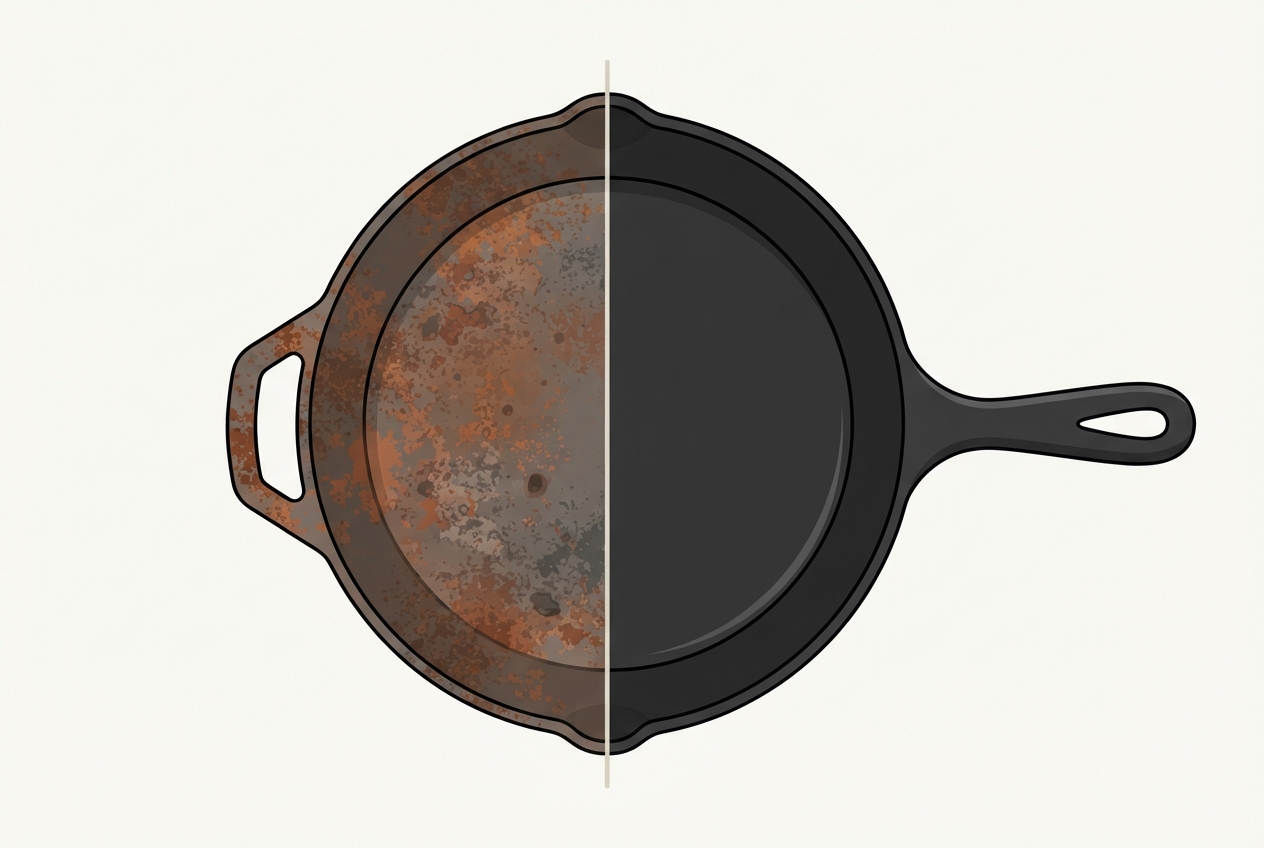
Rusty skillet — fastest fix
If you have a self-cleaning oven, you're 3 hours from a fully restored pan with zero chemicals. If you don't, electrolysis takes 4-24 hours and costs about $10 in supplies. Either way the result is the same: bare gray metal that needs immediate re-seasoning.
The fastest way to remove old seasoning and surface rust is the self-cleaning cycle (900°F+, 2-3 hours). Skillet comes out chalky gray. Immediately re-season — do not leave bare cast iron out for more than 1-2 hours.
For heavy rust without a self-cleaning oven: submerge in a washing soda solution with a steel anode and a 12V battery charger. Rust converts to black iron oxide and falls off. 4-24 hours depending on rust depth.
Wire wheels leave metal particles embedded in the pan's surface. If you must use power tools, use a flap disc at low RPM and rinse thoroughly before seasoning. Better to use chemistry than abrasives.
Apply oil so thin you think it's not enough. Wipe the pan with a paper towel after applying — you want a micro-thin film, not a visible coating. Then bake at 450-500°F for 1 hour, upside down.
Is this pan worth restoring? The two disqualifiers
Before spending time on restoration, check for these two conditions:
Cracked pan: A crack through the cooking surface will worsen with heat cycling — the thermal expansion and contraction of repeated cooking will propagate the crack until the pan splits. This is scrap metal, not a restoration candidate. The exception: very old pans sometimes have casting marks or mold lines on the exterior that look like cracks but are actually surface artifacts from manufacturing. These don't propagate and don't affect cooking. The test is simple — if the mark is only on the exterior and doesn't penetrate into the cooking surface, it's cosmetic.
Deeply pitted surface: Heavy pitting from prolonged rust exposure means the cooking surface is rough and uneven. The pan is still structurally functional and safe to cook in — the pits don't make food unsafe — but pitted surface cast iron will never be as non-stick as a smooth-surface pan, and the seasoning will be thinner over the peaks of the pits. If you're restoring a pan for regular egg cooking, pitting is worth noting. For a camp pan or one used for searing and braising where non-stick performance isn't critical, pitting is irrelevant.
Two brands worth looking for at estate sales and thrift stores: Griswold (Erie, PA, pre-1940s) has a machined cooking surface that's noticeably smoother than modern cast iron, and restores beautifully. Lodge (South Pittston, PA, still in production) has the typical bumpy factory finish from the sand-casting process but is otherwise excellent and the most common pan you'll find in restoration condition. Both are worth restoring. Chinese no-name skillets are worth restoring too — the metal is functional even if the casting quality is lower.
Method 1: self-cleaning oven (fastest, no chemicals)
The self-cleaning oven cycle runs at 900-1000°F — well above the temperature at which any organic material (seasoning, grease, rust) converts to ash. This is the fastest, simplest, chemical-free method and works on any pan with any amount of residue.
- Remove any non-cast-iron components first. If your skillet has a wooden handle insert or rubber grip, remove it. Most traditional cast iron skillets are all-iron and need nothing removed.
- Place the pan in the cold oven upside-down on the lower rack. Upside-down so any ash falls to the oven floor and not into the cooking surface. Run the full self-cleaning cycle — 2-3 hours depending on your oven.
- Let the oven cool to below 200°F before opening. The door locks during self-cleaning; wait for it to unlock. The pan will look chalky gray, possibly slightly lighter at the exterior where factory black paint has burned off. This is normal.
- Remove the pan immediately and begin seasoning within 1-2 hours. Bare iron rusts fast, especially in humid climates. Don't leave the stripped pan sitting overnight.
One note on the oven itself: the self-cleaning cycle burns off everything inside, which produces some smoke and smell. Run it with good ventilation and don't be surprised if your smoke detector activates. If you have a gas range, the cycle runs identically — the heat source doesn't matter.
Method 2: electrolysis (heavy rust removal without heat)
Electrolysis is the method for heavy rust when you don't have a self-cleaning oven, or when the pan is too large to fit in one. It works by passing a low DC current through the water between the rusty pan and a sacrificial steel anode. The rust (red iron oxide, Fe2O3) converts to magnetite (black iron oxide, Fe3O4) and releases from the surface. The anode absorbs the rust and is slowly consumed.
What you need: a plastic bin large enough to submerge the pan, tap water, washing soda (sodium carbonate — Arm & Hammer Super Washing Soda, not baking soda which is sodium bicarbonate), a piece of steel for the anode (rebar, a steel lid, an old pan that's truly scrap), and a 2-6A 12V battery charger or trickle charger (not a fast charger or a jump starter).
- Fill the bin with water and dissolve 1 tablespoon of washing soda per gallon. The solution should be lightly soapy-feeling. More washing soda speeds the process slightly but doesn't improve results.
- Suspend the rusty pan in the solution as the cathode — connect the negative (black) charger clamp to the pan. The pan should be fully submerged but not touching the anode piece.
- Suspend the steel anode piece so it faces the rusty surface without touching the pan — connect the positive (red) clamp to the anode. The anode is sacrificial: rust migrates to it. Use a piece of metal you're willing to destroy or heavily corrode. If your pan is a skillet, a flat piece of steel panel in front of the cooking surface works well.
- Turn on the charger and let it run 4-24 hours. You'll see bubbling from the pan surface (hydrogen from the cathode) and a brown/black sludge building up on the anode. This is the rust migrating. Heavily rusted pans may need 24 hours; light rust can be done in 4-6 hours.
- Remove the pan, scrub with a stiff brush under running water, and immediately re-season. The surface will be dark gray to black. All red rust should be gone. Dispose of the washing soda solution per local regulations — it's mildly basic but not acutely hazardous.
Lye bath for old seasoning and heavy grease buildup
If the pan is caked in decades of old seasoning, carbonized grease, and grime — the kind that looks like a thick black plastic coating — a lye bath strips it faster than the oven method and without the smoke. Oven cleaner (the purple-can type, sodium hydroxide-based — Easy-Off Heavy Duty in the purple can) is the accessible version of a lye bath.
Wear nitrile gloves and eye protection. Apply oven cleaner liberally to the entire pan, seal it in a heavy garbage bag, and leave it 24-48 hours. The lye dissolves the seasoning and loosens the carbonized layer. Scrub off with a stiff brush under running water — the old seasoning rinses away as black-gray slurry. Rinse with a dilute vinegar wash (1 part vinegar, 3 parts water) to neutralize any remaining lye, then rinse with plain water. Combine with electrolysis afterward if rust is also present.
Don't use the lye bath method on pans with a nickel or chrome finish (some vintage Wagner pans had this) — lye will damage the plating.
Re-seasoning: the part most guides get wrong
The goal of seasoning is polymerized oil, not a coating of oil. Oil heated above its smoke point undergoes polymerization — the fatty acid chains cross-link into a hard, plastic-like layer that bonds to the iron. This layer is what's non-stick and rust-resistant. Oil that's applied too thickly never fully polymerizes — it bakes into a gummy, soft layer that comes off in flakes and turns rancid. Thin layers are the entire secret.
- Wash the bare pan with hot soapy water to remove any remaining ash or residue from the strip method. This is the last time soap touches this pan for a while. Rinse thoroughly.
- Dry completely on the stovetop over low-medium heat. The surface must be 100% dry before applying oil — any moisture trapped under the first oil layer will cause flash rust under the seasoning. Heat until you see no steam rising and the surface looks matte-dry, not damp.
- Apply a thin coat of oil to every surface: cooking surface, sides, bottom, handle. Use Crisco shortening, Lodge Cast Iron Seasoning Spray, or any high-smoke-point oil. A paper towel works well as an applicator.
- Wipe off almost all of it. This step is where most guides fail to be specific enough: after applying, take a clean dry paper towel and wipe the pan down as if you're trying to remove the oil entirely. You want a micro-thin film that makes the metal look barely shiny, not a visible wet coating. The pan should not look oily. If it does, wipe more off.
- Place the pan upside-down in a cold oven, then heat to 450-500°F and bake for 1 hour. Upside-down prevents oil from pooling in the cooking surface and creating drips. Place a sheet of foil on the rack below to catch any drips. The oil will smoke significantly during the first seasoning layer — ventilate well.
- Let the pan cool in the oven with the oven off. Don't remove it immediately — the cooling phase is part of the polymerization. Rapid temperature change can crack the thin seasoning layer before it's fully set.
- Repeat steps 3-6 a total of 4-6 times. After 4 cycles the pan has a serviceable thin patina. After 6 cycles the patina is solid. The pan won't be jet-black and non-stick like a well-used 10-year-old skillet yet — that comes from cooking with fat over hundreds of uses — but it's protected and functional.
Which oil is actually best for seasoning?
Flaxseed oil was the trending recommendation for several years after a well-circulated blog post claimed it produced the hardest, most durable polymerized layer based on its high omega-3 content driving thorough cross-linking. This turned out to be partly right and importantly wrong. Flaxseed oil does polymerize hard — harder than most other oils — but it polymerizes brittle on rough cast iron surfaces. Serious Eats ran a long-term comparative test and found flaxseed-seasoned pans flaking after months of real use on the textured sand-cast surface of modern Lodge pans. The hard layer doesn't flex with the pan's thermal expansion.
The most consistently durable options are Crisco vegetable shortening (partially hydrogenated, produces a flexible, bonded layer) and Lodge's own seasoning spray (canola-based, similar results). Any refined oil with a smoke point above 400°F — refined canola (400°F), sunflower (450°F), avocado (520°F) — works for maintenance seasoning layers. Use whatever's in the pantry for maintenance; use Crisco or Lodge spray for the initial rebuild.
Oils to avoid for seasoning: olive oil (smoke point 375°F or lower, goes rancid in the pores), butter (smoke point 300-350°F, same problem), coconut oil (smoke point 350°F, also rancid risk for stored pans). These are great cooking fats; they're poor seasoning materials.
Daily care to maintain the restored finish
Rinse the pan with hot water and a stiff brush or chain mail scrubber while it's still warm from cooking — heat releases food particles and the warm metal dries faster. Never soak cast iron in standing water and never put it in the dishwasher. Both strip seasoning completely and leave bare iron exposed to rust within hours.
Dry the pan on the stovetop over low heat until you see no moisture on the surface. Apply a very light coat of oil — just enough to make the surface look slightly shiny — and wipe with a paper towel before storing. Store in a dry location. In high-humidity climates, storing the pan in the oven (even unlit) keeps it drier than a cabinet.
The "never use soap" rule is a myth that originated when dish soap contained lye, which actually does strip seasoning. Modern dish soaps are surfactant-based and a brief wash with a small amount of dish soap won't damage well-established seasoning. What damages seasoning is prolonged soaking, high-temperature dishwasher cycles, and leaving the pan wet. A quick scrub with dish soap followed by immediate drying is fine if you have stuck-on food that won't release with plain water.
2026 cost reference
| Component | Typical 2026 cost | Notes |
|---|---|---|
| Lodge Cast Iron Seasoning Spray | $8–12 | Convenient for thin, even application; canola-based; widely available |
| Flaxseed oil (food-grade) | $10–16 | Hard polymerization but may flake on textured surfaces — use Crisco instead for initial rebuild |
| Washing soda (for electrolysis) | $6–10 | Arm & Hammer Super Washing Soda; not baking soda — different chemistry |
| Battery charger (2-6A trickle charger) | $25–50 | Multi-use; also maintains car, RV, and marine batteries |
| Chain mail scrubber | $10–20 | Best daily cleaning tool for cast iron; gentler than steel wool, more effective than plastic |
| Oven cleaner, sodium hydroxide type | $5–9 | Easy-Off Heavy Duty (purple can); for heavy seasoning removal without self-cleaning oven |
Chain mail scrubber, oil, spatulas.
Check Price on Amazon →As an Amazon Associate, FixForge earns from qualifying purchases.