FixForge › Marine › 12V Battery Isolator Wiring
12V Marine Battery Isolator Wiring
The goal of a dual-battery marine setup is simple: keep your engine starting battery separate from your house battery so running electronics all day doesn't leave you stranded. The two components that accomplish this — a diode isolator or a voltage-sensitive relay (also called a battery combiner or VSR) — work differently, have different trade-offs, and are confused more often than any other part of a marine electrical install. Here's how each works and how to wire them.
Last Updated: May 2026
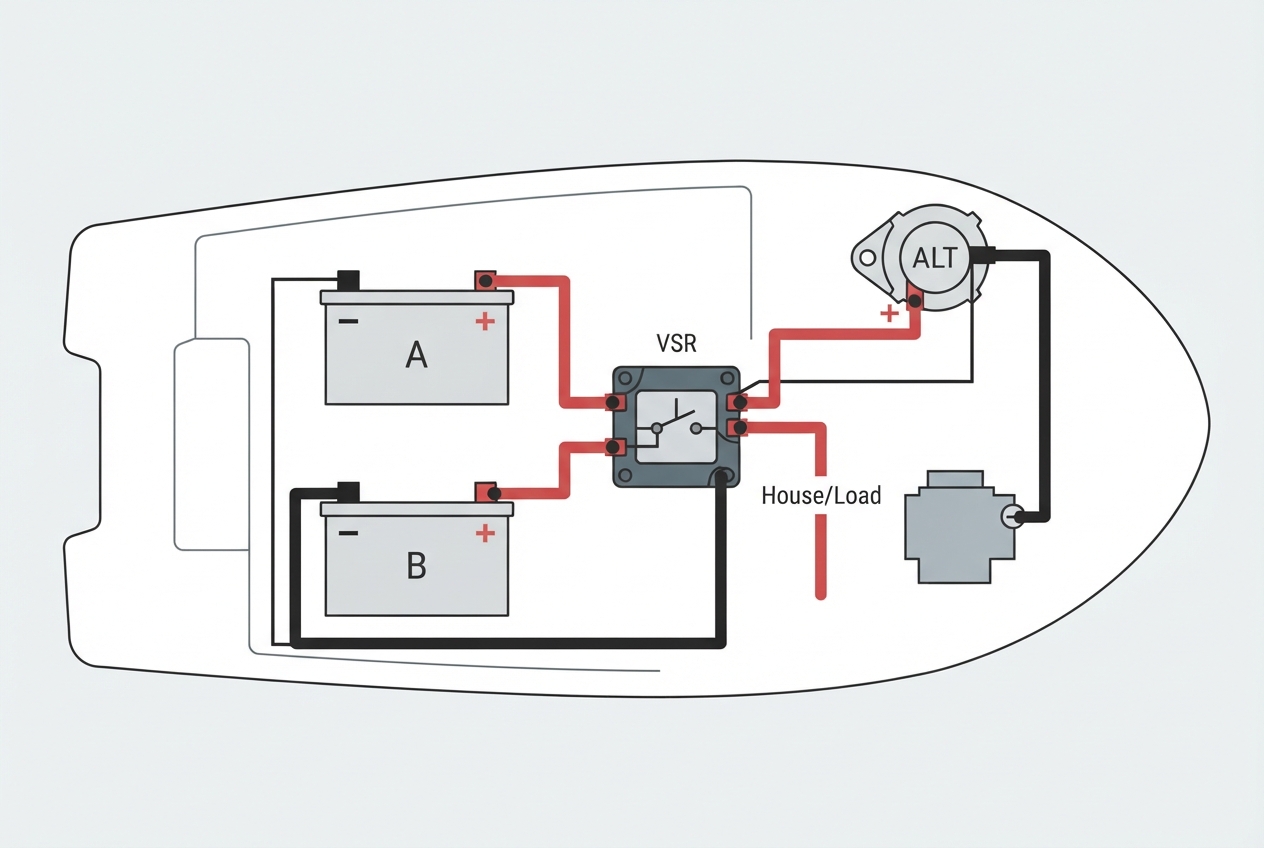
Dual battery setup — key decisions
Before buying any hardware, answer these three questions: What chemistry are your batteries? How long are your cable runs? Is your alternator sized for the load of charging two banks? The answers determine which component you need and what wire gauge to buy.
A diode isolator charges both batteries simultaneously but drops 0.6V per battery (your alternator must compensate). A VSR/combiner connects the batteries only when voltage is high enough, charges more efficiently, but disconnects if load pulls voltage down — on some boats this causes relay chatter.
Undersized cable between the alternator and the isolator causes voltage drop that ruins charging. Use 4 AWG for runs under 6 feet at up to 50A; 2 AWG for runs to 10 feet; 1/0 for longer. Follow ABYC E-11.
If your house battery is AGM and your starting battery is flooded, a simple diode isolator works fine. If both are lithium (LiFePO4), you need a DC-DC charger (B2B charger), not a VSR — lithium chemistry doesn't work correctly with simple voltage-sensing.
The main cable from the positive battery terminal to the isolator must be fused as close to the battery as possible — within 7 inches of the terminal per ABYC. Use a Class T fuse or ANL fuse of appropriate rating.
Why you need isolation (what happens without it)
Without isolation, both batteries share the same positive bus. The alternator charges both simultaneously, but they also discharge together. Run a fishfinder, VHF, stereo, and cabin lighting for 6 hours at anchor and you'll draw down both batteries equally, including the starting battery. A starting battery at 50% state of charge is borderline for cold-cranking, and on a hot day with a high-compression diesel that margin disappears.
With isolation, the house bank can drain to 50% (normal for deep-cycle use) while the starting battery stays at or near full charge, never touched by house loads. The starting battery only discharges when cranking the engine — a brief, high-current draw — and is immediately recharged by the alternator once the engine runs. This is the architecture that stops you from being stranded.
Some boaters use a manual battery switch (A-B-Both) instead of an automatic isolator. This works if you reliably switch from "Both" to "A" after every charging session, and never forget, and never accidentally leave the switch in the wrong position during a long passage. Most boaters eventually wire in an automatic solution because the manual switch depends on human memory, which fails.
Diode isolator: how it works and where it falls short
A diode passes current in one direction only. A two-output diode isolator has one input (from the alternator) and two outputs (one to each battery). Current flows from the alternator into both batteries simultaneously, but neither battery can discharge backward into the other — the diodes block reverse flow. The result: both batteries charge at the same time, and if one battery is dead, the good battery won't be drained into it.
The trade-off is the diode voltage drop: typically 0.5-0.7V per diode. A 14.4V alternator output becomes 13.7-13.9V at the batteries. For flooded lead-acid batteries, this is acceptable — they fully charge at 14.4V nominal but will reach full charge at 13.8V given enough time (the absorption phase just takes longer). For AGM batteries, which require 14.4-14.7V for a complete absorption charge, the diode drop is a real problem — the batteries will regularly be left at 80-90% state of charge and their long-term capacity will decline faster.
Many diode isolators have a sense wire (usually labeled "S" or "SEN") that connects to the alternator's voltage regulator. When connected, the regulator compensates by raising its output voltage to account for the diode drop — so the batteries actually see full voltage. This connection is often not made on DIY installs because it requires accessing the alternator's regulator terminal. If you're using a diode isolator with an AGM house bank, the sense wire connection is not optional.
Best use case for diode isolators: simple two-battery setups with flooded lead-acid chemistry, where full charging voltage isn't critical and simplicity of wiring matters more than efficiency.
VSR/battery combiner: how it works and the relay chatter problem
A VSR (voltage-sensitive relay) is a relay switch controlled by voltage. When the alternator raises voltage above the threshold — typically 13.2-13.4V, indicating the engine is running and charging — the relay closes and connects both batteries in parallel. Both batteries then charge at the full alternator output voltage with no diode drop. When the engine stops and voltage drops below the isolation threshold (typically 12.7-12.8V), the relay opens and the batteries are isolated again.
The relay chatter issue is real on some boats. If large loads (a windlass, a powerful bilge pump, or an inverter) pull the voltage below the isolation threshold momentarily while the engine is running, the relay opens and closes rapidly. This wears the relay contacts and can cause audible clicking near the electrical panel. The fix: use a VSR with a built-in switching delay — 0.5-2 seconds of voltage-below-threshold before opening. The Victron Cyrix-CT 120A ($35-60) has this delay built in. Cheaper VSRs (some under $20) often lack it and are worth avoiding on boats with heavy intermittent loads.
The other VSR consideration: on engine shutdown, as alternator voltage drops through the threshold, both batteries will be connected in parallel briefly. If the house bank is significantly discharged (say, 12.2V) and the starting battery is at full charge (12.8V), the house bank will pull current from the starting battery for the few seconds before the relay opens. This is a short, low-current equalization pulse — not enough to strand you — but worth knowing. Some VSRs have a time delay on opening to manage this more gracefully.
Best use case for VSRs: AGM or gel house banks that need full charging voltage, boats where efficient charging matters, or any boat where you want the simplicity of fully automatic operation without a sense wire installation.
Complete dual battery wiring procedure (VSR-based)
- Mount the VSR in a dry, accessible location above the bilge. Electrical enclosures near the engine compartment are common. The Victron Cyrix is sealed but still shouldn't be mounted where it'll be submerged or regularly splash-wet. Label it clearly.
- Run a main cable from the positive terminal of the starting battery to the "start" terminal on the VSR. Fuse this cable within 7 inches of the starting battery positive terminal — an ANL fuse holder with a 100A fuse is appropriate for most installations. Use tinned marine-grade cable (not automotive cable). Size: 4 AWG for runs under 8 feet, 2 AWG for 8-15 feet, 1/0 for longer runs.
- Run a cable from the positive terminal of the house battery to the "house" terminal on the VSR. Fuse this one too, with the same ANL fuse holder setup near the house battery terminal. Same AWG guidelines apply.
- The alternator charges the starting battery directly via its existing output connection — this doesn't change. On most marine installations, the alternator B+ output connects to the starting battery positive directly (or via the starting circuit). The VSR monitors this voltage and closes when it indicates the engine is running. You don't reroute alternator output through the VSR.
- Connect the VSR ground wire to a solid chassis ground point — the same bus or bonding point used by other DC equipment. A clean, low-resistance ground is necessary for accurate voltage sensing. A bad ground here causes erratic VSR behavior.
- Test the installation. With everything connected, start the engine. After the VSR delay period (30-90 seconds depending on the unit), measure voltage at the house battery positive terminal. It should match alternator output voltage within 0.05-0.1V if the VSR has closed. If the reading is still showing resting voltage on the house battery, the VSR hasn't closed — check for loose connections or insufficient voltage at the VSR's sensing input.
Cable sizing reference per ABYC E-11
ABYC E-11 specifies ampacity for marine wire in engine-compartment and non-engine-compartment conditions. These are the key figures for dual battery installations (tinned copper, in a bundle or conduit, non-engine-compartment):
| Wire gauge (AWG) | Max continuous amperage | Typical application |
|---|---|---|
| 10 AWG | 30A | Small accessory circuits, alarm wiring |
| 8 AWG | 40A | Bilge pump circuits, lighting panels |
| 6 AWG | 50A | Short VSR runs on small boats |
| 4 AWG | 65A | Standard VSR/isolator cable under 8 feet |
| 2 AWG | 90A | VSR runs 8-15 feet, starter cables on small engines |
| 1/0 AWG | 150A | Long battery cable runs, large alternators |
| 2/0 AWG | 175A | High-output alternators, large inboard engines |
Always use tinned marine-grade copper wire, not automotive wire. Marine wire uses tinned strands to resist corrosion in the high-humidity, salt-air environment — untinned automotive wire oxidizes internally within 2-3 years and the corrosion isn't visible from outside the insulation. The resistance rise from internal corrosion on an undersized or untinned cable run kills charging efficiency and can cause heat buildup under load.
DC-DC charger for lithium or mixed chemistry
If your house bank is LiFePO4, a DC-DC charger (also called a B2B charger or battery-to-battery charger) is required. The standard recommendation is the Victron Orion-Tr Smart 12/12-30A ($120-180). Here's why it's necessary and what it does differently:
A lithium battery's internal resistance is very low. When a deeply discharged lithium bank is connected to an alternator via a VSR, it draws current at the maximum rate the alternator can provide — potentially 80-120A or more on a large alternator. Marine alternators are typically designed for continuous loads well below their rated peak. Running at maximum output for extended periods at engine compartment temperatures overheats the windings and kills the alternator, sometimes within a single long charging session. This is a well-documented failure mode on sailboats that install lithium banks without a DC-DC charger.
A DC-DC charger isolates the lithium bank from the alternator circuit entirely. It takes input power from the alternator/starting battery side (whatever voltage is present) and outputs a regulated, current-limited charge to the lithium bank at the correct lithium voltage profile. The current limit (30A in the Orion-Tr Smart 30A model) protects the alternator. The programmable output voltage and charge curve ensures the lithium bank gets a complete charge without overcharge. It also provides full galvanic isolation between the two battery banks.
For AGM banks on boats with small alternators (under 60A), a DC-DC charger is also worth considering — it limits the charging load on the alternator and extends alternator life even without the urgency of the lithium alternator-destruction scenario.
2026 cost reference
| Component | Typical 2026 cost | Notes |
|---|---|---|
| Diode isolator (Blue Sea 7620, Perko, or equivalent) | $30–80 | Standard 70-130A models for typical boats; check for sense wire terminal if using AGM |
| VSR/battery combiner (Victron Cyrix-CT 120A) | $35–60 | Recommended for AGM banks; built-in delay prevents relay chatter |
| ANL fuse holder + 100A fuse | $12–25 | For main cable protection near battery terminal; per ABYC within 7 inches of positive |
| 4 AWG tinned marine cable (per foot) | $2–4 | Tinned copper only — do not substitute automotive cable |
| DC-DC charger (Victron Orion-Tr Smart 12/12-30A) | $120–180 | Required for lithium house banks; best practice for AGM banks on small alternators |
| Heat-shrink ring terminals (10-pack) | $8–15 | Adhesive-lined heat-shrink type; not spade connectors, not non-insulated rings |