FixForge › RV › Roof Sealant Inspection
RV Roof Sealant Inspection & Reapplication
Water intrusion is the leading cause of serious RV damage, and failing roof sealant is the leading cause of water intrusion. The good news: sealant inspection is a 30-minute visual check you can do twice a year, the signs of failure are obvious once you know what you're looking for, and reapplication costs $20–40 in product. The bad news: ignoring a sealant failure that looks minor leads to rot, delamination, and $5,000+ in structural repairs.
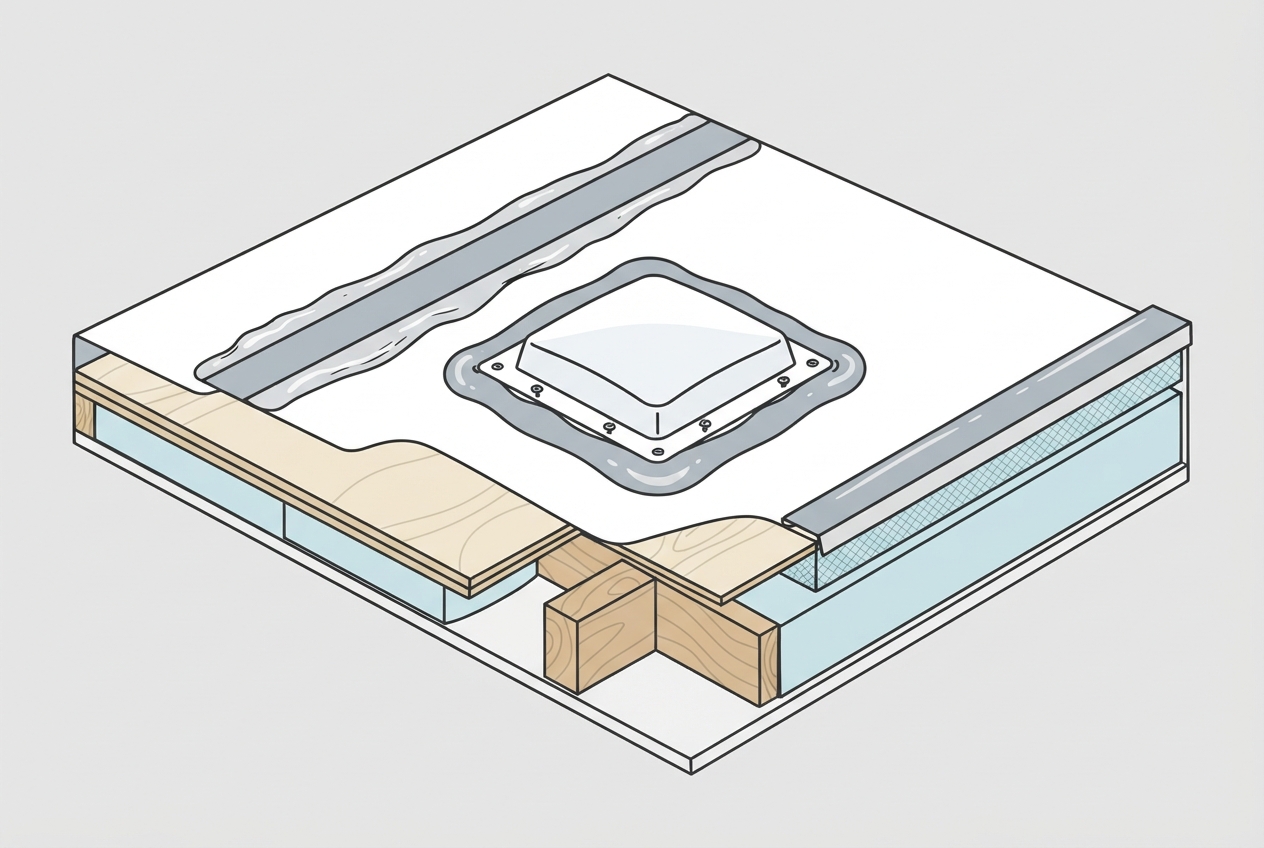
Spring/fall roof check — what to look for
RV roof types and why it matters for sealant selection
Using the wrong sealant on the wrong roof material is worse than using no sealant at all, because some products actively damage the membrane. Know your roof type before you buy anything.
EPDM (ethylene propylene diene monomer): The most common RV roof material. Matte black or white rubber surface that feels slightly pliable and stretchy — not slippery, not glossy. Looks like a large rubber mat laid over the roof. EPDM is chemically reactive with petroleum-based products, including most general-purpose caulks and silicone sealants with petroleum carriers. Use only sealants explicitly rated for EPDM — Dicor 501LSW (self-leveling) and Dicor 505NFL (non-sag) are the standard choices. Geocel 2320 is the widely-used alternative for roof-to-sidewall seams.
TPO (thermoplastic polyolefin): White, smooth surface, slightly glossy compared to EPDM. More heat-reflective than EPDM, increasingly common on newer builds. Use TPO-specific sealant or self-leveling lap sealant explicitly rated for TPO. The same Dicor products rated for EPDM are generally safe on TPO — verify the specific product's label before application.
Fiberglass: Rigid, non-flexible surface with a gel coat finish. Common on higher-end fifth-wheels and motorhomes. No rubber-compatibility constraint — urethane or silicone sealants work well. Dicor products work, as does standard urethane caulk in a tube. Surface prep is more critical on fiberglass because adhesion requires a truly clean, degreased surface.
Aluminum: Older coaches and commercial van conversions. Any lap sealant works. Clean surface and verify mechanical fasteners at penetrations before relying on sealant alone.
The full inspection sequence
Do this in order. It takes 30–45 minutes and should happen every spring and fall without exception.
- Ladder up safely. Three-point contact at all times. Use a ladder stabilizer that hooks over the RV's edge — do not lean an unsupported ladder against the roof edge, which can dent or crack it. Have a spotter. Only inspect a dry roof — a wet rubber roof surface is genuinely slippery.
- Start at the AC unit. The air conditioner is the largest single penetration on most RVs and the highest-stress point — it flexes the roof with every bump and vibration. Check all four sides of the AC mounting boot. The sealant bead should be continuous with no gaps, cracking, or lifting. Press it firmly at every point. Lifted sealant at an AC boot is the most common single-point source of catastrophic water intrusion.
- Every vent and fan. Most RVs have 2–5 roof vents. Check the perimeter sealant bead at every one — press it, look for crazing, look for lifting at the corners. Corners fail first because they're exposed to flex in two planes at once.
- All four roof-to-sidewall seams. The horizontal joint where the roof membrane meets the sidewall material runs the entire length of both sides and across the front and rear. These seams flex constantly as the RV body twists during travel. They tend to fail in longer sections than penetration sealant — you'll see a gap or lifted edge running 6–18 inches along the seam rather than a single point failure.
- Any owner-added penetrations. Aftermarket antennas, cable entry glands, solar panel mounts, and added vents are often sealed with whatever the installer had on hand. Check these carefully — they're frequently under-sealed or sealed with incompatible products.
- Walk the entire field. Step carefully on structural members — you can feel the ribs underfoot on most roofs. Avoid the unsupported center spans. Look for any bubbling, blistering, or punctures in the membrane itself. Small punctures (under 1/4 inch) can be sealed with lap sealant. Larger tears need a membrane patch kit.
Sealant product selection
Two products handle the vast majority of RV roof sealant work:
Dicor 501LSW self-leveling lap sealant: Flows like a thick gel after application and levels itself into gaps. Best used on flat or low-slope horizontal surfaces where gravity helps it seat — the main roof field, around flat vent flanges, around the AC boot base. Does not work well on vertical surfaces because it drips. The standard choice for most penetration reseals on EPDM roofs. Cures to a slightly tacky, flexible finish that moves with the roof membrane. Available in white and gray. One tube covers a typical reseal of 3–4 penetrations.
Dicor 505NFL non-sag sealant: Same chemistry as 501LSW but formulated to stay in place on vertical surfaces and curved edges — "NFL" for non-flow. Use this at the roof-to-sidewall seams where the application surface is near-vertical, and at any rounded fitting edge where 501LSW would run off before curing. Also use it as a finish bead over the edge of a 501LSW application where you want a clean defined line.
Geocel 2320 Travel Sealant: Urethane-based, widely used for roof-to-sidewall seams. More elastic than the Dicor products once cured, which suits the high-flex sidewall seam application. Compatible with EPDM, TPO, fiberglass, and aluminum. Requires a standard caulk gun. Slower cure than Dicor — allow 72 hours before rain exposure.
Over existing sealant vs. full removal: Fresh Dicor will bond well to clean existing Dicor sealant that is still adhered to both surfaces — you don't need to remove intact sealant to add a fresh bead over it. Remove existing sealant only when it has fully separated from the surface, has become hard and granular, or when it's a petroleum-based incompatible product. Use a plastic scraper (never metal on EPDM) and follow with Dicor roof cleaner or denatured alcohol to remove residue before applying new sealant.
Application technique
The prep work is more important than the product. Sealant applied over a dirty, chalky, or oily surface will not adhere — it will look fine for weeks and then peel off at the first thermal cycle. Clean surfaces are non-negotiable.
Cleaning: Wipe the entire area to be sealed with denatured alcohol on a clean rag. This removes chalk, oxidation residue, silicone contamination, and surface oils. Dicor makes a dedicated EPDM roof cleaner ($12–18) that also works well and is formulated to be safe on rubber. Let the surface dry completely — 15–20 minutes minimum. Don't work in direct sun that makes the surface too hot to touch; sealant cures too fast and won't flow into gaps properly.
Application: Cut the tube tip at a 45-degree angle to get a bead roughly 3/8 inch wide. Apply in a continuous bead around the entire perimeter of the fitting — maintain contact pressure on the gun so there are no thin spots or gaps. For self-leveling sealant, apply generously; it will spread. For non-sag, apply the bead and smooth it immediately with a wet finger or a plastic spreader tool, pressing it firmly onto both surfaces (the fitting and the roof membrane).
Bridging vs. seating: The most common application mistake is bridging — the sealant spans a gap without actually touching both edges. A bridged sealant bead looks complete but fails within weeks because it's only stuck on one surface. Always press the sealant firmly enough to confirm contact on both sides of the joint.
Cure time: Dicor 501LSW becomes tacky (skin-over) in about 30 minutes and is rain-safe within 4–6 hours. Full cure to maximum adhesion takes 72 hours. Geocel 2320 needs 72 hours minimum before rain exposure. Do not inspect by pulling at a newly-applied bead — wait 72 hours before testing adhesion.
Annual maintenance schedule
Spring (before first trip): Full inspection as described above. Reseal any failed points before the camping season starts. This is the most important inspection — winter freeze-thaw cycles are hard on sealant, and any small failure that started in fall has had all winter to allow moisture to infiltrate.
Fall (before storage): Repeat full inspection. Any failure found in fall means water has been entering all season. Address it before storage so the rig doesn't sit for 4–6 months with an open moisture path. Document what you find and what you repaired.
After any significant hailstorm or roof impact: Get up and look. Hail bruises EPDM, which eventually leads to small tears. A $10 patch now is worth far more than a rot repair later.
Full roof coating (membrane renewal): The EPDM membrane itself, separate from the sealant around penetrations, benefits from a renewal coat of roof coating product (Dicor Rubber Roof Coating, Heng's Rubber Roof Coating, or Camco Pro Tec) every 3–5 years. This restores UV protection and surface elasticity. Apply it in two coats with a roller, 24 hours between coats, on a dry day over 50°F. One gallon covers roughly 100 sq ft.
What it costs in 2026
| Item | Cost | Notes |
|---|---|---|
| Dicor 501LSW self-leveling lap sealant (tube) | $10–14 | EPDM flat surfaces; buy 3–4 tubes for a full inspection job |
| Dicor 505NFL non-sag sealant (tube) | $10–14 | Vertical edges and curved surfaces; sidewall seam work |
| Geocel 2320 Travel Sealant (caulk tube) | $8–12 | Alternative for sidewall seams; highly elastic once cured |
| Dicor EPDM roof cleaner | $12–18 | Required prep before full reseal; denatured alcohol substitutes for spot work |
| Caulk gun (standard 1/10 barrel frame) | $8–15 | Any standard frame works; a smooth-rod model gives better flow control |
| Roof membrane coating (Dicor, Heng's, or Camco, per gallon) | $35–70 | Full membrane renewal coat every 3–5 years; covers approx. 100 sq ft/gallon |
Frequently Asked Questions
How often should I reseal my RV roof?
Inspect every spring and every fall. Reseal failure points immediately when found. A full reseal of all penetrations every 2–4 years is reasonable preventive maintenance. Roof membrane coating renewal every 3–5 years. Don't wait for a leak to appear — by then the damage has already started.
What sealant should I use on an EPDM rubber RV roof?
Dicor 501LSW for flat horizontal surfaces (self-leveling, flows into gaps). Dicor 505NFL for vertical edges and curved surfaces (non-sag). Do not use petroleum-based, silicone, or generic caulk — they damage EPDM. When in doubt, check Dicor's product label for EPDM compatibility.
How do I find where my RV roof is leaking?
Start inside — locate the water stain or soft wall area and note its position. Get on the roof and inspect every penetration within 3–4 feet of that position. Water travels before dripping, so the entry point is often 6–18 inches uphill (toward the front). Do the pull test on every sealant bead near the stain — peeling with finger pressure means it's failed even if it looks intact.
Can I walk on my RV roof?
Usually yes, near the structural walls. Step on the raised ribs or framing members you can feel underfoot; avoid unsupported center spans. Check your owner's manual — some motorhome roofs are rated for walking, some are not. Never walk on a wet roof; wet EPDM is genuinely slippery.