FixForge › Vintage › Singer Featherweight Motor Service
Singer Featherweight 221 Motor Service
The Singer Featherweight 221 is the most popular vintage quilting machine in the world, and a properly-serviced motor will outlast you. Brushes, wiring, and lubrication are the three service points that account for nearly all motor-related complaints. Doing them right requires patience and the discipline to NOT do things that 'restoration' enthusiasts often suggest.
Last Updated: May 2026
Fast answer for someone who just acquired a Featherweight
Before plugging it in, inspect the wiring. The original cloth-insulated wire becomes brittle after 70+ years and frequently cracks at the strain reliefs where wire enters the motor and foot pedal. Cracked insulation = short circuit risk = potential fire. If wires look brittle, replace them with period-correct cloth-covered wire BEFORE any power test. Once wiring is confirmed safe: lubricate per Singer's original instructions (sewing machine oil only, NOT WD-40), inspect brushes for wear (replace if shorter than ~1/4 inch), and run the motor briefly under light load to check function. Don't repaint, don't rewire with modern wire, don't disassemble the motor windings.
Pre-1970 wiring is brittle. Brittle insulation = fire risk. Don't power up without checking.
$8-18 set. Replace if worn below 1/4 inch.
Singer oil, "Lily White", or equivalent. WD-40 destroys motors.
Repaint = value loss. Service preserves; restoration often destroys.
Why Featherweights remain the standard 70 years later
The Singer Featherweight 221 was produced from 1933 to 1968 with relatively minor variations. It's the smallest practical sewing machine Singer ever built — about 11 pounds, fits in a small carrying case — while retaining the full mechanical robustness of larger Singer machines of the era. The reason quilters still seek out Featherweights today rather than buying modern machines is straight-line precision: the Featherweight excels at perfectly straight, even stitches through multiple fabric layers, which is exactly what piecing quilt blocks requires.
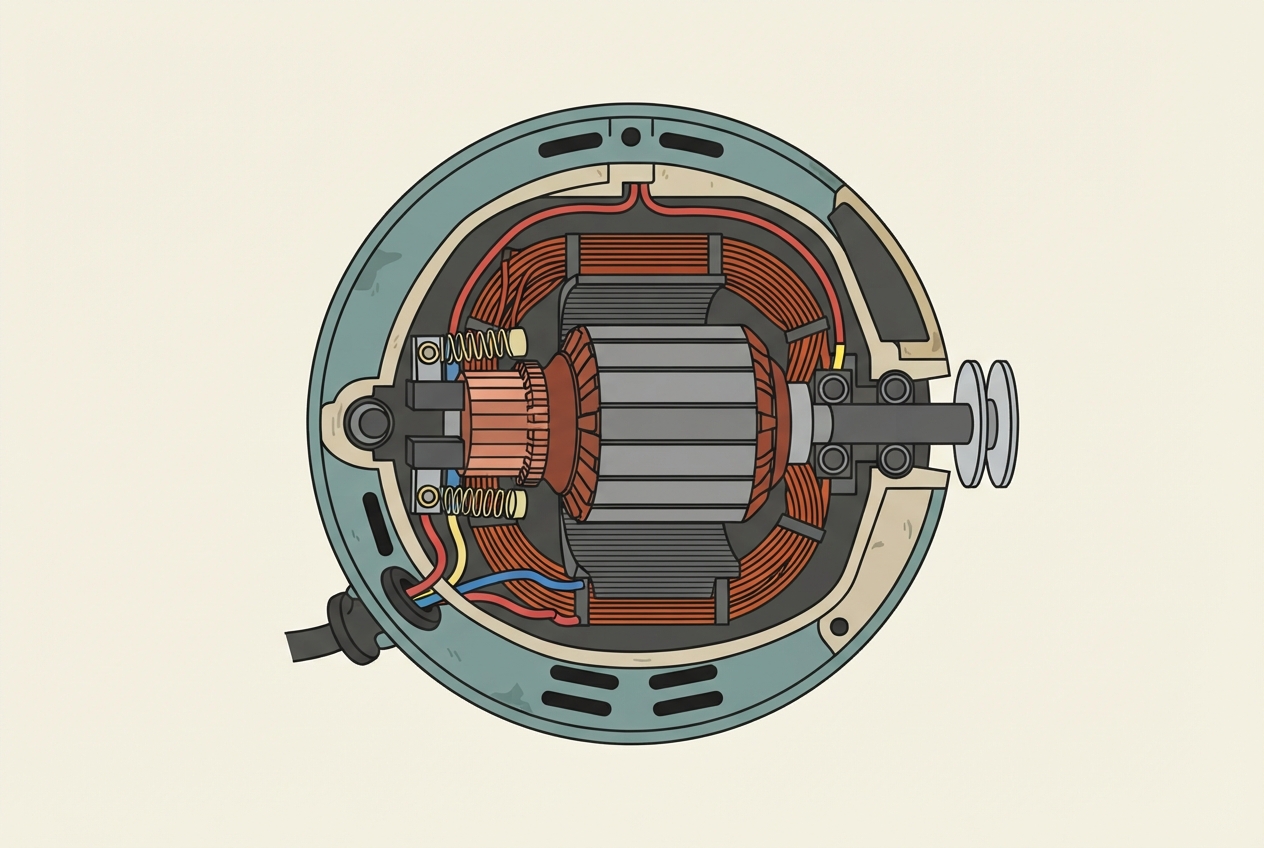
The motor on a Featherweight is a universal-type series motor — meaning it works on AC or DC, uses carbon brushes, and has a relatively simple architecture that lends itself to long-term service. Compared to brushless or stepper motors in modern machines (which can't be serviced by an owner and have a 10-15 year functional life regardless), a Featherweight motor can be brought back to perfect function indefinitely with periodic brush replacement and lubrication.
The three service points that matter
1. Wiring inspection (do this first, before anything else)
Original Featherweight wiring used cloth-covered rubber insulation that was excellent in 1948 and brittle by 2020. The failure mode is consistent: the rubber dries, cracks at points of repeated flex (where wire enters the foot pedal, where wire enters the motor housing, where wire enters the plug), and exposes bare copper. Bare copper at a flex point will eventually short to chassis ground (the machine's metal body), creating a shock hazard or fire risk.
Inspect every visible inch of wire. Flex it gently. If the insulation visibly cracks or you can see copper through the cracks, the wire is end-of-life. The fix is replacement with period-correct cloth-covered wire (available from Featherweight-specific suppliers like Singer-Featherweight Shop) rather than modern PVC-jacketed wire. Period-correct wire preserves the machine's value; modern wire works electrically but is a visible difference that collectors will note.
2. Brush replacement (when symptomatic, every 10-20 years typical)
The motor has two carbon brushes, one on each side of the commutator (the segmented copper ring on the armature). As the motor runs, the brushes wear down. Original brushes are typically 3/8 inch when new; replace when worn to 1/4 inch or shorter, OR when sparking becomes pronounced, OR when the motor labors under load.
Brush replacement procedure: locate the brush access caps on either side of the motor (small screw-in caps, often visible as a screwdriver slot). Unscrew. The brush will come out with its spring. Replace with new matched-pair brushes. Replace the spring and cap. Both sides should have equally worn (or new) brushes — never mix old and new on opposite sides.
3. Lubrication (annually for regular use, before storage)
Featherweights have lubrication points marked on the original Singer service manual: bearings (top and bottom of motor housing), gear meshes (if the machine has been disassembled), needle bar, hook race. Apply 1-2 drops of sewing machine oil to each point. NOT WD-40 (it's a solvent, not a lubricant, and removes existing lubrication). NOT 3-in-1 oil (too heavy, gums over time). NOT household oils. Singer-brand machine oil or "Lily White" oil is the standard.
Over-lubrication is worse than under. Excess oil seeps onto belts and clutches where it causes slippage. Light, precise application is the goal.
What NOT to do (the restoration mistakes)
Featherweight collectors and serious users distinguish "service" from "restoration." Service maintains and repairs original components. Restoration replaces or refinishes them with non-original substitutes. The line matters because collectors value originality, and well-meaning improvements often reduce machine value by 20-40%.
- Don't repaint the motor housing or the machine body. Original japanning (the black lacquer finish) is part of what makes the machine collectible. Touch-up of small chips with matched paint is fine; a full repaint is value-destroying.
- Don't replace wiring with modern PVC. Period-correct cloth wiring is available and looks original. Modern wire works but is visually wrong and reduces resale value.
- Don't disassemble the motor windings. If the windings are damaged, find a replacement motor on eBay (often $50-150 for working examples) or accept that the motor is past restoration.
- Don't replace the belt with a modern leather or rubber belt. Featherweights use a specific belt type; period-correct replacements are inexpensive and available.
- Don't strip and clean the case interior with harsh solvents. Acetone or paint thinner can damage the original tag adhesive and any felt insulation. Mild soap and water for cleanup.
2026 cost reference
| Item | Typical 2026 cost | Notes |
|---|---|---|
| Matched brush set (pre-1953 motor) | $10-18 | Sized for early motor. |
| Matched brush set (1953+ motor) | $8-15 | Most common, easier to source. |
| Period-correct cloth wire (5 ft) | $15-25 | Specific to Singer original style. |
| Replacement foot pedal cord (3-wire grounded) | $30-55 | Safer than 2-wire original; matches modern outlet expectations. |
| Singer Lily White sewing machine oil (4 oz) | $10-18 | The standard. Lasts indefinitely. |
| Replacement belt | $5-12 | Period-correct types available from Featherweight suppliers. |
| Replacement motor (used, working condition) | $50-150 | If existing motor is past brush-replacement scope. |
| Professional motor service / rewiring | $80-200 | Featherweight specialists often charge $120-180 for full service. |
When to stop and call a pro
Three scenarios. First: motor windings appear burned (smell of burnt insulation, visible discoloration on the windings when you remove a brush). Replace the motor; don't try to rewind. Second: foot pedal feels intermittent or sparks when used. This is wiring or pedal-internal contacts; while in scope for DIY, mistakes here have fire risk. If you're not confident with the electrical work, hire it out. Third: the machine has been in unknown storage for many years (decades) and you want a full inspection before powering on. Featherweight specialists offer "evaluation" services that include teardown inspection of motor, wiring, mechanical components, and tension assembly. Often worth the $50-100 fee for peace of mind on a pre-1960 machine you've just acquired.
Clear oil for all vintage Singer models.
Check Price on Amazon →As an Amazon Associate, FixForge earns from qualifying purchases.