FixForge › RV › Fresh Water Pump Replacement
RV Fresh Water Pump Replacement
When the pump cycles constantly, runs without pressure, or won't start, it's usually past the point of repair — rebuild kits exist but cost nearly as much as a new pump. Replacement is a 30-60 minute job with basic tools. Sizing and adding an accumulator tank are the choices that determine how nicely the new system runs.
Last Updated: May 2026
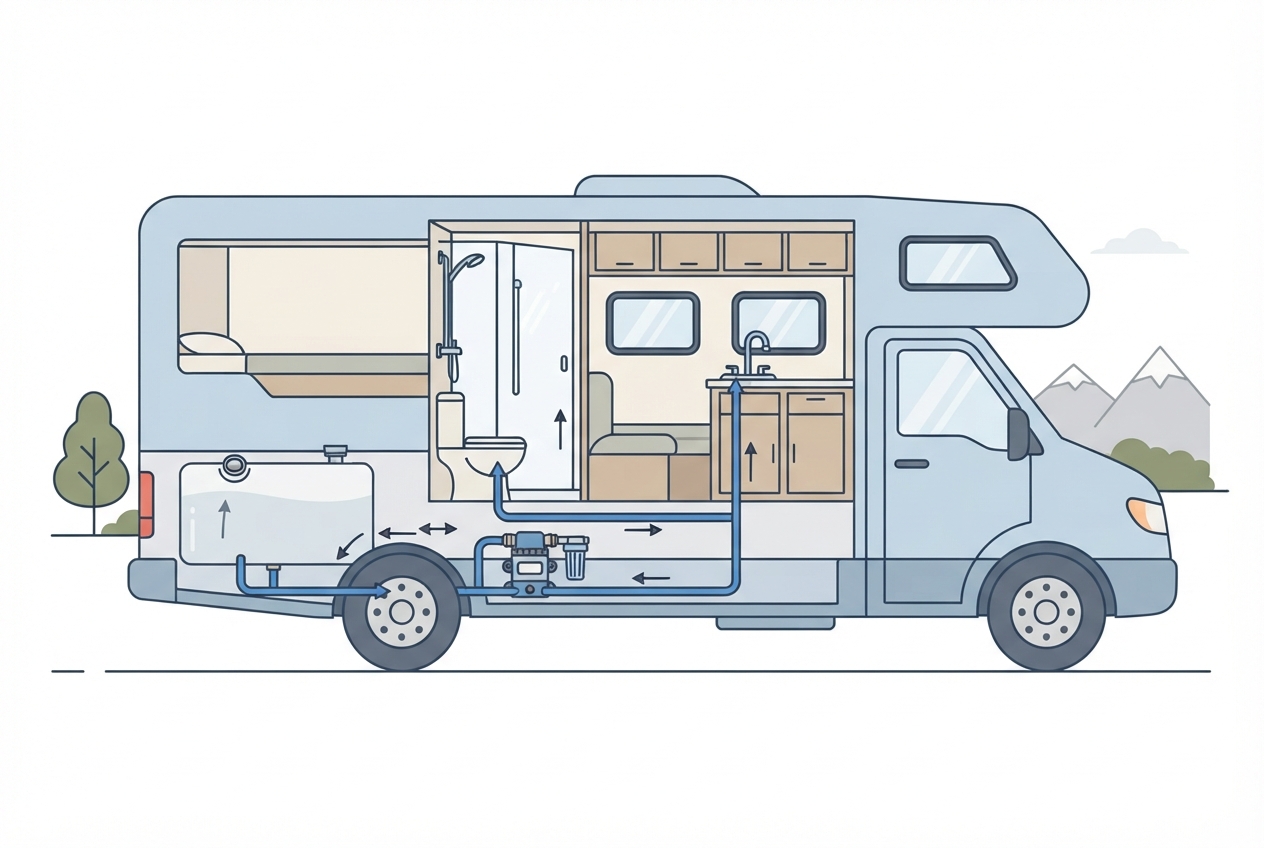
Fast answer for a stuck-on or rapid-cycling pump
Pump cycling rapidly with no demand = failed pressure switch or internal leak. Pump running continuously without pressure = worn impeller or air leak in the inlet. Both failure modes mean the pump is at end-of-life. Order a Shurflo 4008-101-A65 (the industry-standard 3.0 GPM, 55 PSI unit) for $90-130. Optional accumulator tank ($50-90) reduces cycling and extends pump life. Replacement takes 30-60 minutes with a screwdriver and adjustable wrench. Turn off 12V, disconnect inlet/outlet/wiring, swap, reconnect.
If yours is past 8 years and acting up, replace rather than rebuild.
Shurflo 4008 fits 90% of RVs. Don't oversize.
$50-90 add-on. Worth it during a pump swap.
Mount must be properly grounded. Don't rely on chassis ground.
How RV water pumps fail and why rebuild kits aren't worth it
A modern RV diaphragm pump has three primary wear components: the diaphragm itself (flexes millions of times over its life and eventually develops pinholes), the check valves (small one-way valves that prevent backflow during the pump's return stroke; foul with mineral deposits and stop sealing), and the pressure switch (a small mechanical switch that detects line pressure and cycles the motor off when the system is full). Pumps don't usually fail because the motor dies; they fail because one or more of these wear components deteriorates to the point where the pump can't build or hold pressure.
Manufacturers sell rebuild kits ($40-70) that replace the diaphragm and valve assembly. They work, but they install in roughly the same time as a complete pump swap, cost nearly as much, and address only one of the three failure modes. Most experienced RVers skip rebuilds and just replace the whole unit — cheaper per hour of work, and the new pump has a fresh pressure switch and motor too.
Diagnosis before you buy a new pump
Before assuming the pump is dead, check the cheaper failure modes:
- Fuse: water pumps typically have a 10A or 15A fuse in the main panel. A blown fuse means the pump won't start; cheap fix, but also a symptom — what blew it? If the new fuse blows again immediately, the pump has shorted internally and needs replacement.
- Switch: the manual pump switch (often in the bathroom or kitchen) can fail. Bypass it temporarily by jumping power directly to the pump. If the pump runs, the switch is the problem.
- Water in the tank: sounds obvious, but empty fresh tank + pump running = pump sucking air. Refill before assuming the pump is broken.
- Air leak in inlet: if the pump runs without building pressure, check the inlet hose connection for tightness. Air leaks on the suction side prevent pressure buildup but don't visibly leak water.
- Frozen or restricted line: rare except in cold weather, but a partially-blocked inlet line behaves like a worn pump. Disconnect the line at the pump and confirm water flows freely from the tank.
If none of these fixes the symptom, the pump itself is the problem.
Sizing the replacement
Match or slightly exceed the original GPM/PSI rating. Most factory-installed pumps are 3.0-3.5 GPM at 45-55 PSI — check the label on the existing pump for the exact spec. Going significantly higher (4.5-5.5 GPM) is appropriate only if you regularly run multiple fixtures simultaneously AND your plumbing can handle the flow without pipe rattle.
The dominant brands:
- Shurflo: the OEM choice for most RV builders. The 4008-101-A65 is the universal direct replacement. Reliable, quiet for its class, easy to source replacement parts.
- Flojet: equivalent quality to Shurflo, similar pricing, sometimes available at marine supply stores when RV channel is out of stock.
- ProGear / Seaflo / Bayite: budget alternatives at 30-50% lower cost. Specs claim equivalence but real-world life is shorter. Acceptable for budget-constrained replacements or as a temporary fix.
The replacement procedure
- Turn off the 12V system at the battery disconnect or main breaker. No live electrical work.
- Locate the pump. Common locations: under the bed, behind an access panel near the fresh water tank, in a basement compartment on Class A motorhomes. Follow the line from the fresh tank if not obvious.
- Photograph the existing installation before disconnecting anything. Wiring colors, hose orientation, mount position.
- Disconnect the 12V positive and negative wires. These typically use spade connectors or screw terminals.
- Disconnect the inlet hose (coming from the fresh water tank). Have a small bowl ready — some water will spill.
- Disconnect the outlet hose (going to the manifold or hot water heater).
- Unscrew the pump from the mounting surface. Usually 4 small screws.
- Install the new pump in the same mounting position. Use the existing screw holes if possible. Maintain the same orientation (inlet/outlet sides).
- Reconnect hoses, ensuring the inlet and outlet are correctly identified (most pumps label them clearly; inlet is the side closest to the tank).
- Reconnect 12V wiring. Positive (typically red) to positive terminal, negative (typically black or white) to negative terminal.
- Restore 12V power. The pump should prime within 30-60 seconds.
- Open a faucet to bleed air from the lines. Pump should cycle to build pressure, then shut off when the faucet is closed. Done.
2026 cost reference
| Item | Typical 2026 cost | Notes |
|---|---|---|
| Shurflo 4008-101-A65 (3.0 GPM, 55 PSI) | $90-135 | Industry standard. Direct replacement for most factory installs. |
| Shurflo 4048-153-E75 (4.0 GPM, 55 PSI) | $160-220 | Step up for larger coaches or quad-zone plumbing. |
| Flojet R3526144A (3.0 GPM) | $80-115 | Equivalent to Shurflo 4008. |
| Seaflo / ProGear budget (3.0 GPM) | $40-75 | Acceptable for budget; expect 3-5 year life vs 7-10 for Shurflo. |
| Accumulator tank (Shurflo 2.0 quart) | $55-85 | Adds smooth flow + reduces cycling. |
| Inline strainer (replace if old one is clogged) | $10-20 | Cheap insurance against pump damage from debris. |
| Replacement hose clamps | $3-8 | Often the original clamps are still fine; replace if rusted. |
| Service-center pump replacement | $180-310 total | $80-180 labor + parts. |
When to stop and call a pro
The pump itself is squarely within DIY scope. Where this gets harder is the surrounding plumbing. If the inlet hose is brittle and cracks during removal, the manifold has corroded fittings, or the pump-to-tank line shares a junction with the city water inlet check valve, you may end up with a project that grows beyond the pump itself. Have a pre-set time budget — if a 30-minute job is approaching 2 hours, stop and reassess. Many service centers will install a customer-supplied pump if you bring it in, charging only labor — reasonable hybrid if the surrounding plumbing is unfamiliar to you.
Shurflo 2088 and Flojet. Filter by GPM.
Check Price on Amazon →As an Amazon Associate, FixForge earns from qualifying purchases.