FixForge › Marine › Bilge Pump Replacement
Bilge Pump Replacement
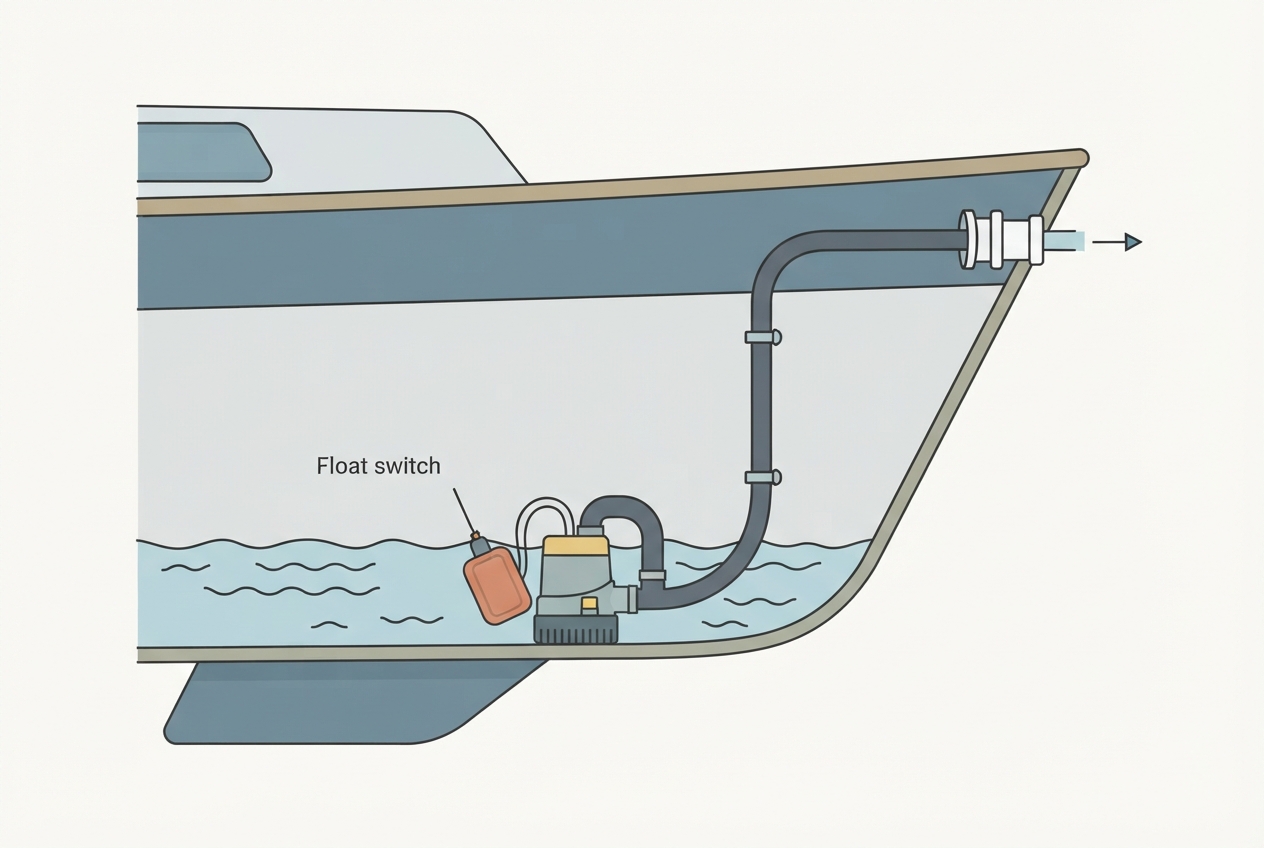
A bilge pump that doesn't run when it should is a safety item, not an annoyance. Most automatic submersible bilge pumps last 3-5 years in real use — the float switch fails before the pump motor in most cases. Replacement is an hour of work if you have the right pump on hand. The critical step most DIYers skip: testing the new pump's float switch actually triggers at the water level you expect, and the pump's output hose runs continuously uphill to the through-hull (no dips where water can trap and back-siphon).
Last Updated: May 2026
Bilge pump failed — first checks
Before you order a new pump, spend 10 minutes diagnosing which component actually failed. In most cases it's the float switch, not the motor, and a float switch replacement costs $8-20 versus $35-65 for a full pump.
Before buying a pump, test whether the pump runs when you bypass the float switch by jumpering the two float switch wires. If the pump runs on bypass but not on auto, the float switch has failed — replace the float switch only ($8-20), not the whole pump.
Don't undersize. A 500 GPH pump for a 25-footer is undersized; use 750-1100 GPH minimum. High-water alarm adds a second circuit at a higher level — worth wiring in on any boat over 22 feet.
The discharge hose from the pump must run uphill continuously to the through-hull. Any dip or loop creates a siphon trap — bilge water back-flows into the bilge every time the pump stops.
Carry a spare pump and float switch. Bilge pump failures happen in weather, not in the marina. A Rule 1100 or Attwood T1100 in a sealed bag under a seat has saved more boats than most safety gear.
How a submersible bilge pump system works
The pump sits in the lowest accessible point of the bilge — the sump — and is wired to a float switch and usually to a manual override switch at the helm. The float switch is a sealed mechanism that rises with water level; when the water reaches the trigger height, the switch closes and the pump runs. Output water travels through a hose from the pump to a through-hull fitting, ideally above the waterline (or at the waterline with a check valve to prevent back-siphoning).
The pump itself is a centrifugal impeller design. Unlike a positive-displacement pump, a centrifugal impeller doesn't self-prime — it must be submerged in water to pump anything. Running a submersible bilge pump dry, even briefly, damages the impeller and can burn out the motor. This is why mounting location matters: the pump bracket must position the pump low enough to be submerged at the water level that triggers the float switch. If the float switch triggers before there's enough water to cover the impeller, you'll burn up pumps regularly.
The manual override switch at the helm is separate from the float switch circuit — it bypasses the float and runs the pump regardless of water level. It's useful for active pumping if you're taking on water, and essential for float switch testing.
Diagnosing why the pump failed
Four failure modes cover the majority of bilge pump problems:
Float switch sticking or corroded (most common): The float mechanism is usually a small sealed ball or bladder inside a housing. Corrosion in the housing, debris wrapping around the float, or a sticking internal mechanism prevents it from rising. Test by manually lifting the float — if the pump starts, the switch mechanism works but isn't floating freely. Clean or replace. If manually lifting the float still doesn't start the pump, the switch itself has failed internally.
Pump motor shorted from running dry: The impeller spins but no water pumps, or the motor is seized. This happens when the float switch triggers before there's enough water to submerge the pump, or when the boat heels and exposes the pump. Once the motor burns dry it's done — replace the pump unit.
Wiring failure at the connector: The bilge environment is the harshest electrical environment on the boat. Connectors at or near the waterline corrode aggressively. Check every connection in the circuit: at the pump, at the float switch, at the fuse, and at the panel. Green or white corrosion on terminals means high resistance, which means the pump either won't run or runs slowly. Clean with electrical contact cleaner and replace connectors with tinned marine-grade wire terminations.
Incorrect mounting: Pump not level (centrifugal pumps work best level), float switch obstructed by debris or a hose so the float can't rise, or the pump mounted too high in the bilge so it sits in air during normal conditions. All are installation errors that cause repeat failures until the mounting is corrected.
Pump sizing — the spec that matters
The GPH number on the pump box is measured at zero head — meaning the pump is pushing water with no vertical lift, no hose friction, nothing. That number is a marketing figure, not an installation figure. What you need to know is GPH at head, where head equals the vertical distance from the pump to the through-hull outlet.
A typical installation has 5-12 feet of head. At 10 feet of head, a 1100 GPH (zero-head) pump delivers approximately 500-600 GPH. At 5 feet, it delivers roughly 750-850 GPH. The manufacturer's pump curve tells you this exactly — look for it in the spec sheet, not the box front.
Practical recommendations by boat size:
- Boats under 25 feet (trailered): 750-1100 GPH rated pump. Rule 1100 or Attwood Tsunami T1100 are the standard choices. Both are inexpensive, widely available, and have solid reliability records. Don't use a 500 GPH pump here — it's undersized once you account for head.
- Boats 25-35 feet (kept in slip): 1100-2000 GPH minimum for the primary pump. Consider a two-pump system: one 1100 GPH auto pump for routine accumulation, one 2000 GPH manual-switched pump for emergencies.
- Boats over 35 feet or any boat with significant bilge volume: 2000-3700 GPH primary, with a secondary pump on a separate circuit and a high-water alarm on both circuits.
One important note on Rule vs. Attwood: Rule pumps are more common and cheaper. Attwood Tsunami pumps run quieter (important for liveaboards and boats with open bilges near sleeping areas) and many owners report the impeller design handles debris slightly better. Either is a defensible choice.
Replacement procedure
- Disconnect the battery first. Always. Bilge work with power connected is how electrical fires start. The bilge contains fuel vapors on gasoline boats. Disconnect both terminals if you're unsure which circuit the pump is on.
- Remove the old pump. Disconnect wiring at the pump connector — photograph the wiring before disconnecting or note which wire is positive and which goes to the float switch. Unclamp or unscrew the pump from its mounting bracket. If the pump is seized to the bracket from corrosion, a strap wrench and penetrating oil usually free it.
- Remove the old output hose if it's brittle, cracked, or kinked. Bilge hose hardens over time. Any hose that's stiff, cracked, or collapsed at a bend needs replacement — a kinked discharge hose reduces flow by 40-60% and creates the siphon trap that causes continuous cycling.
- Mount the new pump in the lowest accessible point of the bilge sump. Use the bracket screws into solid fiberglass or hardwood backing — not into soft gelcoat alone. The pump must be level and positioned so the float switch can rise freely without obstruction from hoses, cables, or debris.
- Run new discharge hose from pump output to through-hull. This is the step most installations get wrong. The hose must run in a continuous upward path from the pump to the through-hull, with no dips, no valleys, no horizontal runs that sag. Secure the hose every 18-24 inches with hose clamps to prevent sag. Use marine-grade 1-1/8" ID bilge hose (not automotive heater hose, which isn't rated for this application). Double-clamp at both the pump fitting and the through-hull.
- Wire the new pump. Red wire from the pump to a positive bus through a 10A inline fuse — fuse holder as close to the positive source as possible. Black to negative/ground. The float switch wires in series with the positive: float switch has two wires, which wire is which doesn't matter (it's a simple open/close contact). The manual override switch, if you're adding one, goes in parallel with the float switch on the positive line.
- Reconnect the battery. Test the float switch by manually lifting the float. The pump should run and you should see water discharge at the through-hull. If water doesn't appear at the through-hull within 30-60 seconds of running, either the hose is blocked or has a dip preventing discharge. Test the manual override separately. Confirm auto mode responds to water: pour a gallon of water into the bilge and let the float rise naturally.
Wiring a second high-water alarm
A high-water alarm is a second float switch mounted several inches higher than the pump switch, wired to an audible buzzer at the helm and ideally to a second high-volume pump. It's independent of the primary pump circuit — separate fuse, separate wire run. The logic: if water is rising high enough to trigger the alarm, the primary pump is either overwhelmed or failed, and you need to know immediately.
The alarm float switch wires to a 12V buzzer (a simple $8-15 marine buzzer or alarm horn). Most boaters also run the alarm output to a visual indicator (red LED) at the helm. On larger boats, the alarm output can trigger a relay that powers the second emergency pump. Wire the second pump to its own switch at the helm as a manual backup.
Parts for a complete high-water alarm system: a second Rule or Attwood float switch ($8-20), a marine buzzer ($8-15), a fuse holder, and 12-16 AWG tinned marine wire for the run to the helm. Total cost under $50, installation under an hour.
Annual maintenance checklist
Test the auto float switch quarterly: pour water into the bilge until the float triggers. If it doesn't trigger, clean or replace the switch before the next time you need it. Check the bilge sump annually for debris — debris holds moisture (accelerating pump and wiring corrosion), can jam the impeller, and can obstruct the float switch. A handful of rags, hose scraps, or old sealant tubes in the bilge is one of the most common causes of repeat pump failures.
Inspect all hose clamps annually. Stainless clamps in bilge environments still corrode at the screw mechanism — replace any clamp where the screw slot is corroded or where the band shows rust bleeding. Check the pump's output at the through-hull each season by running it manually for 30-60 seconds.
After any extended layup (winter storage), run the pump manually before launching. Impellers can stick after months of sitting dry. Better to find a seized pump in the driveway than after splashdown.
2026 cost reference
| Component | Typical 2026 cost | Notes |
|---|---|---|
| Rule 1100 GPH automatic submersible | $35–55 | Most common choice for trailered boats up to 28 ft; widely available at West Marine, Amazon, Defender |
| Attwood Tsunami T800 or T1100 | $35–65 | Quieter impeller than Rule; popular on sailboats and liveaboards |
| Replacement float switch (Rule or compatible) | $8–20 | Test this first if the pump runs on bypass — saves buying a whole new pump |
| Marine bilge hose, 1-1/8" ID (per foot) | $2–4 | Replace if cracked or hardened; do not substitute automotive heater hose |
| High-water alarm kit (float switch + buzzer) | $15–35 | Second float switch plus buzzer; strongly recommended on any boat over 22 feet |
| Marine hose clamps, stainless (2-pack) | $5–12 | Replace if corroded; double-clamp at pump fitting and through-hull |
1100 GPH with float switch.
Check Price on Amazon →As an Amazon Associate, FixForge earns from qualifying purchases.