FixForge › Marine › Outboard Winterization
Outboard Motor Winterization: Step-by-Step
A two-hour winterization procedure prevents thousands of dollars in damage from stale fuel, frozen water passages, and internal corrosion. The steps are simple and the same across nearly every modern four-stroke outboard. The cost of skipping them is much higher than doing them.
Last Updated: May 2026
Fast answer with the boat already on the trailer
Five steps, in order: (1) add fuel stabilizer to the tank and run the engine for 5-10 minutes to circulate. (2) Connect freshwater flush adapter or "earmuffs" and run engine 10 minutes to flush cooling system. (3) Spray fogging oil into each cylinder per manufacturer procedure (typically through carb intakes or via spark plug holes). (4) Drain lower unit oil and refill with new gear oil; check for water in old oil (sign of seal failure). (5) Change engine oil + filter if four-stroke. Total time about 90 minutes, supplies cost $40-80.
Run stabilized fuel through the system before doing anything else.
Order matters. Fresh water through cooling, THEN cylinder fogging.
Milky or watery old oil means seal failure. Address NOW, not in spring.
After fogging and water flush. Storage with old oil = sludge.
Why outboards fail during storage and not during use
The two great enemies of stored outboards are stale fuel and trapped water. A running outboard burns fuel before it goes stale and continuously cycles cooling water through the lower unit and exhaust passages. A stored outboard sits with old fuel oxidizing into varnish, and any residual water in cooling passages can freeze and crack aluminum housings, water pump impellers, or thermostat assemblies.
Fuel stabilization addresses the first problem. Modern ethanol-blended gasoline begins degrading within 30 days, and by 90 days unstabilized fuel develops gums and varnishes that plug carburetors, fuel injectors, and small fuel passages. Stabilizer additives extend usable life to 6-12 months, covering a full winter storage season.
Freshwater flushing addresses the water problem. Saltwater boats accumulate chloride deposits that continue corroding aluminum even after the boat is out of the water; flushing rinses these out. Freshwater boats accumulate silt and biological matter that can clog small passages over storage; same flush procedure removes it. Either way, the cooling system needs to be flushed AND fully drained before storage.
Fogging — the step most owners skip and shouldn't
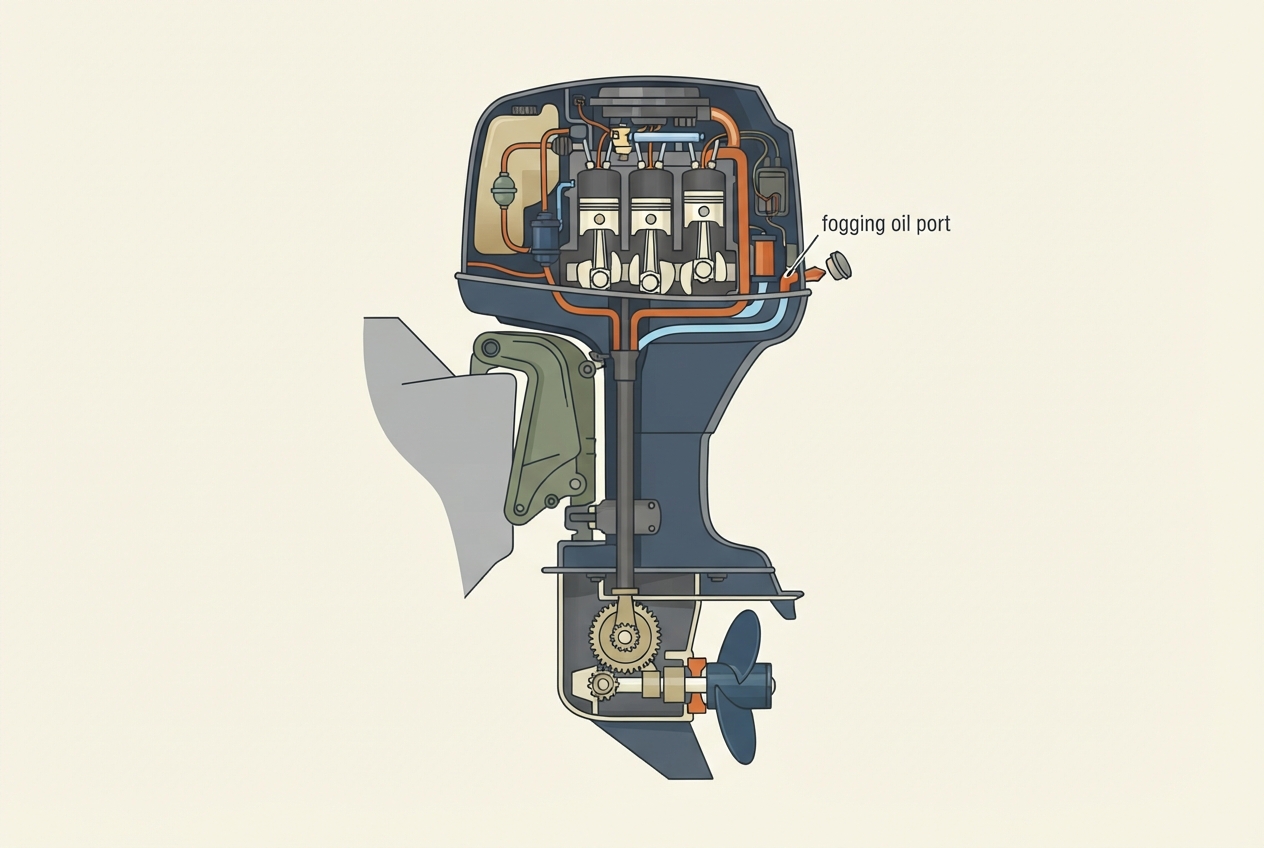
Fogging puts a thin protective oil film on cylinder walls, piston rings, and valve faces. During storage, oxygen and humidity inside the engine produce surface oxidation that scuffs rings on first startup in spring. The damage is invisible but cumulative — engines that are never fogged develop progressively worse compression after each storage cycle, while properly-fogged engines maintain compression for hundreds of storage-and-start cycles.
Fogging procedure varies by engine type:
- Four-stroke EFI: spray fogging oil into the throttle body intakes while the engine runs at slow idle. The engine will smoke, sputter, and eventually stall as the spray displaces fuel. Stalling is normal; it means the cylinders are saturated.
- Two-stroke: remove spark plugs, spray fogging oil directly into each cylinder for 2-3 seconds, then rotate engine slowly by hand to distribute the oil. Reinstall plugs (or leave out until spring, depending on local advice).
- Carbureted four-stroke (older outboards): spray into the carb intake while running, similar to EFI procedure.
The full winterization sequence
- Fill the fuel tank to roughly 90% capacity and add the manufacturer-recommended dose of fuel stabilizer (Sta-Bil, Star Tron, or Mercury Quickstor). Don't fill to the very top — leave some room for thermal expansion during storage.
- Connect a freshwater source via flush adapter or muffs over the cooling water intake. Run garden hose at moderate pressure.
- Start the engine and run at fast idle for 5-10 minutes. This circulates the stabilized fuel through the entire fuel system — tank, lines, filter, injectors, carburetor — and simultaneously flushes the cooling passages.
- Begin fogging procedure while engine is still running. Spray fogging oil into the air intake until the engine starts smoking heavily. Continue until engine starts to stall, then let it die.
- Disconnect freshwater source and lower the engine to fully tilted-down position so any water in the lower unit drains out.
- Change the lower unit oil. Locate the drain and vent screws (typically two screws on the gear case, one near the bottom and one higher up). Open the top vent screw first to allow air in, then open the bottom drain screw. Catch the oil in a pan. Look at the drained oil carefully. Clean oil = healthy seals; milky or watery oil = water has gotten past the seals, indicating seal failure that needs addressing before next season.
- Refill the lower unit with fresh gear oil. Pump from the BOTTOM screw using a hand pump until oil emerges from the TOP vent. This fills from the bottom up, displacing all air. Replace and tighten both screws. Use new gaskets if available.
- For four-stroke engines, change engine oil and filter. Drain warm old oil (run engine briefly to warm if cooled). Replace filter. Refill with manufacturer-spec oil. Run briefly with garden hose flush attached to circulate new oil before final storage.
- Replace the fuel filter / water separator if it hasn't been done recently. Cheap insurance against fuel contamination during long storage.
- Disconnect the battery and store it on a maintainer (Battery Tender or similar). Lead-acid and AGM batteries self-discharge during storage; if they go below 12.4V for extended periods, sulfation reduces capacity permanently.
- Cover the engine with a breathable cover that fits properly. Plastic or non-breathable covers trap moisture against the engine and cause MORE corrosion than no cover at all.
2026 cost reference
| Item | Typical 2026 cost | Notes |
|---|---|---|
| Fuel stabilizer (Sta-Bil 16 oz) | $10-18 | Treats 80 gallons. One bottle covers most outboards. |
| Star Tron Enzyme Fuel Treatment (16 oz) | $14-22 | Alternative to Sta-Bil; some prefer it for ethanol blends. |
| Fogging oil (12 oz can) | $10-18 | Mercury Storage Seal, Yamaha Stor-Rite, or generic equivalent. |
| Lower unit gear oil (32 oz or 1 quart) | $15-25 | Most outboards take 16-32 oz. Buy the exact spec for your engine (SAE 80W-90 or 75W-90 depending on model). |
| Engine oil (four-stroke, quart) | $8-15 | 10W-30 marine four-stroke. Yamalube, Quicksilver, or equivalent. |
| Oil filter | $10-20 | Matched to engine. |
| Fuel filter / water separator element | $15-30 | Replace annually regardless of mileage. |
| Battery maintainer (one-time purchase) | $40-80 | Lasts decades. Best ROI tool in the garage. |
| Service-center winterization (full) | $150-350 | Plus any parts they install (filter, oils included). |
When to stop and call a pro
Two scenarios where winterization should be professional. First: water in the lower unit oil. This indicates seal failure that lets water past the prop shaft or gear case mating surface. Continuing to use the engine in this state damages internal gears. Lower unit seal replacement requires partial gear case disassembly and is beyond most DIY scope. Second: any indication of internal engine damage (low compression on one or more cylinders, milky engine oil indicating coolant intrusion, unusual noises during operation). Storage on top of an underlying problem makes spring startup worse, not better. Diagnose and address before storage.