FixForge › RV › RV Battery Not Holding Charge
RV Battery Not Holding Charge
An RV battery that dies overnight is almost always one of three things: the battery has a dead cell and simply can't hold a charge anymore, there's a parasitic draw draining it while you sleep, or the charging system (converter) isn't getting it back to full charge when you're on shore power. Distinguishing which is a 30-minute test with a multimeter. The fixes are very different — and buying a new battery before doing that test is a coin flip.
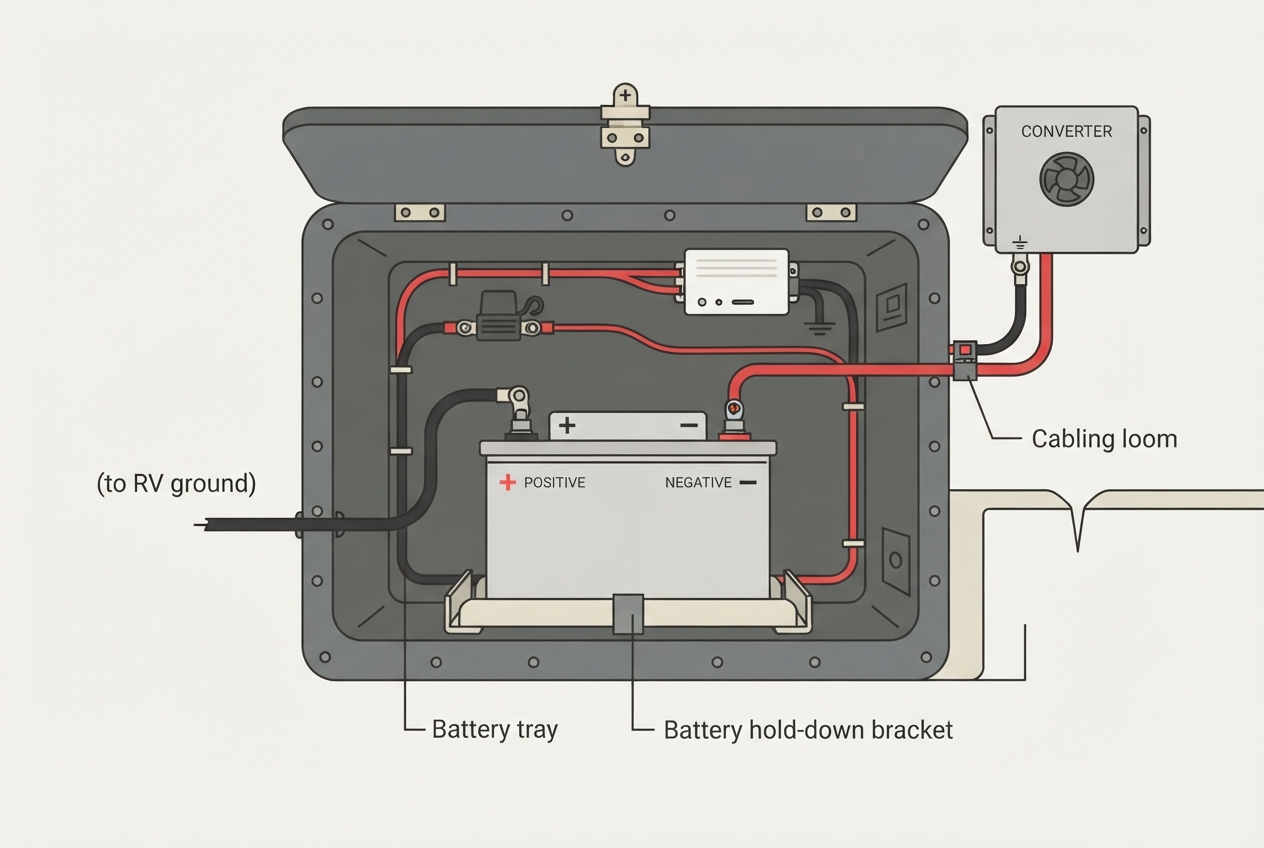
Battery dead in the morning — first tests
How RV house batteries fail
Lead-acid batteries — both flooded and AGM — fail primarily through sulfation. When a battery sits in a partially or fully discharged state, lead sulfate crystals form on the lead plates. During a normal charge cycle, lead sulfate dissolves back into sulfuric acid in the electrolyte. But when the crystals have time to harden and grow (days to weeks at a low state of charge), they don't dissolve during normal charging. They stay on the plates permanently, reducing the active plate surface available for chemical reactions.
The result is a battery with reduced capacity. A new 100Ah battery that's been sulfated for months might now only hold 60Ah, or 40Ah, or have one cell that contributes essentially zero capacity. A standard 12V lead-acid battery is made up of six 2V cells in series. If one cell fails completely, the battery now runs on five cells — maximum voltage around 10–10.5V, which is below the minimum operating voltage of most 12V equipment. The battery reads "full" on a charger because the other five cells charge up, but it can't sustain any load because the dead cell drags everything down.
This is why an overnight drain in an otherwise normal rig almost always means cell failure, not a mystery electrical problem. A bad cell is the most common single cause of "my battery won't hold a charge" complaints in RV forums.
The three failure modes and how to distinguish them
Dead or failing cell: Battery reads low resting voltage (under 12.0V) after overnight disconnected from everything, OR resting voltage looks normal but voltage collapses immediately under any meaningful load. Food test: the battery charges up fine overnight, starts the morning at 12.4V, and is at 11.5V by mid-morning with only the fridge running. Fix: replace the battery. Desulfation may recover it if the cell failure is early-stage; see the desulfation section below.
Parasitic draw: Battery was genuinely full (12.6–12.8V) when you went to sleep, dead or significantly drained in the morning, and this pattern repeats consistently. The battery passes a load test — it can sustain voltage under a real load — but something is pulling it down while you're asleep. Put a multimeter in current-measurement mode in series with the negative terminal with everything switched off. Fix: find and eliminate the draw.
Converter not charging: Battery is chronically undercharged — rests at 12.2–12.4V even when you've been plugged in for 12 hours. The battery itself may be fine, but it never reaches full state of charge so its effective capacity is reduced. Measure voltage at the battery while on shore power: should be 13.6–14.4V actively charging, then taper to 13.2–13.6V during float. If it reads 12.5V, the converter isn't charging. Fix: check converter connections, fuses, and converter output — or replace the converter.
The load test — the correct diagnosis for dead cells
A resting voltage reading alone does not tell you whether a battery is healthy. A battery can show 12.6V at rest and fail completely under any real load. You need a load test.
With a dedicated load tester ($20–35): Connect the tester, set it to the battery's rated CCA or RC, and run the test. The tester applies a controlled load for 15 seconds and reports pass/fail. This is the most accurate method. Auto parts stores (AutoZone, O'Reilly, Advance Auto) will test your battery for free if you bring it in.
Improvised load test: Turn on the exterior coach lights or any known steady load of 10–15 amps. Measure battery voltage at the terminals while the load is running. Within 30 seconds: above 12.0V = healthy. 11.5–12.0V = weak but possibly recoverable. Below 11.5V = failing cell, replace or attempt desulfation. Immediate collapse to below 11V = dead cell, replace.
Do this test after the battery has been disconnected from shore power for at least 2 hours — a battery sitting on a charger reads "surface charge" that will fool the test. Rest time is required for accurate results.
Parasitic draw hunting
Set your multimeter to DC amps (the 10A setting on most meters, not the mA setting — you'll start here and switch if the reading is low). Disconnect the negative battery cable and connect the multimeter in series between the battery negative terminal and the negative cable. You're now measuring all current flowing out of the battery.
Baseline draws that are normal and expected: Propane/LP detector (100–300mA when LP is connected — this is always on by design), CO detector (50–150mA), radio memory (under 20mA), clock circuits (under 10mA). Total baseline of 200–400mA is normal in most RVs. If you're reading 50mA with the propane disconnected and all switches off, you're in good shape.
Draws worth investigating (over 100mA above baseline):
- Inverter in standby — some inverters draw 0.5–2A with the switch on and no load. The fix is a switched outlet or simply turning the inverter off at the unit when not in use.
- Slide-out controller — some systems draw 50–200mA continuously. Check your specific controller's spec sheet.
- Aftermarket stereo, backup camera system, or accessories — any add-on electronics are candidates.
- Faulty relay or solenoid stuck partially open.
Fuse pull method: With the multimeter in series, pull fuses from the RV fuse panel one at a time. When the reading drops significantly, you've identified the circuit. Then trace that circuit to the specific device.
Can you desulfate an RV battery?
Yes, sometimes. Pulse desulfation chargers send high-frequency pulses into the battery that break apart soft sulfation crystals on the plates. The Noco Genius 10 ($70–80) has a dedicated "repair" mode that runs a 72-hour desulfation cycle. The Battery Tender 12V Desulfator and similar units in the $25–60 range do the same thing.
When desulfation works: Batteries with mild to moderate sulfation from 1–3 months of storage in a low state of charge. You'll see capacity improve noticeably after the repair cycle. A load test before and after shows clear improvement. Success rate is roughly 50–60% on batteries that have been sulfated for weeks.
When desulfation does not work: Hard sulfation from 6+ months of neglect (crystals have hardened past recovery). Physical damage — plates that have shed active material (you'll see dark sediment in the electrolyte of a flooded battery). A cell with an internal short. If the battery is more than 4–5 years old and completely dead, the recovery rate drops below 20%. At that point, replacement is the better investment.
Worth attempting on any battery under 4 years old before spending $150–300 on a new one. The charger is reusable and will maintain future batteries properly.
Battery replacement guide
When you've confirmed the battery is beyond recovery, here's what matters in the selection:
Flooded lead-acid deep-cycle (Group 24 or 27): The cheapest option at $80–150. Requires regular electrolyte checks and topping off with distilled water every 2–3 months. Can be fully discharged without damage if watered properly. Fine for weekend campers who don't mind the maintenance. Interstate and Trojan are the reliable brands; avoid no-name batteries.
AGM deep-cycle (Group 24 or 27): $150–300. Sealed, no maintenance, better cold-weather performance, lower self-discharge rate. Can be mounted in any orientation. More sensitive to overcharging than flooded (requires a compatible charger set to AGM mode — most modern RV converters have this setting). Our recommendation for most RVers who want to set it and forget it.
LiFePO4 (lithium iron phosphate) 100Ah: $400–800. Four times the cycle life of AGM (2,000–5,000 cycles vs. 500–1,000). 80% usable capacity vs. 50% for lead-acid (a 100Ah lithium is effectively 80Ah usable; a 100Ah AGM is 50Ah usable). No memory effect, extremely low self-discharge, much lighter. Important caveat: requires a lithium-compatible converter/charger. Many RV converters made before 2018 do not have a lithium charge profile and will either not fully charge the battery or damage it. Verify your converter's compatibility before buying.
Sizing: A standard RV fridge runs 3–5A. Interior LED lighting runs 1–3A total. A furnace blower runs 6–10A. Plan for 40–80Ah per night of realistic use. A single Group 27 AGM (110Ah, 55Ah usable) covers light overnight use. Two batteries in parallel cover a full day of boondocking. Size up if you run a residential fridge, CPAP, or microwave regularly.
What it costs in 2026
| Item | Cost | Notes |
|---|---|---|
| Multimeter | $15–35 | Required for diagnosis; Fluke 115 is the workhorse option |
| Battery load tester | $20–35 | More accurate than multimeter for cell failure diagnosis |
| Pulse desulfator (Noco Genius 10 or similar) | $45–70 | Attempt recovery before replacing; reusable charger/maintainer |
| Flooded Group 24/27 deep-cycle battery | $80–150 | Budget option; requires electrolyte maintenance every 2–3 months |
| AGM Group 24/27 deep-cycle battery | $150–300 | Recommended for most RVers; maintenance-free |
| LiFePO4 100Ah battery | $400–800 | Long-term best value; verify converter compatibility first |
Frequently Asked Questions
Why does my RV battery keep dying overnight?
Three causes: dead or failing cell (battery can't hold charge regardless), parasitic draw (something is pulling current while everything is off), or converter not charging (battery starts each night undercharged). A multimeter test at the battery and in-series current measurement distinguishes all three in under 30 minutes.
How do I test if my RV battery has a dead cell?
Load test: disconnect charger, let rest 2 hours, then apply a 15–20A load (exterior lights) and measure voltage at the battery terminals. Hold above 12.0V = healthy. Sag below 11.5V within 30 seconds = dead or failing cell. Free testing also available at any AutoZone or O'Reilly.
What is a parasitic draw in an RV?
Any circuit pulling current when everything is switched off. Some are normal (propane detector, CO detector). Abnormal draws over 200mA — often inverter standby, slide-out controllers, or aftermarket electronics — will kill any battery overnight. Find them by measuring current in series with the negative cable, then pulling fuses one at a time.
Can I use a regular car battery in my RV?
Not for the house bank. Car/starting batteries are not designed for deep-cycle use — drawing them down 50% and recharging destroys them quickly. Use only deep-cycle rated batteries (flooded deep-cycle, AGM, or LiFePO4) for the house bank.
How long should an RV battery last?
Flooded lead-acid: 2–5 years with proper watering. AGM: 4–7 years, no maintenance required. LiFePO4: 8–15+ years. All types fail faster when stored partially discharged, overcharged, or regularly deep-discharged below minimum voltage.
Group 24, 27, 31.
Check Price on Amazon →As an Amazon Associate, FixForge earns from qualifying purchases.