FixForge › Marine › Zinc Anode Replacement
Marine Zinc Anode Replacement: When & How
Sacrificial anodes are the cheap insurance that prevents galvanic corrosion from eating your shafts, props, rudders, drives, and through-hulls. Skip them and you'll pay for what they protect, usually starting with the most expensive component. Most replacements take 10-30 minutes per anode.
Last Updated: May 2026
Fast answer for a haul-out next week
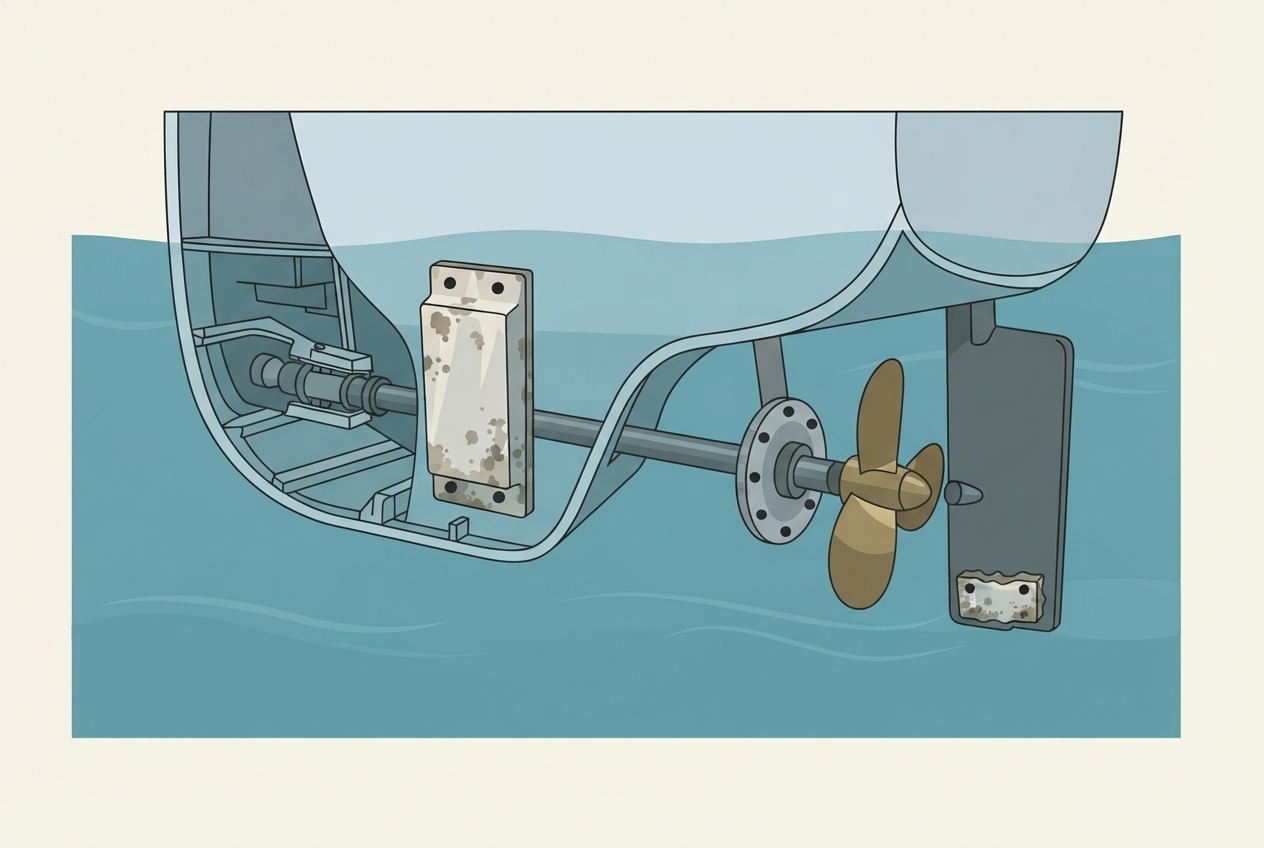
Inventory every anode on the boat before haul-out: shafts, props, rudders, trim tabs, hull plates, gimbal, trim rams, transom. Note the size of each. Order matching replacements from a marine supplier (Defender, West Marine, Boatzincs) sized to your specific boat — never guess. Match the chemistry to your water: zinc for salt, aluminum for brackish or mixed, magnesium for fresh. Bring a stainless socket set rated for marine use. Replace any anode that's more than 50% consumed. Apply waterproof anti-seize on threads before reinstalling.
Zinc in saltwater. Aluminum for brackish. Magnesium for freshwater only.
Replace when half-gone. Don't wait until exposed bolt heads.
Anode must touch bare metal of what it's protecting. Paint over an anode and you've installed jewelry.
Saltwater plus steel bolts plus zinc = welded threads next time. Anti-seize prevents that.
Why galvanic corrosion eats boats
Any boat in the water with two or more dissimilar metals in electrical contact is a galvanic battery. The more reactive metal becomes the anode and corrodes; the less reactive becomes the cathode and is protected. Without intervention, the metal that corrodes is whatever's most reactive in your system — often the bronze in a through-hull fitting, the aluminum in an outdrive housing, or the steel in a shaft.
The fix is to put something even more reactive than any of your boat's metals into the circuit. Zinc (in saltwater), aluminum (in brackish), or magnesium (in fresh) all corrode preferentially when properly bonded to the boat's underwater metals. The anode is consumed; the rest of the boat is protected. When the anode is gone, protection ends and the next-most-reactive metal starts being eaten.
This is why missing or paint-covered anodes are so destructive. A $20 anode protects a $4000 outdrive. The math is unambiguous; the only question is whether owners pay attention.
Choosing the right anode chemistry
The ABYC (American Boat & Yacht Council) provides specific guidance on anode selection by water type, and it's not optional — the wrong anode either provides no protection or causes accelerated damage.
- Zinc: for saltwater (salinity above 25 ppt). Zinc has the right electrochemical reactivity to provide protection in saltwater without corroding so fast it becomes uneconomical. Zinc in freshwater barely corrodes at all and provides essentially no protection — you'd be installing a 2-pound paperweight.
- Aluminum: for brackish water (salinity 5-25 ppt) and for boats that move between salt and fresh. Aluminum is the modern preferred default for mixed-use boats because it works in both environments, even if not optimally in either. Many newer boats spec aluminum even for full-time saltwater use because of slightly better protection of aluminum hull/drive components.
- Magnesium: for freshwater (salinity below 1 ppt). Magnesium is highly reactive and provides excellent protection in freshwater, but in saltwater it corrodes so aggressively it's consumed in weeks AND its rapid reaction can cause overprotection that damages painted surfaces by lifting paint via hydrogen production at cathodic surfaces. Never use magnesium on a boat that goes to salt.
Where to look for anodes on a typical boat
Anode count and locations vary by boat type, but here's the canonical map:
- Inboard shaft boats: shaft collar anode (between strut and prop), prop anode (bolted to prop hub or cap), rudder anode (bolted to rudder shoe), hull plates (rectangular plates bonded through-hull, typically near engine bay), heat exchanger pencils (small zinc pencils inside the engine's raw-water heat exchanger).
- I/O drives (Mercruiser Bravo, Volvo Penta DPS): gimbal housing anode (rear of transom assembly), trim ram anode (top of each trim ram), drive shaft anodes (vary by model), bearing carrier anode, sometimes a trim tab anode at the cavitation plate.
- Outboards: trim tab anode (above cavitation plate), gear case anode (typically a small zinc plate bolted to the lower unit), and on larger models, additional gear case or transom-mount anodes.
- Sailboats with prop & strut: shaft anode (between strut and prop), prop anode (on the cap or directly bolted), sometimes a small rudder shoe anode.
Many boats also have internal anodes for the engine cooling system that owners forget about — engine heat exchanger zincs, transmission cooler zincs, and on some inboards, a separate raw-water strainer zinc. These corrode just as fast as external anodes and require periodic replacement, but are often skipped because nobody can see them from outside the boat.
The replacement procedure (haul-out)
- Inventory every anode before starting work. Photograph each location, note size, and confirm you have replacements for everything you'll find.
- Clean the mounting surface where the anode meets the protected metal. Bare metal contact is essential. Wire brush any oxidation, paint, or barnacle residue off the contact area. An anode bolted to a painted surface provides zero protection.
- Apply anti-seize to the bolt threads only — never to the contact face between anode and protected metal. Threads need anti-seize because saltwater plus stainless plus zinc generates galvanic welding. The contact face needs metal-to-metal conduction.
- Torque to manufacturer spec. Tight enough to maintain contact, not so tight you strip threads in the underlying metal. Most are 10-25 ft-lbs depending on size.
- Verify electrical continuity with a multimeter between the new anode and the metal it's protecting. Resistance should be effectively zero. If continuity isn't present, you have paint, corrosion, or a loose connection breaking the path.
- Document the date in your maintenance log. Anode replacements compound knowledge — tracking consumption rate over time tells you whether your bonding system is healthy.
2026 cost reference
| Component | Typical 2026 cost | Notes |
|---|---|---|
| Small transom-mount anode (outboard) | $8-22 | Various brands; OEM Mercury/Yamaha tend to cost 2x the third-party equivalent. |
| Shaft collar anode (1-1/4 to 1-3/4 inch) | $18-45 | Sized to shaft diameter. Buy by exact diameter, not "close enough." |
| Prop hub anode | $22-65 | Brand-specific (Mercury Bravo, Volvo DPS, etc). |
| Rudder anode | $25-70 | Sailboat rudder shoe anodes vary widely by hull design. |
| Hull plate anode (4x6 to 6x12 inch) | $30-90 | Bonded through-hull, the largest sacrificial mass on most boats. |
| Heat exchanger zinc pencil | $8-15 | Cheap parts but easy to forget. Replace at every engine service. |
| Complete anode set, 30-foot cruiser | $120-280 | Owners' kits sold by brand-specific suppliers. |
| Diver in-water replacement service | $80-200/visit | Plus parts. Common for boats kept in slips year-round. |
| Haul-out anode replacement labor | Often included in haul-out package | Confirm with your yard before assuming. |
When to stop and call a pro
Two scenarios. First: persistent rapid anode consumption (months instead of a year). This indicates a stray current problem — either galvanic isolator failure, shore-power grounding issue, or wiring leak somewhere in the boat's DC system. Diagnosing stray current requires a marine electrician with specific test equipment; ignoring it accelerates corrosion of everything underwater. Second: any visible corrosion damage to protected metals (pitting on shafts, exfoliation on outdrive housings, etching on through-hulls). At that point, anodes alone won't reverse the damage; the affected components need professional inspection and possibly replacement.
Filter by brand for correct fit.
Check Price on Amazon →As an Amazon Associate, FixForge earns from qualifying purchases.