FixForge › Appliance › Dryer Not Heating
Dryer Not Heating
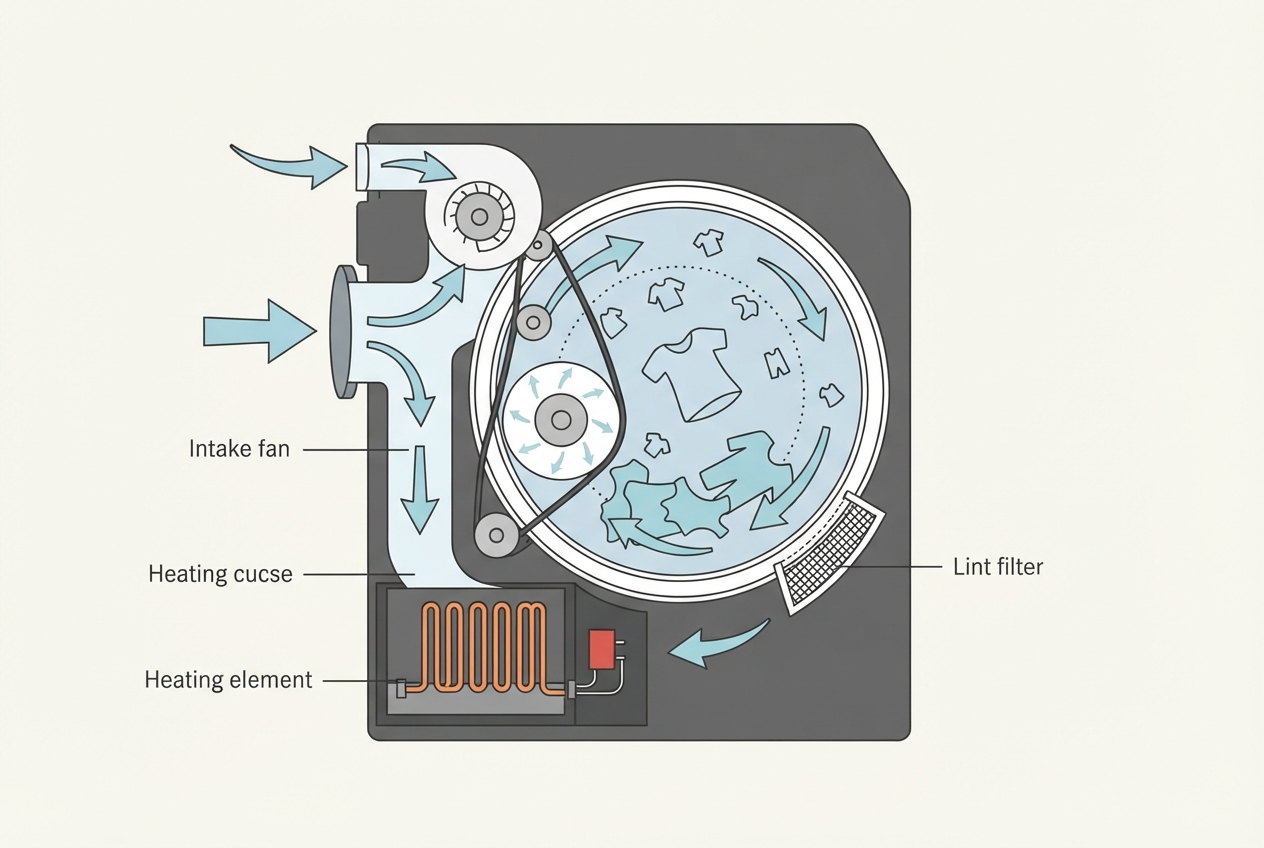
A dryer that tumbles but produces no heat is one of the most common appliance repairs — and one of the cheapest. On electric dryers, a blown thermal fuse (a $5-10 part) causes 60% of no-heat calls. On gas dryers, failed igniter or gas valve coils are the culprit. The machine runs because the motor circuit is separate from the heat circuit.
Last Updated: June 2026
Fast answer
Electric dryer: replace the thermal fuse first ($5-10, 20 minutes). It's the most common cause and cheapest fix. If the fuse keeps blowing, check vent restriction — that's the root cause. Gas dryer: if you hear clicking but no ignition, the igniter is likely failed ($15-25). If the igniter glows but flame doesn't hold, the gas valve coils have failed ($20-35).
Most common electric dryer cause. $5-10 part, 20 min fix. One-time use — always replace.
Restricted vent causes thermal fuse to blow. Fix the vent or fuse will blow again.
Glows orange but flame won't catch = coils. No glow = igniter failed ($15-25).
Electric dryers: element fails after 8-12 years. $20-50 part, 45 min job.
Electric dryer diagnosis
Electric dryers have two heat-related failure points you can test with a $10 multimeter:
- Thermal fuse. Located on the exhaust duct inside the dryer — usually on the back panel. Unplug the dryer, remove the back panel, locate the fuse (cylindrical, 1-2 inches long with two terminals). Set multimeter to continuity mode. A good fuse shows continuity; a blown fuse shows open circuit. Replace with exact OEM match ($5-10).
- Heating element. If the thermal fuse tests good, check the heating element. Located in a housing near the exhaust. Test for continuity between the two terminals — should read 8-12 ohms on most elements. Open circuit = failed element ($20-50).
- Thermostat. A cycling thermostat regulates heat during the cycle; a high-limit thermostat is a safety cutoff. Both are testable with a multimeter. Failed thermostats are less common than fuses but worth checking if both fuse and element test good.
Gas dryer diagnosis
Gas dryers have more components in the heat circuit:
- Igniter: Glows to ignite the gas. Watch it through the burner assembly — if it glows orange but the flame doesn't light, gas valve coils have failed. If it doesn't glow at all, the igniter itself has failed.
- Gas valve coils (solenoids): Open the gas valve to allow flow. They fail as a set — replace all coils together ($20-35 for a set).
- Flame sensor / radiant sensor: Detects whether the burner is lit. A failed sensor causes the valve to close immediately after lighting, producing short burst heating that isn't enough to dry clothes.
The vent problem you can't ignore
A restricted exhaust vent is the root cause of most thermal fuse failures. The fuse blows because the dryer overheats because hot air can't escape. If you replace the fuse without clearing the vent, the new fuse will blow within weeks. Check the vent run from dryer to exterior — lint clogs are most common at bends and at the exterior flap. A dryer vent cleaning kit ($20-30) handles most clogs. If your vent run is over 25 feet with multiple bends, hire a vent cleaning service ($80-120).
Includes thermal fuse + thermostat. Check compatibility with your model number.
Check Price on Amazon →As an Amazon Associate, FixForge earns from qualifying purchases.
For electric dryers. Verify model compatibility before ordering.
Check Price on Amazon →As an Amazon Associate, FixForge earns from qualifying purchases.
Flexible rods + brush. Clears 25+ foot vent runs from the dryer end.
Check Price on Amazon →As an Amazon Associate, FixForge earns from qualifying purchases.
Frequently asked questions
Is it dangerous to run a dryer that doesn't heat?
The motor still runs, which is safe, but a dryer running without heat can mask a venting problem that is a fire hazard. Diagnose and fix promptly, and always check the vent when addressing heat issues.
My dryer heats sometimes but not consistently. What's wrong?
Intermittent heat is usually a failing cycling thermostat or a partially clogged vent that allows heat to build up, trips the high-limit, then cools and resets. Check the vent first.
How long should a dryer heating element last?
8-12 years is typical. Oversized loads, restricted venting, and running dryers on high heat exclusively all shorten element life.
Related guides
Last updated June 2, 2026. Repair procedures and part prices verified against manufacturer documentation and current market data. Prices may vary — confirm at time of purchase.