FixForge › Appliance › Refrigerator Not Cooling
Refrigerator Not Cooling
A refrigerator that isn't cooling falls into two categories: freezer works but fridge is warm (evaporator fan or damper failure), or neither section cools (condenser coils dirty, start relay failed, or compressor issue). Most cases are fixable for under $30. Start with the free fix — cleaning the condenser coils takes 15 minutes and solves 20% of cooling problems.
Last Updated: June 2026
Fast answer
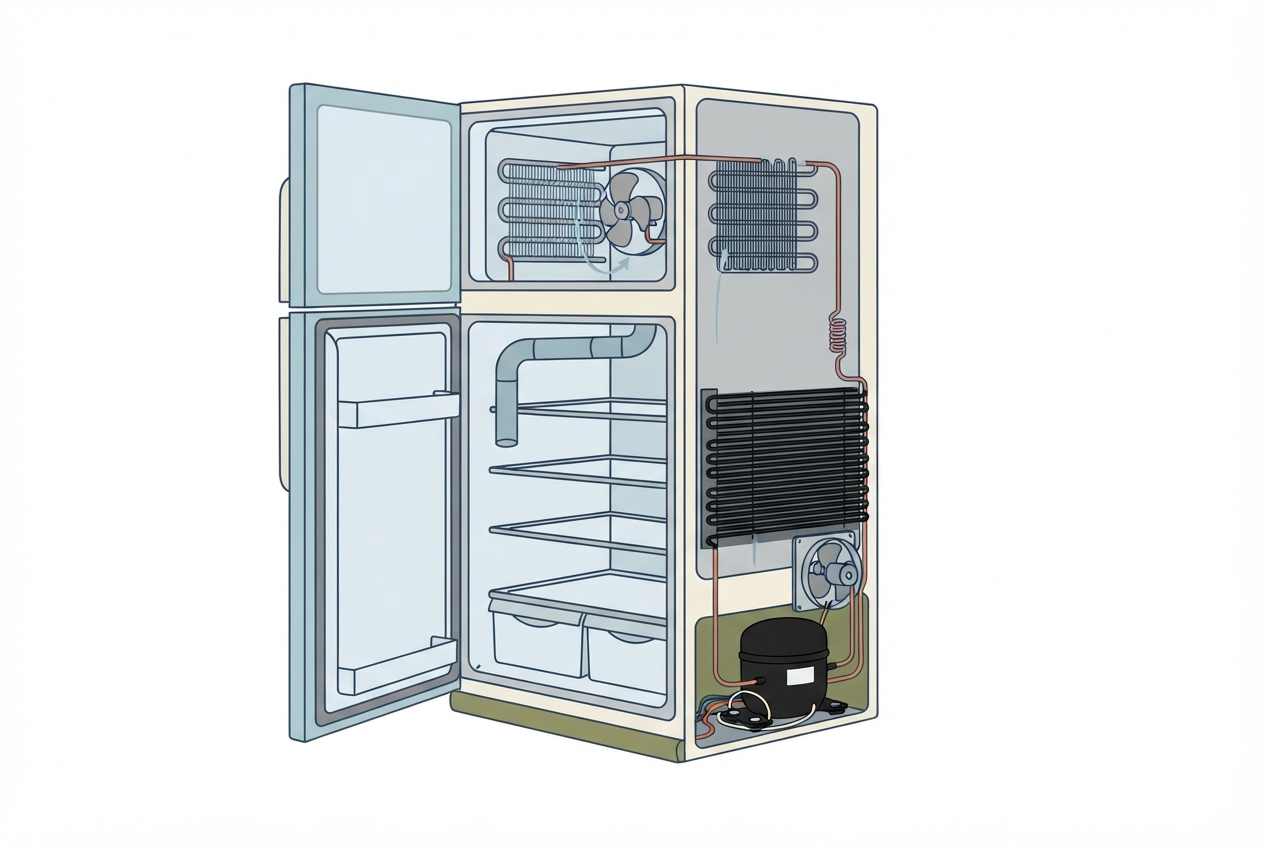
Freezer cold, fridge warm: the evaporator fan ($20-35) or damper control has failed. The fan circulates cold air from the freezer into the fridge — when it stops, the freezer stays cold but the fridge warms. Both sections warm: check condenser coils (vacuum them — they may be clogged with dust) and the start relay on the compressor ($8-15).
Dirty condenser coils = overheating compressor = poor cooling. Free fix, 15 min.
Freezer cold + fridge warm = fan failed. $20-35, moderate difficulty.
Click sound when compressor tries to start = relay failed. $8-15 part.
Ice buildup on evaporator coils blocks airflow. Defrost and check timer/thermostat.
Step 1: Clean the condenser coils (free, 15 minutes)
Condenser coils release heat from the refrigerant to the room air. When clogged with dust and pet hair, the system can't shed heat efficiently and the compressor overworks or shuts down on thermal protection. Coils are located either behind a kick plate at the front bottom of the fridge, or across the back.
Unplug the fridge, vacuum the coils with a brush attachment, and wipe with a damp cloth. This should be done every 6-12 months regardless of whether you're having problems.
Step 2: Check the evaporator fan (freezer cold, fridge warm)
The evaporator fan sits behind the back panel inside the freezer compartment. It pulls air across the evaporator coils and pushes it into both the freezer and refrigerator sections through a damper. When the fan fails, cold air doesn't circulate — the freezer stays cold because it's directly adjacent to the coils, but the fridge section warms.
Test: open the freezer door and manually press the door switch (this tricks the refrigerator into thinking the door is closed while open). You should hear the fan running. If it's silent, the fan motor has failed. Listen also for ice buildup around the fan — a blade hitting ice can stop the fan and also indicates a defrost system problem.
Step 3: Check the start relay
The start relay is a small component plugged into the side of the compressor. It provides the startup current burst the compressor needs to start. A failed relay produces a clicking sound every few minutes as the compressor tries to start and fails. Remove the relay (unplug the fridge, access the rear, the relay plugs into two terminals on the compressor) and shake it — a rattle sound indicates a failed relay. Replacement costs $8-15.
Step 4: Diagnose the defrost system
Modern frost-free refrigerators run a defrost cycle every 8-12 hours to melt ice from the evaporator coils. If the defrost heater, defrost thermostat, or defrost timer/control fails, ice builds up on the coils and eventually blocks all airflow — the refrigerator slowly warms over days or weeks.
Force defrost mode (procedure varies by brand — look up your model number) to cycle the defrost heater. If the coils defrost and cooling returns, the defrost system is the problem. Check the defrost heater (continuity test), defrost thermostat, and timer/control board.
When it's the compressor
If coils are clean, fan runs, relay is good, and the defrost system is functional, the compressor itself may have failed. Compressors are expensive ($200-600 for the part) and require refrigerant handling by a certified technician. On refrigerators over 10 years old, replacement is usually more economical than compressor repair.
Model-specific. Verify compatibility with your refrigerator model number.
Check Price on Amazon →As an Amazon Associate, FixForge earns from qualifying purchases.
Shake test: rattles = failed. $8-15 fix. Enter model number to confirm fit.
Check Price on Amazon →As an Amazon Associate, FixForge earns from qualifying purchases.
Long flexible brush reaches coils behind kick plates.
Check Price on Amazon →As an Amazon Associate, FixForge earns from qualifying purchases.
Frequently asked questions
My refrigerator runs constantly but doesn't get cold. What's wrong?
Continuous running without cooling = the refrigerant system isn't removing heat effectively. Causes: dirty condenser coils (check first), low refrigerant charge (requires a technician with gauges), or a failing compressor. Check the coils — if they're clean and warm/hot to the touch during operation, the system is running but not cooling effectively, which points to refrigerant or compressor issues.
How do I know if the evaporator fan is the problem?
Open the freezer door and hold in the door switch manually. You should hear the fan. If you don't hear it, remove the back panel of the freezer — you may find the fan blades iced over. If the fan runs freely and the motor tests for continuity but still doesn't run during normal operation, the control board may not be sending power to it.
My fridge stopped cooling after a power outage. Why?
Power surges during outages can damage the control board or trip the compressor's internal thermal protector. Let the fridge sit unplugged for 30 minutes, then restore power. If it doesn't start within an hour, the start relay or control board may have been damaged.
Related guides
Last updated June 2, 2026. Repair procedures and part prices verified against manufacturer documentation and current market data. Prices may vary — confirm at time of purchase.