FixForge › Appliance › Microwave Not Heating Food
Microwave Not Heating Food
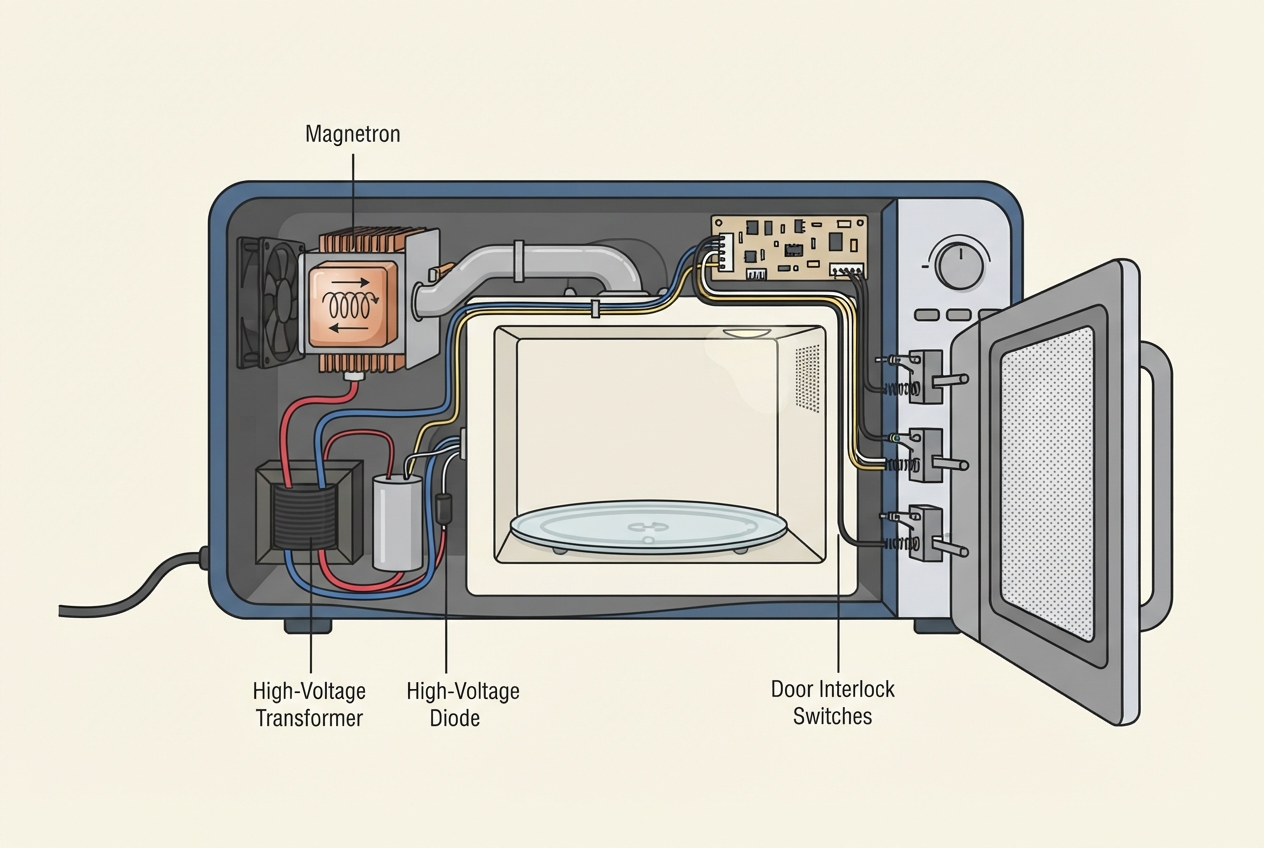
A microwave that runs (turntable spins, light works, fan runs) but doesn't heat has a failed high-voltage component — most commonly the diode ($10-20) or the magnetron itself ($50-100+). Important: microwave capacitors store lethal voltage even when unplugged. Do not open a microwave unless you know how to safely discharge the capacitor.
Last Updated: June 2026
Fast answer
Quick check first: run a cup of water for 2 minutes. If water is room temperature after 2 min, the magnetron or diode has failed. The diode ($10-20) is the cheaper first part to replace. If diode tests good, the magnetron has failed — at $50-100+ for the part plus labor risk, weigh repair against replacement on microwaves over 7 years old.
Stores 2100V+ after unplugging. Must discharge before any internal work.
Most common fixable cause. $10-20, tests with multimeter.
More expensive ($50-100+). Often not worth repairing on older units.
Three door switches — if one fails, microwave runs but won't heat.
Safety first: capacitor discharge is mandatory
Microwave capacitors store 2,100 volts DC and can hold that charge for days after unplugging. This voltage is lethal. Before touching any internal component, the capacitor must be discharged using a discharge tool (a resistor across the terminals) or by a technician. Do not skip this step. If you're not comfortable with this procedure, have a technician diagnose and repair — or replace the unit.
Door switch diagnosis (safe to test)
Microwaves have 2-3 door interlock switches that prevent operation with the door open. If one fails in the wrong position, the microwave appears to run (the light and fan work on a different switch) but the magnetron doesn't activate. Test door switches with a multimeter for continuity in closed and open positions — this requires only removing the outer cover, which is lower voltage risk than the main capacitor circuit. Door switches cost $5-15 each.
Diode diagnosis
The high-voltage diode converts AC to DC for the magnetron. A failed diode causes the magnetron not to receive proper voltage. After safely discharging the capacitor, remove the diode (typically connected between the capacitor and chassis ground), and test with a multimeter in diode mode — it should conduct in one direction only. A shorted diode reads low resistance in both directions; an open diode reads high resistance in both directions. Replacement diodes run $10-20.
Magnetron failure
If the diode tests good and door switches are fine, the magnetron has failed. Magnetrons are the core microwave-generating component and are model-specific, typically $50-100+ for the part. On microwaves over 7-8 years old, or countertop units under $200, replacement is almost always more economical than repair. Over-the-range microwaves ($300-600+ to replace) may be worth repairing.
Universal microwave diode. Verify with your model before ordering.
Check Price on Amazon →As an Amazon Associate, FixForge earns from qualifying purchases.
3-pack door interlock switches. Match to your microwave model.
Check Price on Amazon →As an Amazon Associate, FixForge earns from qualifying purchases.
If repair isn't worth it — 1100W, 1.1 cu ft, reliable replacement option.
Check Price on Amazon →As an Amazon Associate, FixForge earns from qualifying purchases.
Frequently asked questions
Is it safe to run a microwave that doesn't heat?
Technically the magnetron just doesn't fire, so there's no immediate danger in running it briefly. But a failed diode can cause the magnetron to draw excessive current when the diode shorts — repeated operation can damage additional components. Diagnose before running it repeatedly.
My microwave sparks inside. Is that related?
Sparking is usually a separate issue: metal in the microwave, a damaged waveguide cover (the cardboard or mica panel inside the microwave cavity), or a failing magnetron. Replace the waveguide cover ($5-10) if it's burned or damaged — this is a common and inexpensive fix.
How long should a microwave last?
7-10 years for countertop units. Over-the-range microwaves 10-15 years. When the repair cost exceeds 50% of a replacement's cost, replacement is usually the better financial decision.
Related guides
Last updated June 2, 2026. Repair procedures and part prices verified against manufacturer documentation and current market pricing. Confirm prices at time of purchase.