FixForge › Appliance › Washing Machine Not Spinning
Washing Machine Not Spinning
A washer that won't spin leaves clothes soaking wet — it washed them but didn't extract the water. The most common causes are a failed lid switch (top-loaders), an overloaded drum, or a broken drive belt or motor coupling. The lid switch check is free; the parts are $10-30.
Last Updated: June 2026
Fast answer
Top-loader: the machine won't spin if the lid switch fails — it's a safety interlock. Listen for a click when you close the lid. No click = switch failed ($10-20). Front-loader: if the door shows locked but no spin, check if there's error code. E and F codes often indicate a motor or control board issue.
Top-loaders won't spin with failed lid switch. Listen for click. $10-20.
Too large a load prevents spin engagement. Run a smaller load to test.
Belt breaks after 8-12 years. Machine hums but drum doesn't spin.
Direct-drive washers: coupling breaks on overload. $10-15 part.
Top-loader: lid switch diagnosis
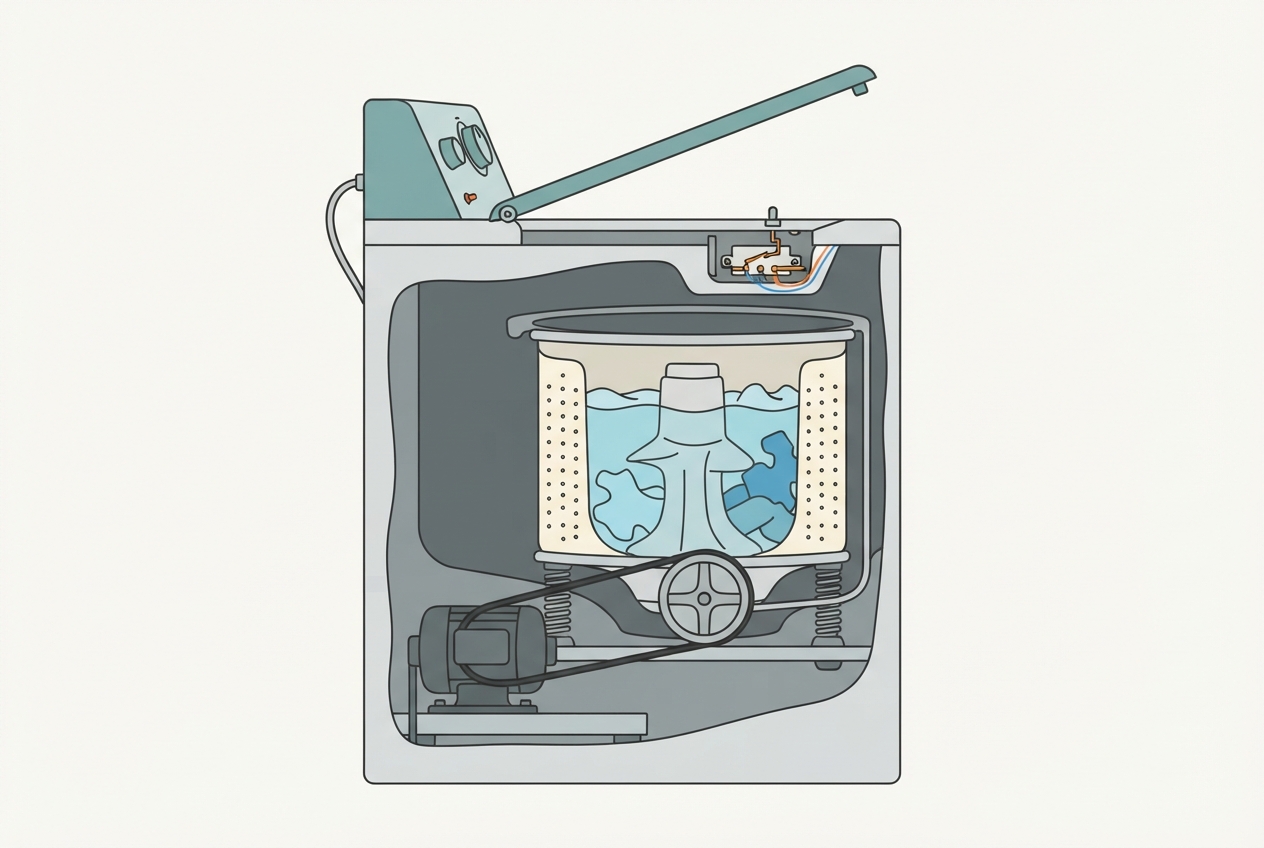
Most top-loading washers won't spin unless the lid switch is activated — it's a safety interlock that prevents the machine from spinning with the lid open. When the switch fails, the machine fills and agitates but stops before spinning.
Test: with the washer mid-cycle, manually press the lid switch tab with a pen. If the machine engages spin, the switch is the problem. A multimeter test (continuity when closed, open when open) confirms failure. Replacement lid switches run $10-20 and are typically one connector and two screws.
Drive belt failure
Belt-drive top-loaders (most older machines) use a belt to connect the motor to the transmission and pump. When the belt breaks, the motor runs but the drum doesn't spin — you hear the motor humming with no drum movement. Access through the back panel. Inspect the belt for breaks, fraying, or slippage off the pulleys. Replacement belts cost $8-15.
Motor coupling failure
Direct-drive washers (common on Whirlpool/Maytag machines made since the 1990s) use a motor coupling instead of a belt. The coupling is a sacrificial plastic piece designed to break under overload rather than letting the motor fail. Symptoms: motor runs, no drum movement, plastic debris in the bottom of the machine. Replacement couplings run $10-15 and require removing the cabinet to access.
Front-loader: drain issue causing no-spin
Front-loaders often won't spin if they can't drain — the flood-lock prevents high-speed spin with water in the drum. If the machine isn't spinning AND there's water in the drum, diagnose the drain first: check the pump filter, drain hose, and pump. Once drained, the spin should re-engage.
Universal and model-specific lid switches. Match to your washer.
Check Price on Amazon →As an Amazon Associate, FixForge earns from qualifying purchases.
Replacement belt for belt-drive top-load washers. Verify fit.
Check Price on Amazon →As an Amazon Associate, FixForge earns from qualifying purchases.
For Whirlpool/Maytag direct drive washers. Includes coupling halves.
Check Price on Amazon →As an Amazon Associate, FixForge earns from qualifying purchases.
Frequently asked questions
My washer spins but clothes are still very wet. Is the spin working?
Yes, but at reduced efficiency. A slow spin (motor issue, belt slipping, load imbalance) removes less water. Also check spin speed settings — some cycles use lower spin speeds intentionally. Run a dedicated Spin Only cycle at maximum speed to isolate whether the spin itself is working at full capacity.
The washer fills and agitates but stops when it should spin. What's wrong?
This is the classic lid switch failure pattern on top-loaders. The machine proceeds through wash but halts at the transition to spin. Test the lid switch by manually activating it — if the machine spins with the switch pressed, replace the switch.
Can I bypass the lid switch to test?
Temporarily yes — jumping the switch terminals will allow spin without the lid closed. This is for diagnosis only, not operation. Running the machine with a bypassed lid switch is dangerous — the open drum at 800+ RPM is a serious injury risk.
Related guides
Last updated June 2, 2026. Repair procedures and part prices verified against manufacturer documentation and current market pricing. Confirm prices at time of purchase.