FixForge › Appliance › Oven Not Heating
Oven Not Heating
An oven that won't heat at all — broil works but bake doesn't, or the oven is completely dead — is usually a failed bake element on electric ovens ($20-50) or a weak igniter on gas ovens ($15-35). Both are accessible DIY repairs with basic tools.
Last Updated: June 2026
Fast answer
Electric oven: inspect the bake element at the bottom of the oven interior. If it has a visible burn spot, crack, or blister, it has failed. Replace it — $20-50, 20 minutes. Gas oven: if the igniter glows but the oven doesn't light within 90 seconds, the igniter is too weak to open the gas valve. Replace the igniter ($15-35).
Visible burn hole or crack = failed. $20-50, 20 min DIY.
Glows but no flame in 90 sec = igniter too weak. $15-35 fix.
Off temperatures (too hot/cold) = sensor. Continuity test confirms.
Last resort. $80-200. Verify cheaper parts first.
Electric oven: bake element diagnosis
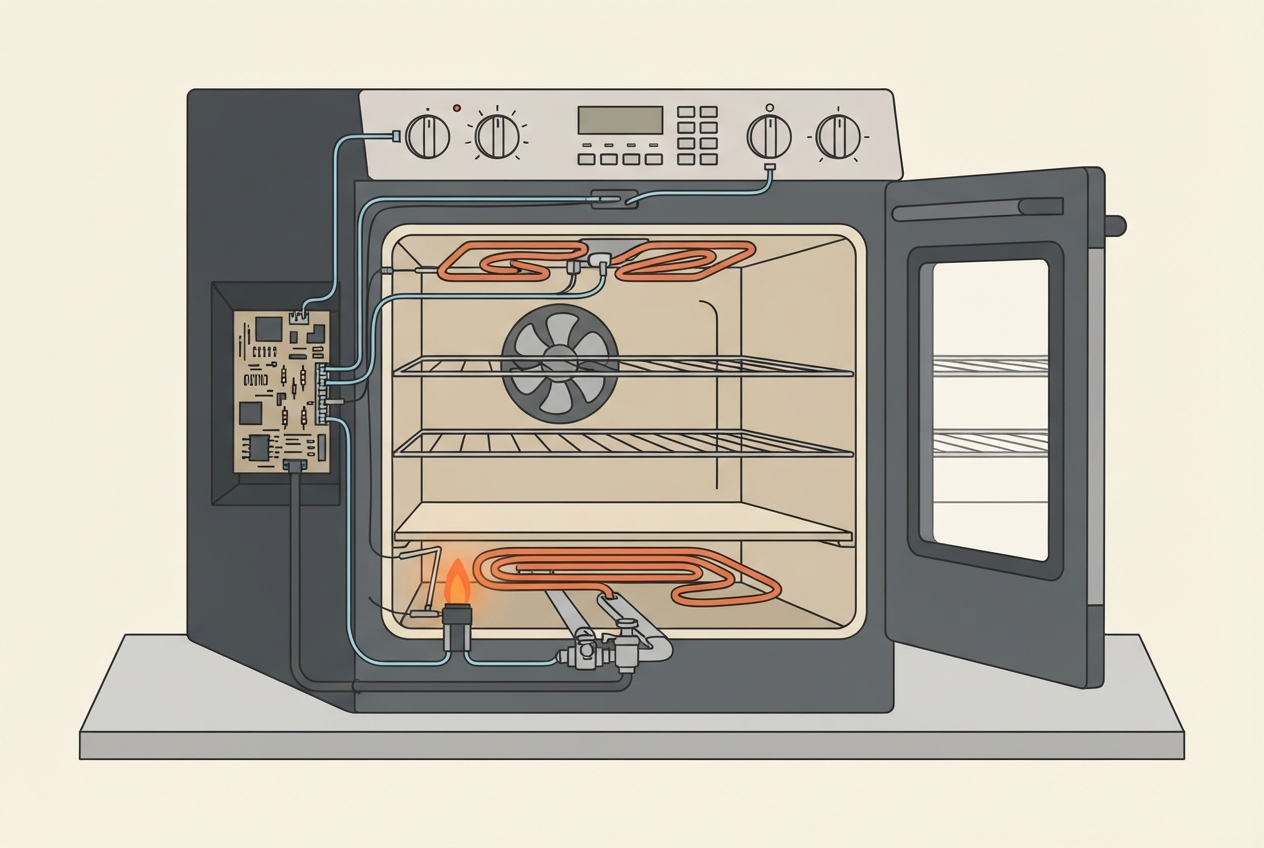
The bake element is the heating coil at the bottom of the oven cavity. It's the first thing to check because it's visible and failures are often obvious. Open the oven and look at the element:
- Visible burn hole, blister, or crack: Failed. Replace immediately — a burned element can arc and damage the oven interior.
- Looks intact but doesn't heat: Test with a multimeter. Set to ohms — a good element reads 20-60 ohms. An open circuit (infinite ohms) = failed internally.
Replacement: unplug the oven, remove the two mounting screws, pull the element forward, disconnect the two wire terminals, connect to new element, reverse. Takes 20 minutes. Match the wattage rating on your original element.
Electric oven: hidden bake element
Many modern ovens have a hidden bake element under the oven floor — you won't see it glowing. Access requires removing the oven floor panel (2-4 screws). Test the same way with a multimeter through the element's wiring harness connector.
Gas oven: igniter diagnosis
Gas oven igniters weaken over time — they still glow but don't reach the current threshold needed to open the gas safety valve. Watch the igniter when you turn the oven on: it should glow bright orange and the burner should light within 90 seconds. If it glows dim orange for 2+ minutes without lighting, the igniter is failing. If it doesn't glow at all, it's fully failed.
Replacement: disconnect power and gas, access the igniter through the oven bottom panel or storage drawer, disconnect the wiring harness, unscrew from the burner, install new igniter. Do not touch the new igniter ceramic with bare hands — skin oils cause hot spots. Use gloves or tissue paper.
Temperature sensor (both types)
If the oven heats but runs significantly hot or cold (more than 25°F off), the oven temperature sensor (RTD probe) may be drifting. It's a thin probe inside the oven cavity, usually at the top rear. Test with a multimeter: at room temperature (70°F) it should read approximately 1080-1100 ohms. Replace if outside range ($15-30).
Universal and model-specific bake elements. Enter oven model to confirm fit.
Check Price on Amazon →As an Amazon Associate, FixForge earns from qualifying purchases.
Flat igniter for most gas ranges. Verify compatibility with your model.
Check Price on Amazon →As an Amazon Associate, FixForge earns from qualifying purchases.
RTD probe sensor. Match to your oven model for accuracy.
Check Price on Amazon →As an Amazon Associate, FixForge earns from qualifying purchases.
Frequently asked questions
My oven broils but won't bake. What's wrong?
The broil element (top) works but the bake element (bottom) has failed. On electric ovens this is almost always the bake element — replace it. On gas ovens, separate burners aren't typical; the single burner serves both modes through different flame levels.
How do I know if it's the bake element or the control board?
If the bake element tests good on a multimeter (20-60 ohms, no open circuit), the issue is upstream — either the temperature sensor, a relay on the control board, or a wiring fault. Check the sensor next before assuming a board failure.
My oven heats but takes forever to reach temperature. Is this the element?
Slow preheating is usually a weak bake element (partially failed, still works but at reduced output), a failing igniter (gas), or a temperature sensor reading high (causing the oven to think it's hotter than it is and cycling off early). Test the element resistance — low ohms can indicate partial failure.
Related guides
Last updated June 2, 2026. Repair procedures and part prices verified against manufacturer documentation and current market pricing. Confirm prices at time of purchase.