FixForge › Appliance › Dishwasher Not Filling With Water
Dishwasher Not Filling With Water
A dishwasher that starts but never fills is almost always a failed water inlet valve ($15-30) or a stuck float switch. The inlet valve is a solenoid-operated valve that opens when the cycle starts — it fails in the closed position, blocking water entirely. The fix is straightforward and one of the most common dishwasher repairs.
Last Updated: June 2026
Fast answer
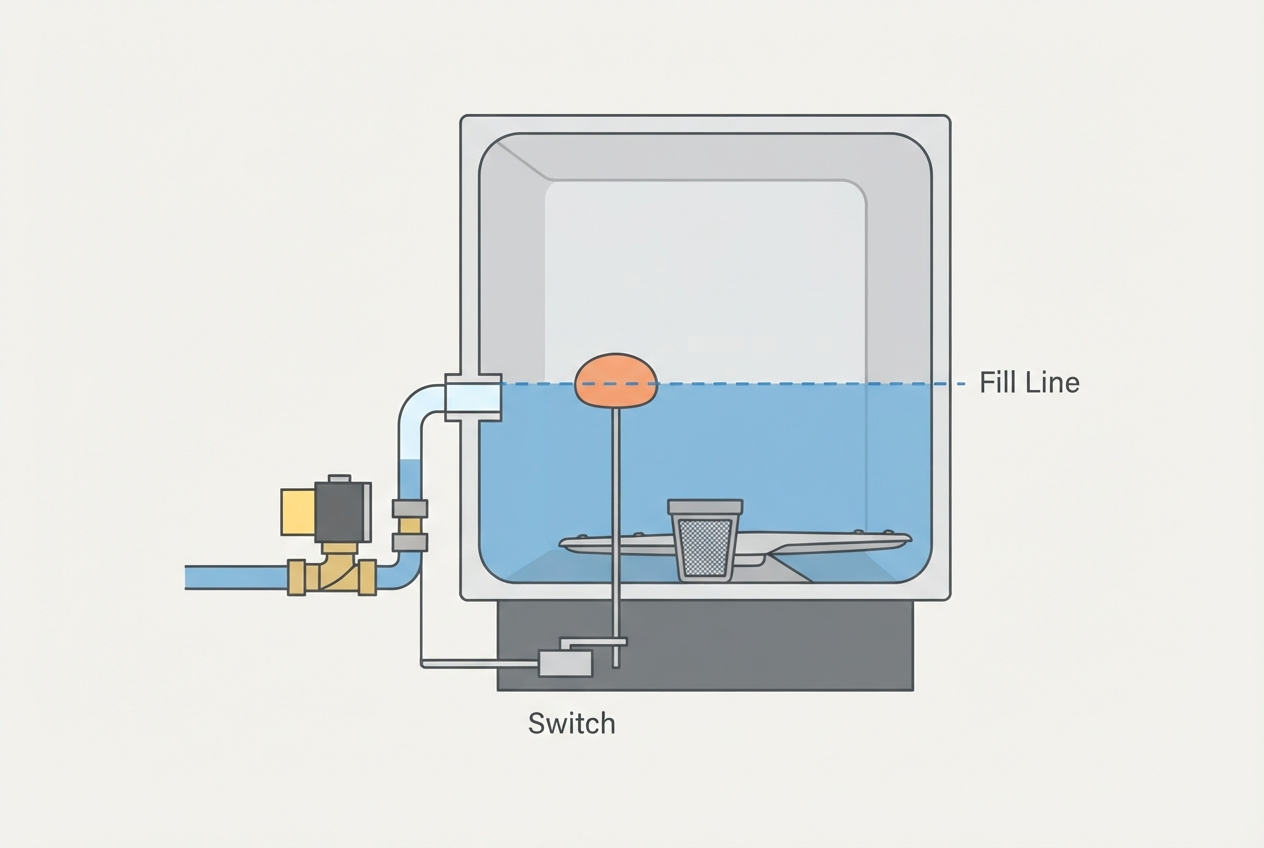
Check the float switch first — it's the small plastic dome or cylinder in the front corner of the dishwasher tub. Lift it by hand; if it's stuck in the up position, it tells the machine the tub is full and prevents filling. Clean or replace the float ($5-15). If float moves freely and the machine still won't fill, the water inlet valve has failed. Replace it ($15-30, 30-45 minutes).
Float stuck in raised position = machine thinks it's full. Lift, clean, test.
Most common cause. Solenoid fails closed = no water. $15-30 part.
Confirm shutoff valve under sink is fully open and supply line isn't kinked.
Some dishwashers won't fill if door latch sensor fails. Less common but check.
Step 1: Check the water supply
Before assuming a component failure, confirm water is reaching the dishwasher. Under the sink, the dishwasher supply line connects to a shutoff valve. Confirm it's fully open (handle parallel to pipe = open). Check the supply hose for kinks. This takes 60 seconds and occasionally solves the problem.
Step 2: Test the float switch
The float assembly is in the front corner of the dishwasher tub — a small plastic dome that rises with water level to prevent overfilling. If debris jams it in the up position, the machine's anti-flood circuit prevents filling. Manually lift the float — it should move freely up and down. If stuck, remove the float cap, clean the assembly, and test again. The float switch underneath ($5-15 to replace) can also fail electrically — test for continuity with a multimeter.
Step 3: Replace the water inlet valve
The inlet valve is located behind the lower access panel at the front of the dishwasher, connected to the supply line. Signs of inlet valve failure: machine starts cycle, motor runs, but you hear no water sound and tub remains dry. A functioning valve makes a distinct whooshing sound as water enters.
Replacement procedure:
- Turn off water supply under sink and unplug dishwasher (or trip the circuit breaker).
- Remove lower access panel (2-4 screws).
- Place towels — residual water in line will drip.
- Disconnect supply line from valve inlet (have a bowl ready).
- Disconnect drain hose from valve outlet.
- Unplug the wiring harness from the solenoid.
- Unscrew mounting bracket and remove valve.
- Install new valve in reverse order. Verify all connections are hand-tight + 1/4 turn.
- Restore water and power. Run a short cycle and watch for leaks at the supply connection.
Control board and wiring issues
Less commonly, a failed control board or damaged wiring harness prevents the signal from reaching the inlet valve. If the valve tests good (continuity on the solenoid coil) but still won't open, check for 120V at the valve harness during fill cycle. No voltage = control board or wiring issue, not the valve.
Universal and brand-specific options available. Match your model number.
Check Price on Amazon →As an Amazon Associate, FixForge earns from qualifying purchases.
Replacement float and switch kit. Check model compatibility.
Check Price on Amazon →As an Amazon Associate, FixForge earns from qualifying purchases.
Braided stainless, 6-foot. Standard 3/8" compression fittings.
Check Price on Amazon →As an Amazon Associate, FixForge earns from qualifying purchases.
Frequently asked questions
Can I run my dishwasher if it won't fill?
No — running a dishwasher dry can burn out the heating element and damage the pump. Don't run cycles until the fill problem is diagnosed.
How do I know if my inlet valve is bad?
The definitive test: disconnect the wiring harness from the valve and apply 120V directly (briefly, with the water supply on). If the valve opens, it's good — the signal from the control board is the problem. If it doesn't open, the valve solenoid has failed.
My dishwasher fills but drains immediately. Different problem?
Yes — that's a check valve or drain pump issue. The fill valve is working, but water exits before the cycle runs. Check the drain hose — if it drops below the drain connection under the sink without a high loop or air gap, water siphons out during fill.
Related guides
Last updated June 2, 2026. Repair procedures and part prices verified against manufacturer documentation and current market data. Prices may vary — confirm at time of purchase.