FixForge › Appliance › Dishwasher Leaving White Residue or Film on Dishes
Dishwasher Leaving White Residue or Film on Dishes
White film, cloudy glasses, or gritty residue on dishes after a dishwasher cycle is almost always caused by hard water mineral deposits, depleted rinse aid, or clogged spray arms. These are not signs of a broken dishwasher — they're maintenance issues. Most fixes cost nothing or under $15 and take 20 minutes.
Last Updated: June 2026
Fast answer
Check rinse aid level first — it prevents water from beading on dishes and leaving spots as it dries. If the dispenser is full, the water is likely hard (high mineral content). Run a hot water cycle with a cup of white vinegar on the top rack. If residue improves, add a water softener tablet or switch to a detergent with built-in rinse aid and water softener.
Most common cause of spotting. Refill and increase dispenser setting.
Mineral deposits on everything. Vinegar rinse or water softener additive.
Blocked jets = uneven wash = residue patches. Clean with toothpick.
Wrong detergent, too much, or old detergent can leave film. Verify type.
Step 1: Check and refill rinse aid
Rinse aid reduces the surface tension of water, causing it to sheet off dishes rather than bead. Beaded water evaporates and leaves mineral deposits — the white spots. The rinse aid dispenser is usually on the inside of the door next to the detergent cup. Fill it and run a test cycle. If your dishwasher has a dispenser setting (1-5), try increasing it by one level.
Step 2: Run a cleaning cycle with vinegar
Place a dishwasher-safe cup filled with 2 cups of white vinegar on the top rack. Run a hot water cycle with no detergent. Vinegar is acidic and dissolves calcium and magnesium mineral deposits. If the residue on your dishes is white and chalky, this is hard water — vinegar will help immediately.
For ongoing hard water treatment, use dishwasher detergent with citric acid or add a dishwasher cleaner/descaler tablet monthly.
Step 3: Clean the spray arms
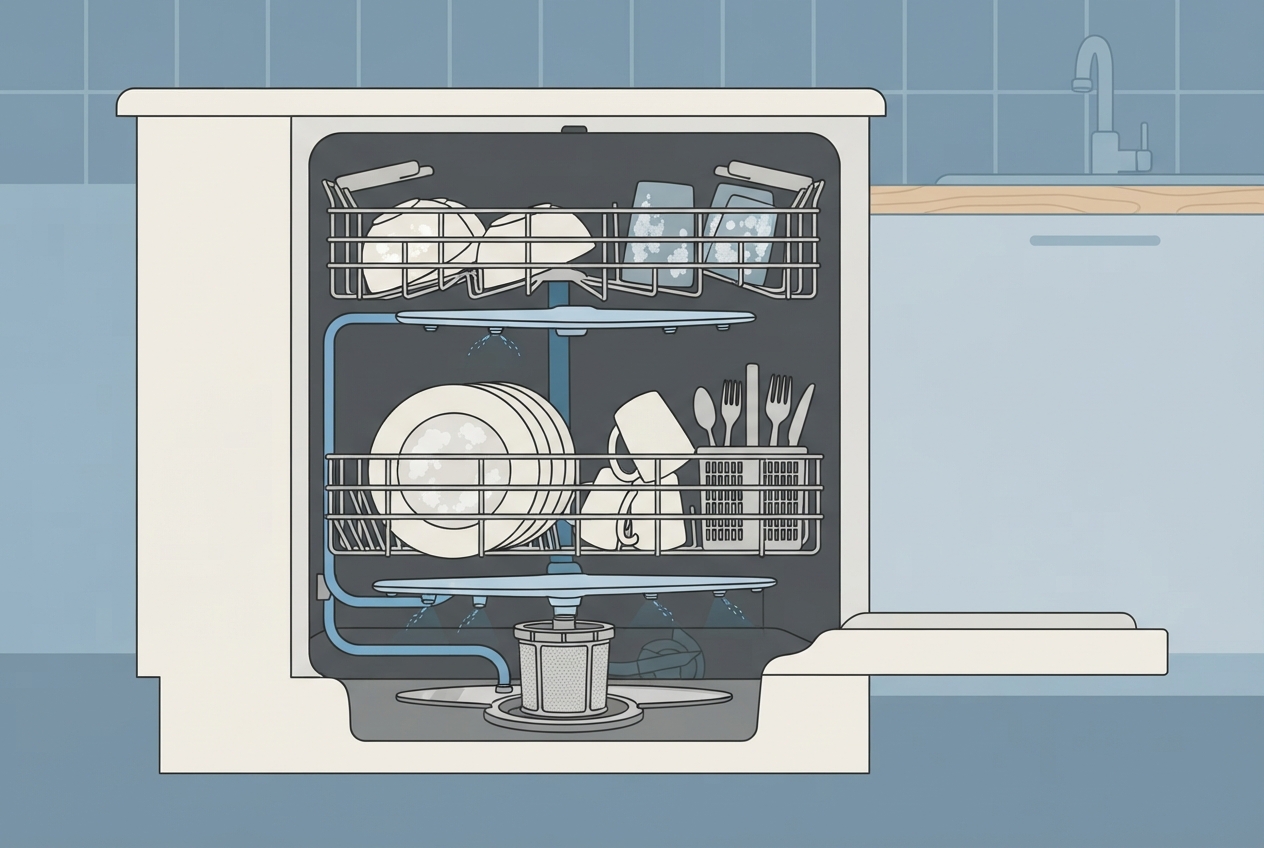
Both upper and lower spray arms have small jets that can clog with mineral deposits or food debris. Clogged jets create water pressure dead spots — areas of the dishwasher that don't get properly rinsed, leaving detergent or food residue on those dishes.
- Remove spray arms — usually unscrew counterclockwise or lift straight off a snap fitting.
- Use a toothpick or thin wire to clear each jet hole.
- Rinse under warm water.
- Soak in white vinegar for 20 minutes to dissolve mineral buildup inside the arm.
- Reinstall and run a test cycle.
Step 4: Check detergent
Using too much detergent leaves a soapy film, especially in soft water areas. Too little leaves food residue. Old or clumped detergent (especially powder type stored in humid environments) doesn't dissolve properly. Use fresh pods or gel, not old powder. Reduce the amount if you're in a soft water area.
Step 5: Clean the filter
Most modern dishwashers have a manual-clean filter at the bottom of the tub. A clogged filter recirculates dirty water, redepositing food particles on clean dishes as gritty residue. Remove the filter (twist counterclockwise), rinse under hot water, scrub with a soft brush, and reinstall. Clean monthly.
Finish Jet-Dry — fills the dispenser and lasts 150+ washes.
Check Price on Amazon →As an Amazon Associate, FixForge earns from qualifying purchases.
Monthly tablet removes mineral buildup from interior, spray arms, and filter.
Check Price on Amazon →As an Amazon Associate, FixForge earns from qualifying purchases.
Cascade Platinum — built-in rinse aid and hard water protection.
Check Price on Amazon →As an Amazon Associate, FixForge earns from qualifying purchases.
Frequently asked questions
Is white film on glassware the same as white spots on plates?
Glassware clouding can be either mineral deposits (wipes off with vinegar) or etching (permanent glass damage from excess heat/detergent). If the cloudiness doesn't wipe off with vinegar, the glass is etched — not a dishwasher malfunction but a sign of using too hot water or too much detergent with delicate glasses.
My dishwasher leaves brown residue. Is that different?
Brown residue is usually rust from hard water with high iron content, or rust from the dishwasher's interior if the coating is chipping. A rust-removing dishwasher additive treats iron-based deposits. Interior rust requires inspection — a rusting interior can damage dishes.
How hard is the water in my area?
Contact your local water utility — they publish annual water quality reports with hardness levels measured in grains per gallon (GPG) or milligrams per liter. Above 7 GPG is considered hard; above 10.5 GPG is very hard and will cause visible spotting without water softening treatment.
Related guides
Last updated June 2, 2026. Repair procedures and part prices verified against manufacturer documentation and current market data. Prices may vary — confirm at time of purchase.