FixForge › Appliance › Dishwasher Not Draining — Standing Water After Cycle
Dishwasher Not Draining — Standing Water After Cycle
Standing water in the dishwasher after a cycle is almost always a clogged filter, a blocked drain hose, or a garbage disposal knockout plug that was never removed during installation. These are free fixes. If all three check out, the drain pump ($25-50) has failed.
Last Updated: June 2026
Fast answer
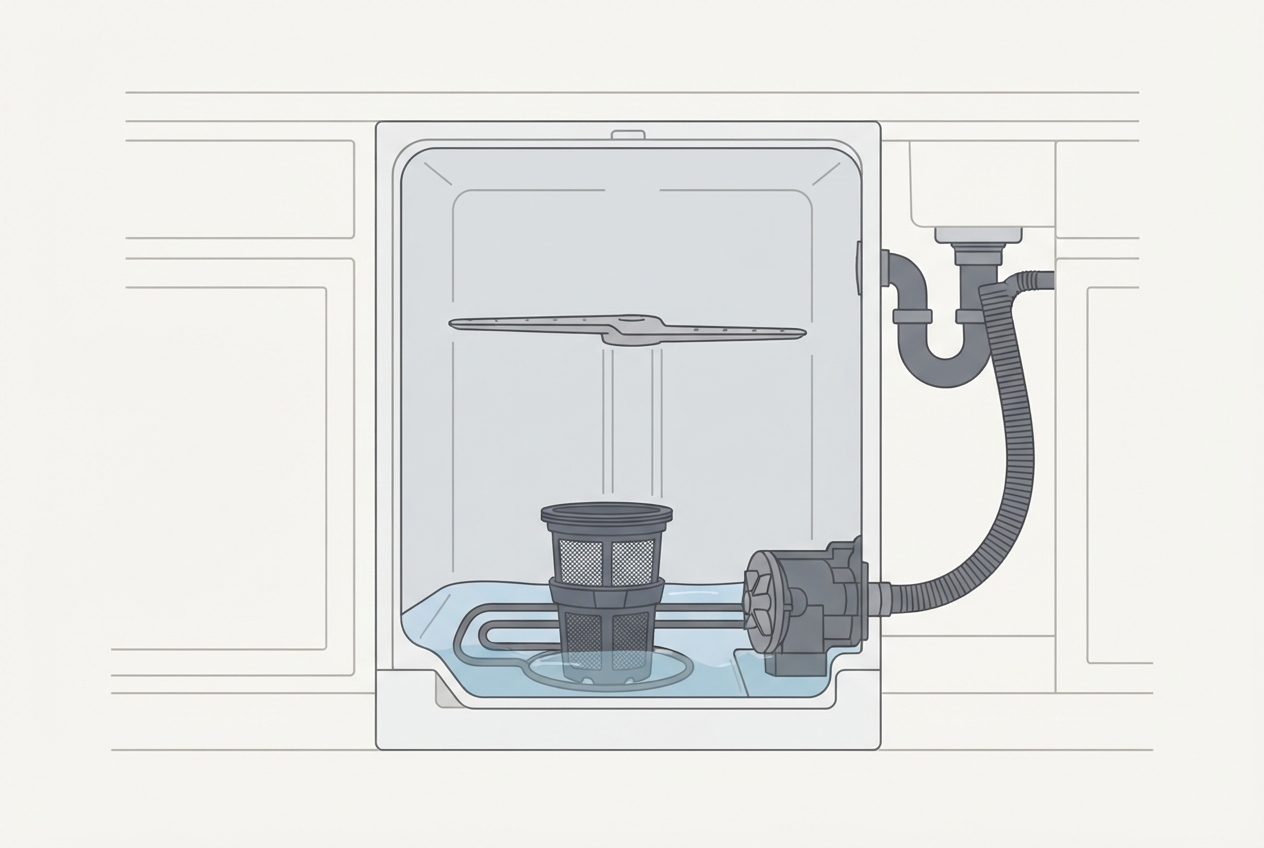
Check the filter first — located at the bottom of the dishwasher tub, it clogs with food debris and should be cleaned monthly. Second: if the dishwasher drains into a garbage disposal, confirm the knockout plug was removed during disposal installation. Third: check the drain hose under the sink for kinks.
Bottom tub filter clogs with food. Remove, rinse, reinstall. Free.
New disposal installs often leave knockout plug in — blocks drain.
Kinked or clogged hose under sink. Reposition or clear blockage.
If all above are clear, pump ($25-50) has failed. Moderate DIY.
Step 1: Clean the dishwasher filter
Most modern dishwashers have a manual-clean filter at the bottom of the tub — a cylindrical mesh filter that captures food particles. When clogged, water can't drain properly and backs up in the tub. This is the most common cause of standing water and costs nothing to fix.
- Remove the bottom rack.
- Locate the filter assembly at the bottom of the tub — twist counterclockwise and lift out.
- Rinse under hot running water, scrubbing with a soft brush to remove debris.
- Reinstall and run a cycle.
Clean the filter monthly to prevent recurrence.
Step 2: Check the garbage disposal knockout plug
If your dishwasher was recently installed alongside a new garbage disposal, a common installation mistake is leaving the drain knockout plug in the disposal inlet. This plug must be removed to allow dishwasher drainage. Remove the disposal, check the dishwasher inlet port — if the plug is still in place, knock it out with a screwdriver and pliers, then reinstall.
Step 3: Check the drain hose
The corrugated drain hose runs from the dishwasher pump to the garbage disposal or sink drain. Check under the sink for kinks. Also confirm the hose has a high loop — it should rise to the underside of the counter before connecting to the drain. Without a high loop or air gap, dirty water can siphon back into the dishwasher during the drain cycle.
Step 4: Replace the drain pump
If filter, disposal knockout, and drain hose all check out, the drain pump has failed. The pump is located beneath the dishwasher, accessed by removing the lower panel and possibly tilting the unit. The pump has a motor and impeller — if the motor hums but water doesn't move, the impeller is jammed or the pump has failed. Replacement pumps run $25-50 and take 1-2 hours to replace.
Model-specific drain pump assembly. Verify compatibility.
Check Price on Amazon →As an Amazon Associate, FixForge earns from qualifying purchases.
Monthly tablets prevent buildup in filter and drain path.
Check Price on Amazon →As an Amazon Associate, FixForge earns from qualifying purchases.
Universal extension for repositioning or replacing kinked drain hose.
Check Price on Amazon →As an Amazon Associate, FixForge earns from qualifying purchases.
Frequently asked questions
There's 1-2 inches of water in my dishwasher — is that normal?
A small amount of water (less than 1 inch) in the bottom of the dishwasher is normal — it keeps the door gasket from drying out and cracking. If it's more than 1-2 inches, or the water is dirty, the drain isn't completing properly.
My dishwasher drains but slowly. Different problem?
Slow draining is usually a partial filter clog or a partially kinked drain hose. Clean the filter first. If it still drains slowly after cleaning, check the hose and check that the air gap (if installed) isn't clogged.
My dishwasher just started not draining after years of working fine. What changed?
Sudden onset usually means a filter clog (if you haven't been cleaning it) or a drain pump that has finally failed. Check the filter first — if it's severely clogged, that's your answer. If the filter is clean, the pump has reached end of life.
Related guides
Last updated June 2, 2026. Repair procedures and part prices verified against manufacturer documentation and current market pricing. Confirm prices at time of purchase.