FixForge › Vintage › Outboard Carburetor Cleaning
Vintage Outboard Motor Carburetor Cleaning
Stale fuel is the number-one reason a vintage outboard won't start or dies at idle. Varnish from evaporated gasoline coats the jets and needle valve seat, cutting off fuel flow. Most vintage carburetors can be returned to service in under two hours with a $8 can of carb cleaner — but knowing when to clean vs rebuild determines whether you fix it once or twice.
Last Updated: May 2026
Fast answer for an outboard that cranks but won't start
If the motor sat over winter: drain the float bowl first (screw on the bottom of the carb bowl), then spray carb cleaner into the float bowl drain and through the main jet passage. If it starts after that and runs rough at idle, the pilot jet is also partially blocked — pull and spray it separately. If the bowl shows heavy varnish, rust, or a white mineral crust, buy a rebuild kit ($15-25) and replace the gaskets, needle valve, and jets all at once. Carb cleaner alone won't fix a compromised needle valve seat.
Cleaning fixes 70% of vintage carb problems. Rebuild kits handle the rest.
Remove the float bowl drain screw before pulling the carb — saves spillage and shows you what you're dealing with.
Wire enlarges the orifice permanently and ruins the fuel mixture. Carb cleaner + compressed air only.
Starts fine but dies at idle? The pilot jet, not the main jet, is usually the culprit.
Clean vs rebuild: how to decide before you start
Opening the float bowl tells you almost everything you need to know. If the fuel inside is amber-colored with a slight varnish smell and there's a thin yellow film on the bowl walls, a cleaning pass will likely restore full function. If the fuel is dark brown or black, there's a jelly-like gum deposit on the bottom, or you see rust particles or a white mineral crust anywhere inside, plan on a rebuild kit.
The other deciding factor is the needle valve. This is the small brass pin with a rubber tip that seals the fuel inlet when the float rises to a set level. The rubber tip develops a circular groove or flat spot from years of seating pressure. A grooved needle valve leaks fuel past the seat even when the float is up, flooding the engine and making it run rich or overflow. No amount of cleaning fixes a worn needle tip — it has to be replaced. Rebuild kits always include a new needle valve; this alone makes kits worth buying when the motor has been sitting more than 3-4 years.
What you need before starting
Tools: flathead screwdrivers (multiple sizes — jets use very small heads), Phillips screwdriver, needle-nose pliers, small open-end wrenches (10mm and 12mm cover most vintage outboards), and a small parts tray or egg carton to keep jets and screws organized. Carb parts are tiny and a single lost pilot jet can stop the job.
Supplies: aerosol carburetor cleaner ($8-12), compressed air (a can of electronics duster works if you don't have a compressor), new gaskets or a full rebuild kit if the float bowl inspection warrants it, and a clean rag. Have fresh fuel ready for the test start — don't refill with the stale fuel you drained.
Step 1: Drain the float bowl before anything else
Before removing the carburetor, locate the float bowl drain screw. On most vintage outboards (Johnson, Evinrude, Mercury, Yamaha) this is a brass flathead screw on the lowest point of the float bowl. Place a rag or small container underneath and remove the screw one full turn. Fuel drains out. Examine it: color, smell, and any visible particles tell you the rebuild decision before you've done any disassembly. Reinstall the drain screw finger-tight.
Draining first matters because carb removal inevitably tilts the unit, and a full float bowl spills fuel into the engine compartment. It also prevents fuel from washing away the varnish you want to examine in place.
Disassembly sequence
- Remove the engine cover and air filter housing. Most vintage motors use a snap-on or two-screw air filter box. Set the filter aside — a clogged air filter can mimic carburetor symptoms, so inspect it while you have it out. If it's saturated with oil or visibly blocked, replace it ($5-15).
- Photograph the throttle linkage before touching anything. Vintage outboard throttle, choke, and governor linkage can be complex with multiple rods, springs, and clips. A photograph from two angles takes 30 seconds and eliminates reassembly guessing. Do this every time, even if you've done it before.
- Disconnect the throttle linkage. Throttle rods typically clip into a small hole in the throttle arm with a C-clip or bend in the rod. Use needle-nose pliers to unhook rods from their mounting points. Choke linkage disconnects the same way. Keep all clips and springs in your parts tray immediately.
- Clamp and disconnect the fuel line. Use a fuel line clamp or fold and pinch the line to prevent flow, then pull the fuel line fitting off the carburetor inlet. Some vintage motors have a barbed fitting that requires a gentle twisting pull; others use a threaded fitting. Have a rag ready for residual fuel in the line.
- Remove the carburetor mounting fasteners. Most vintage carbs mount with two nuts on studs coming off the intake manifold, though some use four bolts. Remove the nuts and pull the carb straight off the studs. The mounting gasket may stick to either the carb or the manifold — peel it off and note its condition (a torn or compressed mounting gasket causes air leaks that mimic carb problems).
Inside the carburetor: what each part does and what failure looks like
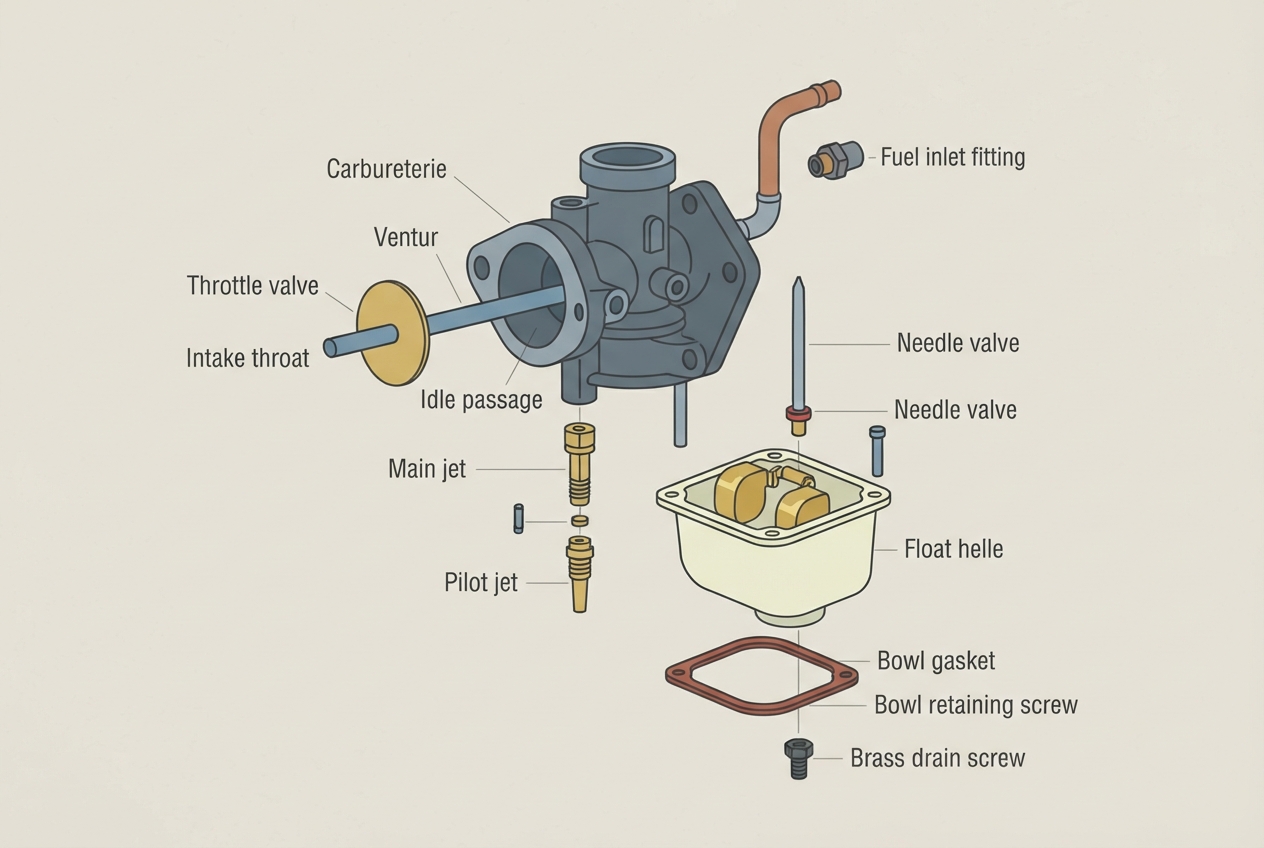
With the carb on your workbench, remove the float bowl (usually 1-4 screws on the bowl flange). Tilt the carb to examine the inside of the bowl under good light. You should see:
- The float: a hollow brass or plastic pontoon hinged at one end. Check for cracks (fuel inside a hollow float makes it sink and flood the engine). Shake the float — liquid inside means replace it. Brass floats can sometimes be soldered; plastic floats must be replaced.
- The needle valve: attached to the float via a small clip or hinge pin. Pull the float and needle valve out together. The rubber tip should be smooth and conical. A groove, flat spot, or hardened/cracked tip means replace.
- The main jet: a brass hex-head screw with a precisely drilled hole, threaded into the bottom center of the carb body. Use the correct-size flathead (usually quite small). Remove it and hold it to light — a clean, round hole is good. Varnish appears as a brownish film partially or fully closing the hole.
- The pilot (idle) jet: a smaller brass jet near the main jet, often recessed. Some vintage carbs use a fixed pilot jet; others use an adjustable pilot air/fuel screw instead. Remove and inspect separately.
- Passages and galleries: with jets removed, spray carb cleaner into every visible hole and passage in the carb body. Watch the cleaner emerge from each corresponding port — a blocked passage shows no exit flow.
What a clogged jet looks like and how to safely clear it
A clogged main jet viewed against light shows either no light passing through (fully blocked) or a distorted, partially shadowed hole (partially blocked with varnish skin). The varnish is a brownish-yellow lacquer that formed as the volatile compounds in gasoline evaporated and the resins polymerized on the jet walls.
The correct cleaning technique: spray carb cleaner directly into the jet orifice and let it soak for 2-3 minutes. Then apply compressed air from a can, directing it through the jet from the fuel-inlet side (the same direction fuel normally flows). Repeat the spray-and-air cycle 2-3 times. Hold the jet to light again after each cycle to verify progress. A fully clear jet shows a crisp, uniformly round hole.
What you must not do: push wire, a toothpick, or any solid object through the jet. The orifice is precision-drilled to a specific diameter that determines the air/fuel ratio. Enlarging it even slightly causes an overly rich mixture across the entire RPM range — the motor will run but consume more fuel, idle roughly, and foul plugs. If carb cleaner and air won't clear a jet after three cycles, buy a new jet (usually $3-8, available from outboard dealers and online) rather than risking the orifice.
Carb cleaner spray technique for passages
Aerosol carb cleaner has a thin straw nozzle for directing spray into specific orifices. With jets removed, spray into: the main jet hole in the carb floor (watch for cleaner to exit the emulsion tube above it), the pilot circuit passage (usually a small hole near the pilot jet boss), the idle mixture screw port, the throttle bore above and below the throttle plate, and the choke bore. After soaking 2-3 minutes, follow with compressed air in the same direction as fuel or air normally flows. For heavily varnished carbs, repeat twice and consider a full carb-cleaner bath — a wide-mouth glass jar with carburetor cleaner solution, soaking for 1-4 hours, is more effective than spray for severe deposits.
Needle valve inspection
The needle valve is the single most important wear item in a vintage carburetor. It controls fuel inlet flow and prevents the float bowl from overfilling. The rubber tip seals against a brass seat pressed into the carb body (or on some vintage motors, the seat is part of the removable needle valve assembly).
Inspection: examine the rubber tip under good light. A serviceable tip is smooth, conical, and resilient (slight finger pressure returns to shape). A worn tip shows a visible circular groove where it contacted the seat, or has hardened and lost its resilience (doesn't spring back when pressed). The seat itself can also wear or develop a groove — run your fingernail across it. Any detectable groove in the seat means the full needle valve and seat assembly must be replaced, because even a new needle tip won't seal against a grooved seat.
Rebuild kits include a new needle valve; many also include a new seat. If your kit doesn't include a seat and the old seat is damaged, source one separately. Installing a new needle valve against a worn seat is a common reason a rebuild fails to fix the flooding problem.
Reassembly order
- Install the needle valve seat if replacing (press in with a blunt dowel or the back of a screwdriver handle, ensuring it seats fully and squarely).
- Thread in the main jet and pilot jet finger-tight, then snug with a screwdriver. Do not overtighten — these are soft brass and the threads strip easily. Snug means stopped, not forced.
- Set the pilot air/fuel screw (if your carb has one): thread it in gently until it seats, count the turns, back it out 1.5 turns as a baseline. Fine-tune at idle later.
- Install the needle valve and float. The needle valve clips onto the float tang; the float hinge pin slides into the carb body bosses. With the carb inverted, the float should sit roughly parallel to the carb mounting flange — use the spec from your service manual if available, or aim for 15-17mm from the carb gasket surface to the highest point of the float.
- Install a new float bowl gasket (included in rebuild kits; dry fit only, no sealant unless the instructions say otherwise). Thread on the bowl screws evenly in a cross pattern.
- Remount the carburetor using a new mounting gasket. Hand-tighten the mounting nuts, then snug evenly. Over-tightening warps the carb body on aluminum manifolds.
- Reconnect the fuel line and remove any clamp or pinch you applied.
- Reconnect the throttle and choke linkage using your photographs as reference. Verify the throttle plate opens fully when the throttle is advanced and the choke plate closes completely when engaged.
- Install the air filter and cover.
Testing after reassembly
Fill the tank with fresh fuel. Connect a flush muffs to a garden hose if testing on land. Prime the fuel bulb (if the motor has one) until firm. Set choke to full closed if cold. Crank — the motor should start within 3-5 pulls on a freshly cleaned carb with proper fuel flow. If it starts and runs, advance the throttle gradually. Look for smooth acceleration with no stumble. An idle stumble means the pilot circuit still has a partial blockage or the pilot screw needs adjustment. Let the motor warm up 3-5 minutes, then adjust the pilot screw in 1/8-turn increments toward the highest stable idle RPM.
If the motor floods immediately (fuel streaming from the carb throat), the needle valve is still not sealing — the needle tip, seat, or float height is wrong. Shut down and reinspect.
2026 cost reference
| Item | Typical 2026 cost | Notes |
|---|---|---|
| Aerosol carburetor cleaner (12 oz) | $8-12 | Gumout, Berryman B-12, or CRC are all effective. Avoid cheap off-brand; the solvents matter. |
| Carburetor rebuild kit (brand-specific) | $15-30 | Includes gaskets, needle valve, sometimes jets. Order by motor make, model, and year. |
| Complete replacement carburetor (aftermarket) | $25-60 | For motors where the carb body itself is cracked or warped. Quality varies by source. |
| Float bowl gasket only | $3-8 | If float bowl gasket is the only failure. Check local marine dealer for immediate availability. |
| Air filter replacement | $5-15 | Replace if oil-saturated. A blocked filter causes rich running independent of carb condition. |
| Professional carb clean (marine shop) | $80-150 | Labor-intensive; shops charge 1-2 hours flat-rate. Usually includes bench test but not reinstall. |
| Professional carb rebuild + install | $150-300 | Full shop job including parts, labor, and test run. |
When to stop and get professional help
Carb cleaning is well within DIY scope for most people. Where it gets harder: if the throttle plate shaft is worn and wobbles (causes an air leak that no cleaning fixes), if the carb body itself is cracked (common on old zinc-alloy bodies that corrode from the inside), or if there are multiple carburetors to synchronize (some vintage outboards have two or three carbs that must be synchronized for smooth running). If you've rebuilt the carb twice and the motor still floods or won't idle, the problem is likely elsewhere — compression, ignition, or the choke circuit — rather than the carb itself.
Search by motor make, model, and year. Kits include gaskets, needle valve, and main jet.
Check Price on Amazon →As an Amazon Associate, FixForge earns from qualifying purchases.