FixForge › Vintage › Hand Plane Restoration
Vintage Hand Plane Restoration
A rusty Stanley or Record hand plane from a garage sale is often a better tool than a new budget plane — cast iron body, thick blade, and 80 years of proven geometry. Restoration takes an afternoon to a weekend depending on rust severity. The result is a plane that planes better than most new tools costing $80-150, at a total cost of $10-40 in supplies.
Last Updated: May 2026
Before you start: grade the rust to know what you're dealing with
Grade 1 (surface rust, no pitting): full restoration candidate, all methods work, expect a clean user-grade result. Grade 2 (moderate rust, very light pitting on non-critical surfaces): still a strong candidate, citric acid soak plus abrasive work on the sole and blade. Grade 3 (significant pitting on the sole): functional restoration possible if the mouth area and frog seat are intact — pitting in the center of the sole doesn't affect planing. Grade 4 (severe pitting compromising mouth geometry or frog seat): not worth restoring unless it's a rare type; use as a parts donor. Flip the plane and look at the sole under raking light before buying or starting work.
Overnight soak removes rust without electrolysis setup. Cheaper and cleaner than most alternatives.
Toe, heel, and both sides of mouth. Center concavity is acceptable and common.
25° primary bevel, 5° microbevel at 30° for a usable working edge fast.
Move frog forward to tighten mouth (smoother finish). Back for thicker shavings.
Condition assessment: rust grades 1 through 4
Rust assessment before you spend time (or money) on a plane determines whether you end up with a great tool or a frustrating waste of an afternoon. Examine the plane under bright directional light, looking specifically at four areas:
- Grade 1 — Surface rust: Red-orange film on the metal surface, no pitting. Wipes off with oil and steel wool or dissolves overnight in citric acid. The plane underneath is fully intact. This is the best garage sale find category.
- Grade 2 — Moderate rust with light pitting: Surface rust plus shallow pits (you can feel them with a fingernail but they're not deep enough to catch). The sole may need lapping; the blade may have minor pitting near the edge. Still a strong restoration candidate, especially for a bench plane rather than a smoother.
- Grade 3 — Significant pitting, non-critical areas: Deep pits on the body sides, tote boss, or center of the sole, but the mouth area, frog seat, and blade back are intact. The plane functions fully; the pits are cosmetic and structural on low-stress areas. Common in planes stored in damp conditions. Worth restoring; just don't expect a mirror finish on the body.
- Grade 4 — Severe pitting, critical areas affected: Pitting in the frog seat prevents a solid frog mounting (the blade chatters). Pitting at the mouth edges affects chip clearance. Pitting on the blade back means you can't flatten it without grinding past usable thickness. At this point, use it as a parts donor for another restoration project.
Also check: is the tote (rear handle) cracked or broken? Cracked totes are common and most can be glued; fully broken-off totes need replacement. Is the frog (the angled casting the blade sits on) intact with no cracks? Is the lateral adjustment lever present and functional? These parts matter and are increasingly hard to find for some models.
Full disassembly
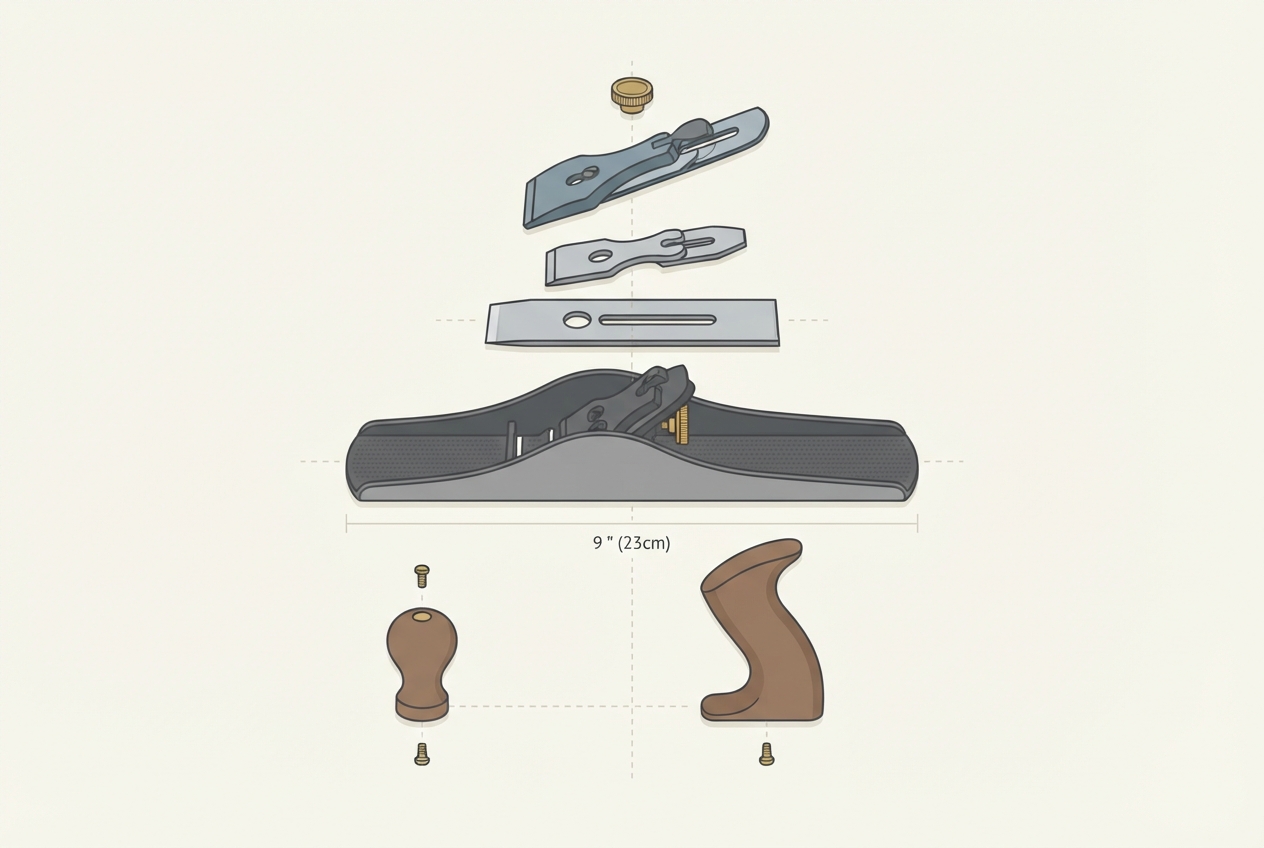
Hand planes disassemble in a consistent order regardless of manufacturer. Take photos before removing anything — especially the frog position relative to the mouth opening, so you can return it to approximately the right position after cleaning.
- Remove the lever cap. The lever cap is the clamping piece that holds the blade assembly in the plane body. On Stanley-pattern planes, flip the cam lever up (the lever attached to the lever cap) and lift the cap off its hook. Some older patterns require loosening a central thumb screw first.
- Remove the blade and chipbreaker as a unit. Lift straight up. The two come out together, held by the chipbreaker screw.
- Separate the blade and chipbreaker. The chipbreaker screw is a large flathead screw on the top face of the chipbreaker. Loosen it (do not remove completely), rotate the chipbreaker 90 degrees, and slide it off the slot in the blade. Keep the chipbreaker screw with the chipbreaker.
- Remove the frog. The frog is secured by two screws accessible through the plane body from below or behind, depending on the type. On Bailey-pattern Stanleys (most common), there are two large screws on the back of the frog base that thread into the plane body. Remove both. The frog lifts straight out. Note: the frog adjustment screw (if present, on Types 11 and later) is separate from the mounting screws.
- Remove the tote (rear handle). A long bolt threads up through the plane body into the tote. Access the bolt head from the bottom of the plane and unscrew. The tote lifts off. If it's cracked, the bolt tension was probably holding it together — now is when it falls apart. Keep all pieces.
- Remove the knob (front handle). Similar to the tote: a bolt threads through the knob mounting boss. Unscrew from below. The knob lifts off.
You now have a pile of separate metal parts (body, frog, lever cap, blade, chipbreaker) and wooden parts (tote, knob). Metal parts go into the rust removal process. Wooden parts get cleaned and oiled separately.
Rust removal: electrolysis vs citric acid vs abrasives — honest comparison
Three methods work. Each has real trade-offs that determine which is right for your situation.
Citric acid soak
The best all-around choice for most hand plane restorations. Mix citric acid powder (sold as a food preservative or cleaning agent, $8-15 for a pound) in warm water at roughly 1 tablespoon per cup of water. Submerge all metal parts. Leave overnight (8-12 hours) for Grade 1-2 rust; up to 24-36 hours for Grade 3. The acid converts iron oxide back to iron and dissolves the rust layer without attacking the underlying metal significantly if you don't over-soak.
After soaking: remove parts, scrub with a brass or nylon brush (not steel — it leaves particles), rinse thoroughly with water, and dry immediately with a heat gun or in a warm oven for a few minutes. Citric acid leaves a clean, gray metal surface without black residue. Apply oil or paste wax immediately after drying to prevent flash rust, which starts forming within minutes on freshly cleaned iron.
Downsides: takes time (overnight), and if you leave parts in too long (48+ hours), the acid starts attacking good metal. Works well, inexpensive, no electrical setup required.
Electrolysis
Faster on heavily rusted parts but requires setup: a plastic tub, washing soda (sodium carbonate, not baking soda), a battery charger, and a sacrificial steel electrode (rebar or steel bar works). The rusty part connects to the negative terminal; the electrode to positive. Current flows through the solution and electrochemically removes rust from the part onto the electrode.
Works in 2-6 hours vs overnight for citric acid. But: produces a black magnetite coating on the part that requires wire brushing or abrasives to remove, produces hydrogen gas (ventilate the work area), and the setup takes 20-30 minutes to assemble. For a big batch of rusted parts or very heavy rust, the speed advantage matters. For a single plane, citric acid is simpler.
Abrasives (sandpaper, wire wheel, evaporust + abrasive)
Best for light surface rust on small areas or for touch-up work between soaking steps. 80-grit sandpaper on a flat surface removes surface rust quickly. A wire wheel on a bench grinder is fast but aggressive and can remove material unevenly — avoid on the sole and blade if you care about flatness. Evaporust (a chelating solution) is effective and safe but expensive ($20+ per gallon) and slow for heavy rust.
For most restorations: citric acid soak for the body and frog, abrasive work for the blade back and bevel (where you want controlled material removal anyway for sharpening prep).
Flattening the sole
The sole must be flat at four contact points: the toe (front), the heel (back), and the two areas flanking the mouth opening. The center of the sole can have a slight concavity — this is common from manufacturing variation and doesn't affect performance. What you cannot have is convexity (a high center), which causes the plane to rock, or a twist (different heights at the four corners), which makes it impossible to produce flat surfaces.
How to check: place a reliable straight-edge across the sole in multiple directions — lengthwise, diagonal toe-to-heel on each side, and across the width at the mouth. Hold up to light. A gap between straight-edge and sole shows low spots (fine); consistent contact shows high spots that need lapping.
Lapping procedure: adhere 80-grit sandpaper to a known-flat reference surface. A 12x12 granite tile ($8 at hardware stores) is ideal; a quality piece of float glass works. Lay the sandpaper abrasive-side up. With the blade and frog installed in the plane (tighten the plane to working tension to replicate real stress on the casting), work the sole on the sandpaper using long strokes covering the full length. Check progress with marker: shade the sole with a permanent marker, take a few strokes, and see where the marker has worn away. High spots wear first; low spots retain marker. Keep working until the four contact points all show consistent material removal. Progress to 150-grit, then 220-grit to reduce the scratch pattern. You don't need a mirror finish on the sole — 220-grit is adequate for a working plane.
Lapping can take 20 minutes for a lightly out-of-flat sole or 2-3 hours for a significantly warped casting. Cast iron is hard; work patiently.
Sharpening the blade: grinding, honing, stropping
The blade is the most important part to get right. A correctly sharpened blade makes the difference between a plane that effortlessly takes tissue-thin shavings and one that chatters and tears the grain.
Step 1: Flatten the blade back
The back of the blade (the flat face) must be flat for the first inch or so from the cutting edge. Work the back on your flat reference surface with 80-grit, then 220-grit, then your finest stone. You're not trying to flatten the entire back — just establish a flat surface at the edge. This step is called "back-preparation" and only needs to be done thoroughly once on a new-to-you blade; subsequent sharpenings only require a light pass on the back.
Step 2: Grind the primary bevel
If the bevel is badly pitted, rounded over, or at the wrong angle, start with a bench grinder (use a friable white aluminum oxide wheel, not the gray wheels that come with most budget grinders — gray wheels overheat blades). Grind to a 25-degree primary bevel. A honing guide makes this consistent; freehand is faster once you have the feel. Grind until you get a wire edge (a slight burr that curls over onto the back face) across the full width — this confirms you've ground to the cutting edge. Cool the blade frequently in water — discoloration (blue/purple) means you've drawn the temper and softened the steel at that spot.
Step 3: Hone on progressively finer stones
Starting at 1000-grit (or 400-grit if skipping the grinder), hone the bevel at 30 degrees (25-degree primary + a slight 5-degree microbevel lift). The microbevel means you're only honing a tiny strip at the very tip, which takes much less time than honing the full bevel. Progress through 1000, 4000, and 8000 grit. At each stage, take a flat pass on the blade back to remove the wire edge that forms. You'll feel the burr with your thumb — a slight roughness on the back that flips sides as you alternate between bevel and back.
Step 4: Strop on leather
A leather strop charged with green chromium oxide compound adds a final polish and removes the last wire edge. 10-15 strokes bevel-down (leading with the spine, not the edge, to avoid cutting the strop), then 5 strokes flat on the back. Test on the back of your hand: the blade should shave arm hair effortlessly. If it doesn't, go back to 4000 or 8000 grit and strop again.
Tuning the frog
The frog is the angled casting that the blade sits on. Its position controls the mouth opening — the gap between the front of the blade and the front of the mouth in the sole. Mouth gap affects how the plane handles tear-out:
- Tight mouth (small gap): The chip is bent back sharply before it can tear into the wood ahead of the cut. Better for smoothing planes used on figured or difficult grain. Achieved by moving the frog forward (toward the toe).
- Open mouth (larger gap): More clearance for the chip. Better for bench planes doing aggressive material removal where a tight mouth would clog. Achieved by moving the frog back (toward the heel).
To adjust: loosen the two frog mounting screws slightly (don't remove), turn the frog adjustment screw (if present) or tap the frog into position, retighten. With the blade installed and plane assembled, sight down the sole to see the mouth gap. For a No.4 smoother on hardwood: aim for a gap you can barely see light through. For a No.5 jack plane removing material: a 1/32"-1/16" gap is fine.
Also check: the frog face (where the blade back rests) should have consistent contact with the blade across its full width. Rock the blade gently on the frog — any movement indicates a high spot on the frog face or a warped blade. High spots on cast iron can be carefully filed; a warped blade is a replacement blade situation.
Reassembly and first shavings test
Reassemble in reverse order: reinstall tote and knob (but don't fully tighten until frog is set), mount frog in the adjusted position and tighten mounting screws firmly, assemble blade to chipbreaker (chipbreaker edge should sit 1/16" behind the cutting edge for most work), set the assembly in the plane body, install and cam the lever cap until there's firm but not crushing resistance to moving the blade.
First shavings test: find a piece of softwood with straight grain (pine or poplar, no knots). Set the blade projection very shallow by sighting down the sole and turning the depth adjuster until the blade barely protrudes. Take a shaving — it should be a thin, continuous ribbon. If the plane chatters, the blade isn't seated firmly on the frog (lever cap too loose, or frog face contact issue). If it tears rather than cuts, the blade needs more sharpening. If it takes a nice shaving, test on end grain to see if the edge is truly sharp — end grain is the hardest test and the best indicator of a properly prepared blade.
2026 cost reference
| Item | Typical 2026 cost | Notes |
|---|---|---|
| Citric acid (2 lbs) | $8-12 | Enough for multiple plane restorations. Available online or at brewing supply stores. |
| Sandpaper assortment (80/150/220/400) | $10-18 | Buy in packs for economy. Silicon carbide (wet/dry) works best on cast iron. |
| Granite reference tile (12x12) | $8-12 | Hardware stores, flooring section. A true flat reference surface is worth having. |
| Sharpening stones (1000/4000/8000 grit set) | $25-80 | Budget King or comparable water stones. A 1000+6000 combo stone at $25 handles most sharpening adequately. |
| Leather strop + green compound | $12-20 | The finishing step that separates a sharp blade from a very sharp blade. |
| Replacement tote/knob (rosewood) | $15-30 | Available from Hyperkitten, eBay, or woodworking suppliers if originals are broken. |
| Replacement blade (Hock, Veritas aftermarket) | $30-60 | Aftermarket blades are often better steel than originals. Worth it for a user-grade plane you'll rely on. |
| Professional plane restoration (service) | $80-200 | Specialist hand-tool restorers exist but are niche; most cost more than a well-restored plane is worth for use. |
When a plane isn't worth restoring
A cracked body (hairline cracks across the mouth or through the tote boss) is a stop. Weld-repair on cast iron is possible but specialized; the heat warps the casting further. A broken or deeply pitted frog seat means the blade will never sit consistently — the plane will chatter no matter how sharp the blade is. A blade that has been sharpened so many times it's too short to engage the chipbreaker screw properly is a blade replacement, not a plane retirement. Know the difference between the plane being worn out and a single component needing replacement.
Water stones and combination stones. A 1000/6000 combo handles most restoration sharpening.
Check Price on Amazon →As an Amazon Associate, FixForge earns from qualifying purchases.