FixForge › RV › Slide-Out Troubleshooting
RV Slide-Out Won't Move: Diagnosis Guide
A stuck slide is one of the few problems that can keep an RV un-roadworthy. Before you panic-call a service center, work through the diagnostic ladder — the actual cause is usually identifiable in under 15 minutes, and many failures have $20 fixes or simple manual overrides that get you home.
Last Updated: May 2026
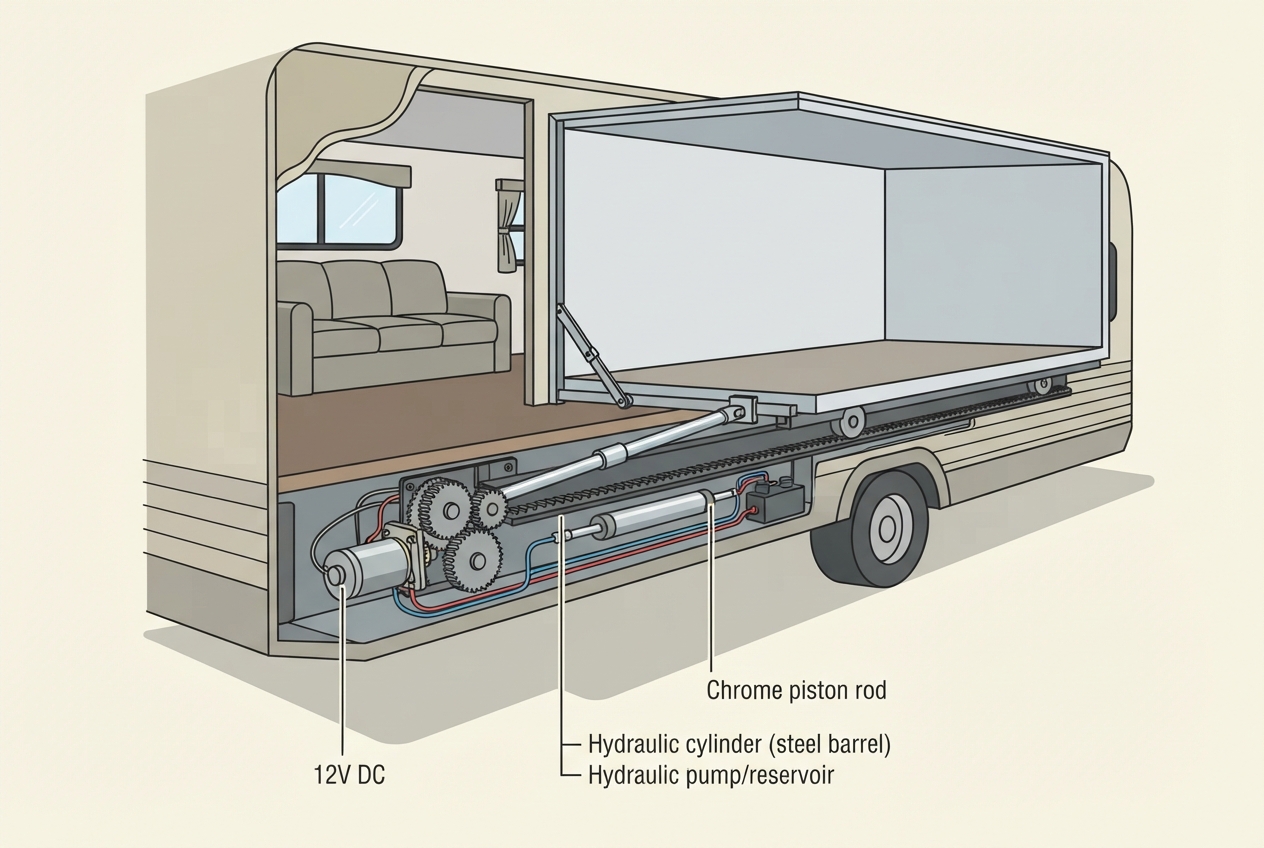
Fast answer at a campsite with a stuck slide
Stop pressing the button. Pressing it again on a jammed slide compounds the damage. Identify your slide type (electric or hydraulic). Check the basics: battery voltage 12V+ at the slide controller, no breaker tripped, no fuse blown, nothing visibly jammed in the slide rails, the room not loaded with so much weight that it can't move. If all basics check out and the slide still won't budge, locate the manual override (every slide has one) and bring it in for the drive home. Diagnose properly at home, not at the campsite.
Slides need full battery voltage. Low voltage = motor stalls under load.
Motor whine = bind. Silence = electrical fault. Don't keep cycling it.
Every slide has an override. Find it BEFORE you need it.
Sudden weight removal can let a partially-extended slide drop.
The diagnostic ladder — work it in order
Stuck slides have a small number of common causes, and you can rule them out systematically. Don't jump to expensive conclusions.
Step 1: Confirm the basics
Battery voltage at the controller should read 12.4V minimum, 12.6V+ ideal. Anything under 12.0V will cause an electric motor to stall or a hydraulic pump to under-perform. Check the controller fuse (typically a 20-30A automotive blade fuse near the controller or in the main fuse panel). Verify shore power if applicable. If you have a multimeter, check voltage AT the slide motor terminals when you press the button — if voltage is present but motor doesn't move, the motor itself is the problem.
Step 2: Visual inspection
Look at the slide from outside the RV with someone inside trying to extend it. You should see motion. If you see partial motion on one side but not the other, that's a gear failure on the still side. If you see no motion but hear the motor, that's a stripped drive gear or broken pin. Check the slide tracks for visible obstructions — rocks, ice, broken seal material, wadded-up Christmas lights from the previous owner. (All of these have actually been reported as causes.)
Step 3: Identify your system
Electric (Schwintek): the slide travels on rails with a thin profile, gears visible on the side of the slide box. Common on travel trailers and smaller fifth-wheels. Motor is usually a 1/4 HP DC unit with a worm-gear drive.
Electric (Power Gear / through-frame rack): a horizontal rack assembly under the floor, with motors driving the rack via gears. Older system, found on mid-2000s and early-2010s coaches. Motor and gearbox typically accessible from underneath.
Hydraulic: a cylinder (ram) connected via hydraulic hoses to a central pump pack, usually mounted in a forward storage bay. Common on larger Class A motorhomes and full-wall slide fifth-wheels. Pump has a reservoir and a control valve assembly.
Step 4: System-specific diagnosis
For electric Schwintek: the most common failure is the small pin that couples the motor shaft to the worm gear. If you hear the motor running freely but no movement, pull the motor cover (4 small screws) and inspect the coupling. Pin replacement is a $5 part. If gears inside the rail are stripped, the rail assembly itself needs replacement — usually a 2-3 hour job and $200-400 in parts.
For electric Power Gear: the rack gear teeth can wear or strip after years of use, particularly if owners forced the slide against an obstruction at some point in its history. Symptom is "slide makes it most of the way then stops" because one section of the rack has worn faster than the rest. Replacement requires partial slide disassembly.
For hydraulic: check fluid level at the pump pack reservoir first (cap is usually clearly marked). Low fluid is the single most common cause of "pump runs but slide doesn't move." If fluid is at the proper level, listen for the pump — if the pump motor runs but you hear no fluid movement, the pump itself or the control valve has failed. If the pump motor doesn't run at all, you have an electrical fault (controller, solenoid, or wiring) feeding the pump.
Manual overrides — locate yours BEFORE you need it
Every slide has a manual override. The location varies, but the principle is the same: a way to manually drive the slide in or out when the powered system has failed. This is what lets you bring a stuck slide home rather than abandon a trip.
- Lippert Schwintek: a 7/16 hex socket on the END of each motor (you'll see two motors, one per side of the slide). A cordless drill with a 7/16 hex bit drives the slide manually. Both sides must be driven equally or the slide racks. Slow and tedious but works reliably.
- Power Gear through-frame: a square shaft adapter accessible from underneath the coach. Uses a special crank handle that should be in your owner's equipment kit. If missing, available from Power Gear/Lippert for $30-50.
- Hydraulic systems: the pump pack has a manual release valve, typically a knob or hex screw labeled "manual override" or "emergency retract." Opening this allows hydraulic pressure to bleed off, letting you push or pull the slide manually. NEVER do this with a partially-extended slide unloaded — the slide will drop. Have someone support it during release.
Spend 10 minutes locating yours on a sunny afternoon when nothing is broken. Stuck slides happen at the worst times — in the rain, in a remote campground, when you're late for departure. Knowing where the override is and how to use it makes the difference between a manageable problem and a service call far from home.
2026 cost reference
| Component | Typical 2026 cost | Notes |
|---|---|---|
| Schwintek motor coupling pin | $3-8 | Most common Schwintek failure. DIY 30-minute fix. |
| Schwintek replacement motor | $80-180 | Direct swap. DIY 1-2 hour job. |
| Schwintek rail assembly (one side) | $200-400 | If gear teeth in the rail are stripped. |
| Power Gear rack gear assembly | $250-550 | Usually paired with motor replacement. |
| Hydraulic fluid (proper type) | $15-40 | ATF or hydraulic-specific. Check pump manual. |
| Hydraulic ram replacement | $300-700 | Plus shop labor; total $700-1700 at service center. |
| Hydraulic pump pack rebuild | $400-900 | Service-center work; full replacement often cheaper than rebuild. |
| Full slide diagnostic at service center | $120-280 | Diagnostic fee separate from repair. Worth it if DIY diagnosis stalls. |
When to stop and call a pro
Three scenarios. First: visible bending or damage to the slide frame or wall. Forcing a bent slide makes things much worse and is unsafe. Second: hydraulic system requiring fluid changes, hose replacement, or pump work — the tools and fluid handling are beyond most DIY setups, and fluid spills inside the coach are difficult to clean up properly. Third: any situation where the slide is partially extended and won't move either direction — this is a roadworthiness emergency. Get help on-site rather than trying to travel with a slide in an unsafe position.