FixForge › RV › Slide Out Motor Replacement
RV Slide Out Motor Replacement
Before ordering a motor, you need to confirm the motor is actually the problem. Slide out failures are commonly misdiagnosed: the controller, limit switches, or wiring cause identical symptoms and cost far more (or far less) to fix. A five-minute voltage test at the motor terminals tells you definitively. Once confirmed, motor replacement is a 2-4 hour job.
Last Updated: May 2026
Fast diagnosis: is it the motor, controller, limit switches, or wiring?
The diagnostic sequence matters because these parts have very different costs. Test in order: (1) Check the slide circuit breaker or fuse first — a tripped breaker from an overloaded motor is a free fix. (2) Test voltage at the motor terminals with a multimeter while pressing the switch — you should see 12V. No voltage at the motor with good voltage at the breaker = wiring or controller problem, not motor. (3) Apply 12V directly to the motor terminals with jumper wires — if it runs, the controller is bad; if it doesn't, the motor is bad. This three-step sequence takes 10 minutes and costs nothing.
A tripped breaker is the most common "motor failure." Reset and try again before anything else.
12V at motor terminals but no motion = dead motor. No 12V at terminals = controller or wiring.
Get the slide in first. Do not work on a motor with the slide extended.
Voltage, RPM, gear type must match. A close-but-wrong motor damages the gearbox.
The four causes of slide out failure — and why motor is not the default assumption
Slide out systems have four potential failure points that produce similar symptoms (slide won't move). Diagnosing correctly before ordering parts saves significant money and time.
- Blown fuse or tripped breaker: Slide out motors draw significant current (10-30 amps depending on system). A momentary overload from debris, ice, or a hard stop can trip the breaker without damaging the motor. This is the first check — free fix. Some RVs have both an inline fuse at the motor and a breaker at the panel; check both.
- Limit switch failure or misadjustment: Limit switches tell the controller when the slide has reached full extension or full retraction, cutting motor power. A failed limit switch (open circuit) stops the slide before it completes travel. A shorted limit switch prevents the slide from moving at all. Limit switches are $5-20 to replace and frequently vibrate out of adjustment on rough roads. If the slide moves a few inches and stops, or if it extends but won't retract, test the limit switches before the motor.
- Controller failure: The slide out controller is the module that receives the switch signal and sends power to the motor in the correct polarity for extend or retract. Controllers fail from moisture ingress, voltage spikes, and age. A dead controller produces no motor motion and typically no response from the motor at all, regardless of which direction you press the switch. Controllers cost $150-400 and are model-specific.
- Motor failure: The actual DC motor driving the gearbox. Motors fail from brush wear (they use carbon brushes that wear down over time in DC motors), internal open circuit, or seized bearings. Motor failure is confirmed only after the above three are ruled out. Rushing to motor replacement when the controller is the actual problem is expensive and doesn't fix the system.
Step 1: Confirm it's the motor
The definitive motor test requires a multimeter and a 12V power source (the RV battery works fine).
- Check the fuse and breaker first. Locate the slide circuit in the main 12V panel. If the breaker is tripped, reset it. If there's an inline fuse, check it with the multimeter on continuity mode. Replace a blown fuse (match amperage exactly) and test the slide. If it works, you're done.
- Test voltage at the motor while pressing the switch. Access the motor (usually in a compartment or under the floor near the slide mechanism). With the multimeter set to DC volts, probe the two motor wires (or terminals) while pressing the slide switch in each direction. You should see approximately 12V in one polarity for extend, and 12V in the opposite polarity for retract. No voltage reading means the signal isn't reaching the motor — controller, wiring, or limit switch problem.
- Apply 12V directly to the motor terminals. With the motor wires disconnected from the system, use jumper wires from the RV battery to apply 12V directly to the motor's two terminals. Touch positive to one terminal and negative to the other. The motor should run. Reverse the leads — it should run in the opposite direction. If the motor runs with direct power, your motor is fine and the problem is upstream (controller, limit switch, or wiring). If the motor does nothing with confirmed 12V at its terminals, the motor is dead.
Step 2: Manually retract the slide before removing the motor
Never remove a slide out motor with the slide in the extended position. The slide will be unsupported and can shift, and the gear mechanism will be under load.
All slide out systems have a manual override. Common types:
- Hex socket on motor shaft: Most common on Lippert Power Gear and similar systems. The motor shaft has a hex end (commonly 1/2" or 3/4") that accepts a socket and ratchet or breaker bar. Insert the socket, turn slowly in the retract direction. There may be significant resistance on the first few turns as the gearbox loads up; continue steadily.
- Hand crank: Some systems have a dedicated fold-out hand crank stored in the compartment. Consult the owner's manual for its location and use.
- Clutch release + manual push: Schwintek slide systems use a rail-and-gear mechanism. The manual procedure usually involves releasing the motor coupling and pushing the slide section in by hand. Requires two people.
Critical: have a second person watching the slide as you crank. Retract slowly and stop immediately if you hear grinding, feel binding, or the slide doesn't move evenly. Uneven retraction indicates the slide is racked (twisted on its rails) and forcing it will cause damage. If the slide is racked, stop and assess the rail alignment before proceeding.
Step 3: Locate and access the motor
Slide out motor location depends on the system type:
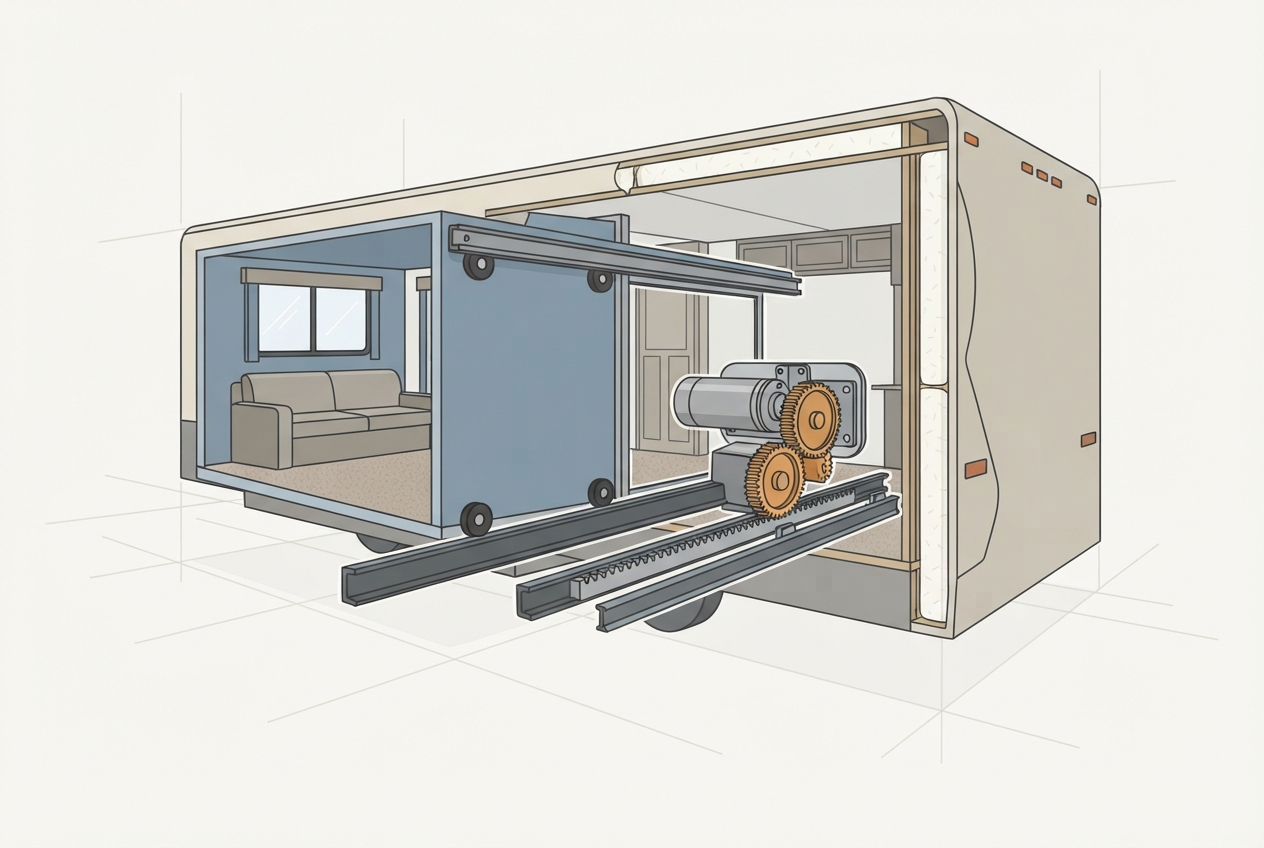
- Lippert Power Gear rack-and-pinion: The motor is mounted in a compartment adjacent to the slide opening, driving a shaft that runs across the slide. Usually visible from the exterior compartment access panel.
- Schwintek in-wall system: The motors are mounted inside the wall cavity, one on each side of the slide. Access is typically from inside the RV by removing trim or an access panel in the wall adjacent to the slide.
- Barker/HWH hydraulic-assist: These use a hydraulic pump motor to extend and retract. Hydraulic system motor replacement involves hydraulic fluid management and is more complex than a pure electric system.
- Older cable-driven systems: A motor drives a cable drum. The motor is usually in the center of the slide mechanism under the floor.
If you can't locate the motor, trace the heavy wiring from the controller. Slide out motors use significant current and have heavier gauge wire (10-14 AWG typically) than other accessories. Follow the wire from the control module and it leads to the motor.
Voltage testing at the motor terminals
With the motor located and accessible, perform a complete electrical check before removal:
- Check for 12V at the motor while pressing the switch. Confirmed 12V with no motor response = dead motor. Proceed to removal.
- Inspect the motor terminals for corrosion. Green or white corrosion on the terminals can cause high resistance that prevents the motor from getting sufficient current even when voltage is present. Clean terminals with sandpaper or a wire brush, apply dielectric grease, and retest before removing the motor.
- Check the ground connection. The motor needs a solid negative connection back to the battery. Test resistance from the motor negative terminal to the RV chassis (with multimeter on resistance mode, engine off) — should be less than 1 ohm. High resistance means a poor ground is preventing full current flow. Trace and clean the ground connection before condemning the motor.
Brush inspection vs full motor replacement
DC motors use carbon brushes that transfer current to the rotating armature. As brushes wear, they shorten until the spring can no longer maintain contact — the motor becomes intermittent and eventually stops. Some slide out motors have accessible brush assemblies that allow brush replacement without replacing the entire motor.
To check: remove the motor from the vehicle, locate the brush caps on the motor housing (small circular plugs, usually 2, on opposite sides of the motor). Remove the caps and extract the brushes. A new brush is typically 3/4" to 1" long. A worn brush is 1/4" or shorter. If brushes are worn short, replacement brushes are often available from the motor manufacturer for $10-20. This is worth doing if the motor is otherwise good and the rest of the RV is in good shape.
If the motor is seized (shaft doesn't turn by hand after disconnection), burned (you can smell it), or heavily corroded internally, brush replacement won't help. Full motor replacement is required.
Motor removal and replacement procedure
- Disconnect 12V power at the main disconnect or disconnect the motor wires at their connector. Label the wires before disconnecting. Motor polarity matters for direction; swapping positive and negative reverses extend/retract direction.
- Support the slide mechanism. If there are any springs, cables, or counterbalances that are under tension when the slide is retracted, be aware they may spring when the motor is removed. Observe the mechanism before removing any fasteners.
- Remove the motor mounting bolts. Typically 3-4 bolts holding the motor to the gearbox housing. On some systems the motor is also bolted to a bracket independent of the gearbox. Remove all mounting fasteners.
- Extract the motor from the gear assembly. The motor output shaft engages the gearbox input. Pull the motor straight out of the gearbox housing. If it's stuck, wiggle gently side-to-side while pulling. Do not pry against the gearbox housing, which is often cast aluminum and cracks easily.
- Inspect the gearbox input port. Look for stripped gear teeth, debris, or water intrusion. A good motor will be destroyed quickly by a failing gearbox. If you see metal debris or ground-up gear material, the gearbox needs evaluation before installing a new motor.
- Source the replacement motor. Match the OEM part number if possible. Verify: DC voltage (12V), output shaft size and gear type (spur, worm, helical), RPM and torque, mounting bolt pattern. Many systems are Lippert-built and use standardized motors; cross-reference tools are available on Lippert's website using the slide serial number.
- Install the new motor. Insert the shaft into the gearbox, align the mounting holes, and thread in the mounting bolts. Tighten evenly to avoid cocking the motor. Apply dielectric grease to the motor terminals and electrical connectors.
- Reconnect the wiring in the correct polarity. Connect the motor to 12V directly and briefly test rotation direction before reconnecting to the controller — confirm the motor turns in the extend direction when positive is applied to the correct terminal.
Limit switch adjustment after motor replacement
After replacing the motor, the limit switches may need adjustment. Limit switches define where the slide stops at full extension and full retraction. They are set at the factory but can drift from vibration and may need resetting if a new motor's output shaft position differs slightly from the old motor.
Run the slide through one complete cycle (extend and retract) while watching it closely. The slide should travel to its full stops cleanly and the motor should cut off. If the slide stops short of full extension, the extension limit switch trips too early — move it slightly away from the cam that trips it. If the slide travels past its normal stop position (the motor stalls against the hard stop), the limit switch is too far and needs to move toward the cam. Adjustment specifics depend on the system; Lippert Power Gear documentation is freely available on their website and covers limit switch adjustment in detail.
2026 cost reference
| Item | Typical 2026 cost | Notes |
|---|---|---|
| Lippert replacement motor (common types) | $80-150 | Most Lippert systems use standardized motors. Verify by slide serial number. |
| Schwintek motor (per side) | $120-180 | In-wall systems have two motors; both often fail within the same season. Consider replacing both. |
| Generic/aftermarket slide motor | $60-100 | Quality varies. Verify specs match exactly. Avoid for Schwintek systems. |
| Limit switch (replacement) | $8-20 | Cheap and often the actual cause of "motor failure." Test before ordering a motor. |
| Slide controller (Lippert) | $150-350 | The expensive misdiagnosis. Confirm motor is dead before assuming controller. |
| Replacement motor brushes | $10-20 | Available for some motors. Worth checking before full motor replacement. |
| Professional motor replacement (service center) | $300-600 total | $100-250 labor + parts. Mobile RV tech rates vary; worth calling if you're not confident with 12V diagnosis. |
When to call a professional
Motor replacement itself is DIY-accessible for anyone comfortable with basic 12V electrical work. Where it gets complicated: if the gearbox itself is damaged (stripped teeth, cracked housing), if the slide is racked (twisted on its rails) requiring mechanical realignment, or if the system is hydraulic rather than purely electric (hydraulic systems require fluid management and specialized knowledge). Also, if after motor replacement the slide still doesn't work correctly, don't guess — the controller or a failed limit switch is usually the remaining issue, and a technician with slide-specific diagnostic experience can resolve this quickly.
Search by Lippert part number or your slide system model. Verify voltage, RPM, and mounting pattern before ordering.
Check Price on Amazon →As an Amazon Associate, FixForge earns from qualifying purchases.