FixForge › Marine › Outboard Motor Not Starting
Outboard Motor Won't Start
Every outboard technician uses the same three-layer diagnostic sequence: fuel first, then spark, then compression. This order matters because each layer is cheaper and faster to check than the next, and because the most common failures are in the fuel system. Skipping to spark plugs or compression testing before confirming fuel is a waste of time 70% of the time.
Last Updated: May 2026
The short version if you're on the water right now
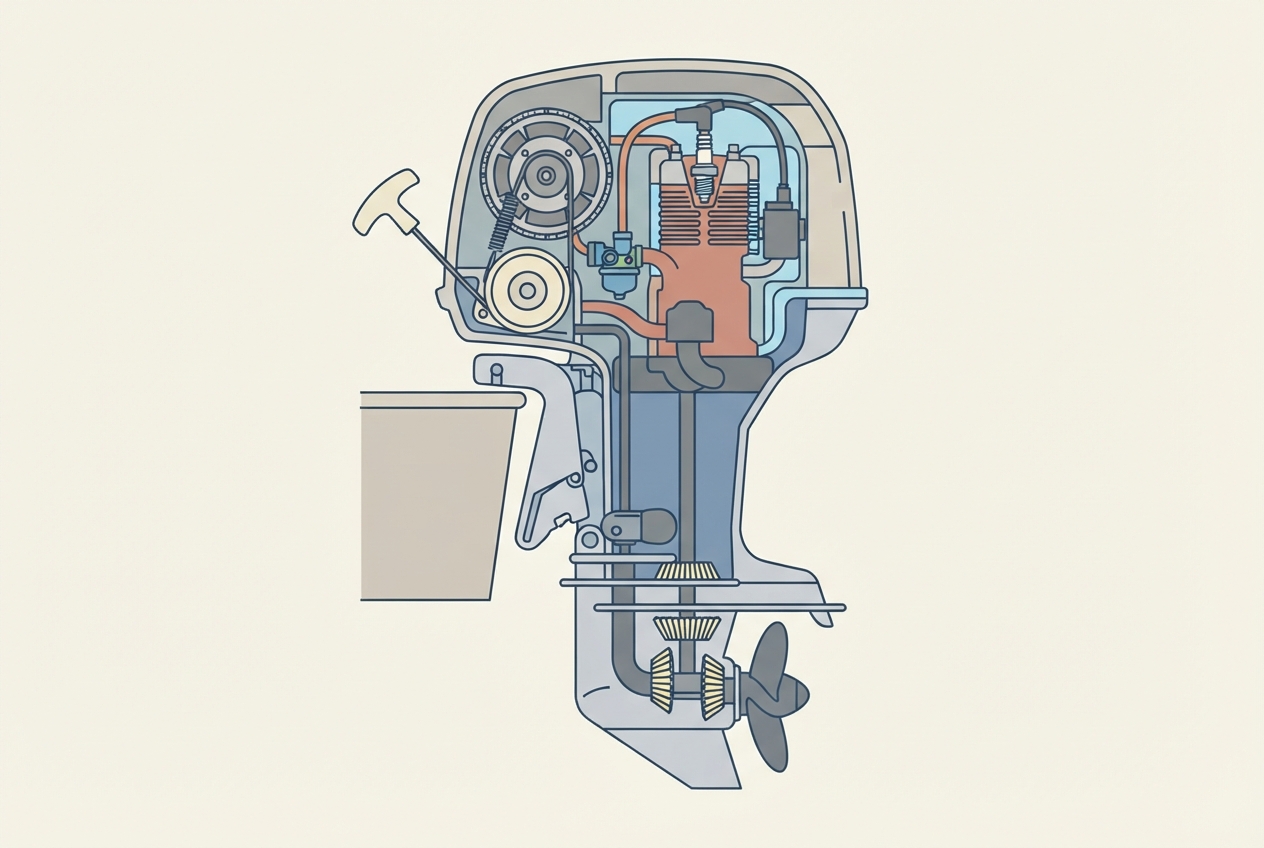
Check in this order: (1) Tank vent — is it open? A closed vent creates vacuum and starves the engine within minutes of starting. (2) Primer bulb — squeeze it. It should firm up within 5-7 squeezes. Stays soft = fuel not reaching the engine. (3) Safety lanyard — is it clipped to the kill switch? Many people overlook this. Engine will not start with lanyard removed. (4) Spark plugs — pull one, reconnect the wire, ground the threads and crank. Blue-white spark is good; no spark or orange spark means ignition issue. (5) Is the engine tilted fully up? Some motors won't start in that position. Lower it to operating angle and try again.
70% of no-start problems are fuel. Check vent, bulb, filter before pulling plugs.
An unclipped safety lanyard kills the ignition instantly. Free fix.
Low compression means internal engine damage. Parts and labor jump significantly.
Yamaha VST, Mercury SmartCraft, and Johnson/Evinrude 3-wire systems each have brand-specific failure modes.
Layer 1: Fuel system — check these in order
The fuel system has five potential failure points between the tank and the cylinders. Check them in order from tank to engine, because each one is cheaper and faster to inspect than the next.
Tank vent
Portable tanks have a vent screw on the cap or a separate vent fitting on the tank. Fixed tanks vent through a hose routed to outside the hull. The vent must be open while the engine is running — as fuel is drawn out of the tank, air must enter to replace it. A closed vent creates a vacuum that eventually stops fuel flow, causing the engine to run for 5-15 minutes and then quit as if it ran out of gas (it did, but from vacuum, not empty tank).
On portable tanks: turn the vent screw counterclockwise until you feel or hear a slight air intake. If you hear a hiss of air rushing in when you open it, the vent was closed and that was your problem. Open the vent, squeeze the primer bulb, and try again. Close the vent when transporting to prevent fuel spillage.
On fixed tanks: vent blockage from a kinked hose, a mud dauber nest in the vent fitting, or a failed vent check valve. Trace the vent hose from the tank to its exterior exit and verify it's unobstructed.
Primer bulb
The primer bulb is the squeeze bulb in the fuel line that manually pressurizes fuel into the carb or VST (Vapor Separator Tank on fuel-injected motors). Squeeze the bulb 5-7 times before starting a cold engine or any engine that has sat. The bulb should firm up — you feel solid resistance when fully primed. If the bulb stays soft after 10+ squeezes, fuel is not flowing from the tank to the engine. Diagnose:
- Bulb stays soft and collapses: Fuel is coming out of the engine side but the tank side isn't refilling. The tank pickup tube may be blocked, the fuel line fitting at the tank may not be fully seated, or the one-way check valve inside the bulb is failed (allowing backflow in both directions).
- Bulb pumps up but immediately goes soft: There's a leak downstream of the bulb — a cracked fuel line, a loose carb fitting, or a failed O-ring at the engine fuel inlet. Inspect the fuel line along its entire length for cracks, especially at the fittings where flex-induced cracking is most common.
- Primer bulb itself is cracked or hard: Old bulbs crack from UV exposure or go stiff from chemical degradation. A cracked bulb can't pressurize. Replace the bulb ($5-15, available at any marine store).
Fuel filter
Outboards have one or two fuel filters: an inline filter in the fuel line (between tank and engine), and often a screen filter inside the carb or VST inlet. The inline filter is usually a translucent plastic bowl with a paper or screen element. If it's brown or opaque with sediment, replace it. A completely blocked filter shows as no fuel flow; a partially blocked filter lets the engine start but starve under load.
On fuel-injected 4-stroke outboards (Yamaha F-series, Mercury FourStroke, Honda BF-series), there's often a fuel filter inside the VST that requires disassembly to access. Consult the service manual for your specific model — VST filters are model-specific and not always obvious to locate.
Carburetor drain and fuel delivery confirmation
For carbureted outboards, confirm fuel is actually reaching the carburetor before pulling plugs. Locate the float bowl drain screw (small brass screw on the bottom of the carb bowl) and remove it over a rag. Fuel should drain out. If the bowl is dry, fuel isn't reaching the carb — confirm upstream (filter, bulb, tank). If the bowl has dark, varnish-smelling fuel, the carb is contaminated from stale fuel — clean or rebuild the carb. If the bowl has good-smelling, fresh-colored fuel, fuel delivery is fine and the problem is elsewhere.
Note: draining the bowl is also the starting procedure for an engine that has sat all winter and has stale fuel in the carb. Drain completely, allow fresh fuel to fill the bowl, and try starting. This resolves a large percentage of end-of-winter no-start calls without any further work.
Layer 2: Spark — ignition system checks
If fuel delivery is confirmed and the engine still won't start, move to the ignition system. Check in this order: free checks first, then parts-replacement.
Kill switch and safety lanyard
The safety lanyard is a tethered clip that connects the operator to the engine kill switch. When the lanyard is removed (pulled from the switch housing), the engine ignition is cut. This is a safety feature to stop the engine if the operator falls overboard. Many people overlook it as a no-start cause, especially when coming back to a boat that sat all winter or after someone worked on the motor and removed the lanyard.
Check: is the lanyard clip inserted firmly into the kill switch? The switch usually accepts the clip in one specific orientation and you'll feel it click into place. If the lanyard is attached but the engine still won't start, check whether the kill switch itself has failed in the open position — with the lanyard inserted, bridge the two terminals on the back of the kill switch with a jumper wire to bypass it and test if the engine starts. If it starts with the switch bypassed, replace the kill switch ($10-25).
Also check: the kill button (the separate stop button, usually red) must not be stuck in the depressed position. These buttons can stick from corrosion. Press and release it firmly before starting.
Spark plug condition and gap
Remove the spark plug(s) and examine them. What you see tells you the engine's recent history:
- Light tan or gray electrode: Normal combustion. The plug is probably fine. Check the gap and reinstall, or replace as routine maintenance if it's been more than 100 hours.
- Black, sooty electrode: Rich mixture (too much fuel) or oil fouling (on 2-strokes, from too much oil in the fuel mixture or a failing crankshaft seal allowing crankcase oil into the combustion chamber). On a 2-stroke: try a fresh plug and correct fuel/oil ratio. Persistent fouling suggests crankcase seal inspection.
- Wet, oily electrode: Flooding. The cylinder is full of raw fuel from over-priming or a stuck-open needle valve. Remove the plug, crank the engine a few times with the plug out to clear the cylinder, install a new dry plug, and start with the choke off and throttle at 1/4 open.
- White, eroded electrode: Lean mixture (too little fuel), overheating, or incorrect plug heat range. Indicates a carburetor or cooling problem that will damage the engine if not corrected before running.
- Cracked ceramic or broken electrode: Replace immediately. Engine damage risk from loose ceramic fragments.
Spark plug gap: use a feeler gauge or gap tool. The correct gap for most outboards is 0.028"-0.040" (0.7-1.0mm), but verify for your specific engine. A gap that's too wide produces a weak spark; too narrow can cause misfiring. Set the gap by gently bending the side electrode.
Testing for spark
Remove the plug, reconnect the spark plug wire (or coil boot), and hold the plug so its threads touch a metal part of the engine block. Pull the starter cord (or use the electric starter) while watching the electrode. Do this in shade or indoors — weak sparks are invisible in bright sunlight. A healthy spark is bright blue-white and audible as a crisp snap. A weak spark is orange, inconsistent, or visible only in darkness. No spark is obvious.
If spark is weak or absent: check the plug wire/coil boot connection (they can pull off the plug or the coil internally), check for a cracked distributor cap (on older 4-strokes with distributor ignition), and test the ignition coil. The coil can be tested with a multimeter — primary resistance (between the two coil primary terminals) should be 0.2-0.5 ohms; secondary resistance (between the coil tower and ground) should be 2,000-5,000 ohms. Values outside these ranges indicate a failed coil.
Brand-specific notes
Yamaha
Yamaha 4-stroke outboards (F-series) are generally very reliable but have known failure modes:
- Tilt limit switch: Yamaha 4-strokes have a tilt switch that prevents starting when the engine is tilted above a certain angle. If you've tilted the motor up and then try to start it before lowering it to operating position, the switch cuts ignition. Lower the engine to the normal operating angle and try again.
- Fuel pump diaphragm: Yamaha uses a pulse-type fuel pump on many 4-stroke models. The diaphragm develops pinholes from age, causing fuel starvation at higher RPMs (runs fine at idle, cuts out at 3000+ RPM). Not a no-start cause by itself, but a common misdiagnosis on engines that start but won't run at speed.
- Thermostat failure: Yamaha 4-strokes with a stuck-closed thermostat overheat quickly, and the over-temperature sensor cuts ignition as a protection. The engine starts, runs briefly, then shuts down. The tell-tale water discharge stream temperature can confirm overheating.
Mercury
Mercury outboards (including Mariner-branded units) have their own patterns:
- SmartCraft system (EFI models): Mercury's electronic monitoring system can cut engine power or prevent starting in response to sensor faults. The system stores fault codes that can be read with SmartCraft diagnostic software or an MercMonitor gauge. Without the diagnostic tool, you're often guessing. If you have a modern Mercury EFI that won't start and passes basic fuel/spark checks, a service center with SmartCraft capability can read the fault codes in 15 minutes.
- OptiMax (direct injection 2-stroke): OptiMax engines have a complex direct injection system. No-start diagnosis beyond basic checks (fuel, spark plug, compression) generally requires Mercury-specific diagnostic tools. These are not carburetor-era engines and most DIY diagnostics stop at confirming the basics before shop visit.
- Older 2-stroke carbureted Mercury: The 9.9, 15, and 25 HP 2-stroke carbureted models from the 1980s-2000s are extremely reliable and easy to work on. Nearly every no-start on these is fuel (stale carb) or spark (worn plug, failed condenser on very old points-ignition models).
Johnson/Evinrude (OMC)
Johnson and Evinrude went out of production as OEM brands in 2020, but tens of thousands of these motors remain in service. Key points:
- 3-wire kill switch system: Many OMC engines from the 1980s-1990s use a 3-wire kill switch circuit rather than the simpler 2-wire system. The circuit is more complex and can cause no-start due to wiring issues that wouldn't affect a simpler system. If the basic kill switch bypass test doesn't work on an OMC engine, look up the specific wiring diagram for your model year before condemning the coil.
- Power pack (CDI) failure: OMC 2-stroke engines use a capacitor discharge ignition module (called the "power pack") that is a known failure point on motors from the 1980s-early 2000s. Symptoms: no spark at any plug, or spark at some plugs but not others. Power packs are still available from aftermarket suppliers (Crowley Marine, CDI Electronics) and can be replaced DIY. Test by measuring the power pack output to each cylinder with a peak-reading voltmeter.
- Parts availability: OMC-specific parts are increasingly hard to find through traditional dealers. CDI Electronics, Crowley Marine, and Sierra Marine are the main aftermarket suppliers. Some parts are no longer available new; used parts from salvage outboards are the only option for some components.
Layer 3: Compression
Compression testing is the final diagnostic layer because low compression indicates internal mechanical failure — worn or stuck rings, a damaged piston, or burned valves on 4-strokes. These problems don't get fixed with parts-counter solutions; they require engine rebuild or replacement.
Manual feel test first
Before using a gauge, pull the starter cord (on a pull-start motor) with the plugs installed, then with one plug removed (with remaining plugs removed to allow cranking without firing). Feel the resistance. A motor with good compression has strong kickback on the cord on each compression stroke. A motor with no resistance on the pull cord has no compression — this is a dramatic failure that requires no gauge to identify.
Electric start motors: with plugs removed, crank the starter and listen to the engine speed. A motor with good compression cranks slowly and unevenly (you can hear each compression stroke). A motor with no compression cranks very fast and smoothly — there's nothing pushing back against the starter.
Compression gauge testing
A compression gauge ($20-35) screws into the spark plug hole. Remove all plugs, disable the ignition (pull the kill switch lanyard, or disconnect the coil lead), and crank the engine for 5-10 seconds while reading the gauge on each cylinder. Typical healthy values:
- 2-stroke outboard (carbureted, 9.9-50 HP typical): 90-150 PSI. Minimum acceptable is approximately 80 PSI; below that, performance will be noticeably degraded.
- 2-stroke outboard (high-performance V6/V8): 100-160 PSI. Varies significantly by compression ratio.
- 4-stroke outboard: 130-200 PSI depending on displacement and compression ratio. Consult the service manual for your specific model.
- Cross-cylinder consistency: The most important metric. All cylinders should be within 10-15% of each other. A cylinder that reads 40 PSI when others read 120 PSI has a specific mechanical failure in that cylinder regardless of whether the other cylinders are healthy.
When compression is low: wet test
If compression is low on a cylinder, squirt approximately 1 teaspoon of motor oil into the plug hole and retest. If compression increases significantly with oil present (the oil temporarily seals the rings), the rings are worn or stuck. If compression doesn't change with oil, the leak is past the rings — a burned valve (4-stroke) or a cracked piston or damaged port (2-stroke). Ring wear is rebuild territory; valve damage on a 4-stroke is also rebuild territory but is sometimes addressable with a cylinder head service.
Tilt/trim lockout
Certain outboards, particularly Yamaha 4-strokes and some Mercury models, have a tilt limit switch that cuts ignition when the engine is tilted beyond a set angle (typically beyond 65-70 degrees from vertical). The intent is to prevent starting and running in full-tilt position where the lower unit intake is out of the water.
This catches people off guard after trailering (motor tilted for transport), after manual shallow-water tilting, or during inspection with the motor raised. Lower the engine to the operating position (lower unit pointing straight down or slightly trimmed under), reconnect the trim/tilt, and try again. If the motor had power applied to the tilt system and the trim switch is still depressed, release it completely before attempting to start.
2026 cost reference for common parts
| Item | Typical 2026 cost | Notes |
|---|---|---|
| Spark plugs (per cylinder) | $5-15 each | NGK is the OEM plug for most Japanese outboards. Verify heat range with service manual — wrong heat range causes fouling or detonation. |
| Inline fuel filter | $8-18 | Replace annually or whenever contamination is visible. Cheap insurance. |
| Primer bulb (replacement) | $8-20 | Universal or brand-specific. Check ID (inner diameter) of fuel line when ordering. |
| Carburetor rebuild kit | $15-30 | Brand- and model-specific. Includes gaskets, needle valve, and main jet for most outboard carbs. |
| Kill switch / safety lanyard assembly | $10-30 | Often sold as a complete replacement unit. Verify it matches your engine's connector style. |
| Ignition coil | $40-120 | Brand and model specific. CDI Electronics and Sierra are main aftermarket suppliers. |
| OMC CDI power pack (aftermarket) | $60-180 | CDI Electronics makes quality replacements for most OMC models. Verify by year and cylinder count. |
| Compression gauge | $20-40 | A worthwhile tool to own. The spark plug thread adapter must match your engine's plug thread size. |
| Professional outboard diagnostic and tune-up | $120-300 | Marine shop diagnostic charge plus parts. Worth it for EFI and direct injection systems where DIY diagnostics hit their limit. |
When to stop and go to a shop
The fuel-spark-compression diagnostic sequence is DIY-complete. Where it ends and professional diagnosis begins: fuel injection system faults (VST, high-pressure fuel pump, injectors) on modern EFI outboards require pressure testing equipment and often brand-specific scan tools. Mercury SmartCraft fault codes require the diagnostic tool. Internal mechanical diagnosis beyond compression numbers — determining whether low compression is rings, piston, or valve, and whether it's worth rebuilding at current parts costs — benefits from a technician who can make the economic judgment with current parts pricing. Any no-start that passes all three diagnostic layers (confirmed fuel delivery, confirmed spark, confirmed compression) is an electrical or control system problem that increasingly requires specialized diagnostic equipment.
NGK plugs, fuel filters, and primer bulbs. Search by engine make and model for exact fit parts.
Check Price on Amazon →As an Amazon Associate, FixForge earns from qualifying purchases.