FixForge › Marine › Marine Head Troubleshooting
Marine Head Troubleshooting
A manual marine head that won't pump, won't flush, or leaks is miserable to live with aboard — and it's almost always fixable with a $15-60 rebuild. The key is diagnosing which failure mode you have before ordering parts, because the symptoms overlap and the repairs are completely different. Walk through the four failure modes in order.
Last Updated: May 2026
Quick diagnosis: which failure mode do you have?
Four failure modes cover 95% of manual marine head problems. Identify yours first: (1) Won't pump at all — handle moves freely but with no resistance and no water flow (joker valve inverted, or intake seacock closed). (2) Pumps but won't flush — pump has resistance and you can hear water moving, but nothing leaves the bowl properly (joker valve deteriorated, partial clog in discharge hose). (3) Leaks from the base — water on the floor around the head (base gasket or piston seal failure). (4) Leaks from hose fittings — drips at the intake or discharge hose clamp connections (clamp corrosion or hose softening at the fitting). Close both seacocks before any disassembly.
The single most common failure. $15-25 part, 30-minute replacement. Do this before anything else.
Both intake and discharge. Always. This is a below-waterline system.
If the head is 5+ years old and acting up, replace all the soft parts at once with a $40-60 kit.
Y-valve must be secured to holding tank in No Discharge Zones. Federal law.
How a manual marine head works
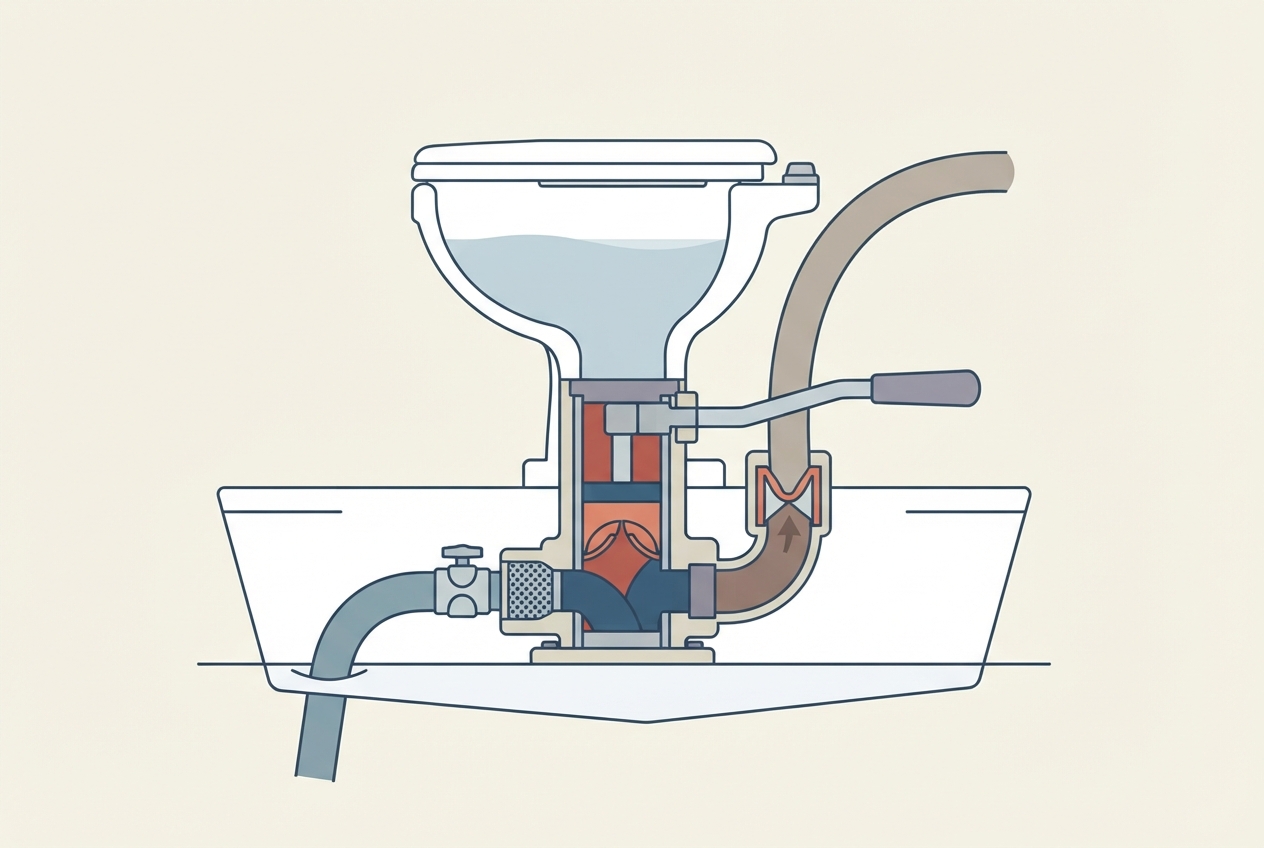
Understanding the mechanism makes diagnosis logical rather than guesswork. A manual marine head is a piston pump system with two check valves and two through-hull connections.
The pump handle drives a piston through a cylinder. On the intake stroke (handle pulled back), the piston creates a vacuum that draws seawater in through the intake through-hull, intake seacock, and intake hose into the bowl for rinsing — or draws waste from the bowl into the pump body for discharge, depending on the pump stroke and valve selector position. On the discharge stroke (handle pushed forward), the piston pressurizes the pump body and forces the contents out through the discharge check valve, discharge hose, and either overboard or to a holding tank.
The two critical check valves: the intake ball valve (or flapper valve, inside the pump body at the intake port) prevents water from the pump from flowing back out the intake hose during the discharge stroke. The joker valve (a duck-bill rubber check valve at the discharge port) prevents backflow from the discharge line into the pump during the intake stroke. Both must function correctly for the system to work.
The pump piston itself has rubber seals (lip seals or O-rings) that seal it to the cylinder walls. When these seals wear, the piston can't generate sufficient suction or pressure. This is the most common cause of gradual degradation — the head still works but requires more pumping strokes per flush, until eventually it stops being effective.
Failure mode 1: won't pump at all (handle is loose, no resistance)
When the pump handle moves with almost no resistance in either direction, the piston can't build suction or pressure. The most common causes in diagnostic order:
- Intake seacock closed: Check first, because it costs nothing. The intake seacock (usually mounted on the hull near the head) must be open for water to flow in. It's easy to leave closed after winterizing or servicing.
- Joker valve inverted: The joker valve can be pushed back into the discharge port by a downstream clog or hose kink, physically inverting it. When inverted, it allows flow backward (from discharge into the pump) on every stroke, making the pump feel like it's doing nothing. This is the most common cause of a suddenly non-functional head that was working fine previously. Inspection requires removing the discharge hose from the head's discharge port and looking into the port with a flashlight.
- Pump cylinder dry (first use of season): A dry piston seal can't generate suction until it's wet. Pour a cup of water into the bowl, let it sit 30 seconds, then try pumping. The water lubricates the seals and often restores function immediately after a winterized boat is recommissioned.
- Piston seals completely failed: If the head has been used for 5+ years without a rebuild, the piston lip seals may be compressed, cracked, or disintegrated. Rebuild kit required.
Failure mode 2: pumps but won't flush (resistance present, no complete evacuation)
If you can feel pumping resistance and you can hear water moving, but the bowl doesn't empty completely or the flush requires excessive strokes, the likely causes:
- Joker valve deteriorated (most common): A worn joker valve allows partial backflow on each intake stroke. The pump moves water, but some comes back through the joker valve on every stroke, so you're fighting backflow. Replace the joker valve.
- Partial discharge hose obstruction: Scale and mineral deposits build up inside discharge hoses over years of use, eventually narrowing the interior significantly. The pump works hard but pushes against restricted flow. Inspect the hose interior if accessible; replace if badly scaled (discharge hose replacement is a full job, $50-150 for hose and fittings).
- Incorrect pump stroke valve setting: Most marine heads have a selector or valve that switches between flush (draw water in) and pump-out (pump waste out). If the valve is partially open or between positions, the pump circulates inefficiently. Verify the valve is fully in the desired position.
- Intake hose partially collapsed: Sanitation hose can collapse internally from age, reducing intake water flow and making the flush require more strokes. Squeeze the hose along its length — you should feel uniform resistance. Soft spots or a kink indicates collapse at that point.
Failure mode 3: leaks from the base
Water appearing on the floor around the base of the marine head (not from condensation or spray) indicates a seal failure inside the pump body. The pump cylinder has a base plate gasket where the cylinder body meets the mounting flange, and the piston rod exits through a shaft seal. Either can fail over time from normal wear, chemical damage from cleaning products, or simple age.
Base leaks are not immediately dangerous (the leaked water is seawater that entered via the intake, or waste water from the bowl — not a below-waterline breach in the hull itself). But they indicate internal failure and usually mean a rebuild kit is needed. The base plate gasket is included in all standard rebuild kits; the shaft seal may be separate depending on the model. Diagnosis: dry the area thoroughly, then pump the head 10-15 strokes and watch exactly where water appears. The location tells you which seal is leaking.
Failure mode 4: leaks at hose fittings
Drips at the hose clamp connections on the intake or discharge hoses are separate from pump internal leaks. Causes: hose clamps corroded through (bronze or stainless hose clamps are required — never use zinc-plated hardware below decks), hose softening and shrinking at the fitting over years (the hose pulls back from the barb, leaving a gap at the clamp), or fitting corrosion creating an uneven sealing surface.
Fix: replace the hose clamp with a proper marine-grade stainless double-clamp (two hose clamps side by side is standard practice on critical sanitation connections). If the hose has softened at the fitting, cut back 2-3 inches and reconnect. If the fitting itself is corroded or rough, replace the fitting. Never ignore a leaking discharge fitting — a discharge-side leak releases overboard or holding tank contents.
Joker valve inspection and replacement
The joker valve is the most commonly replaced part on a marine head and the one most often overlooked at commissioning. Replace it every 2-3 seasons as preventive maintenance regardless of symptoms. Replacement procedure:
- Close both seacocks. The intake seacock (seawater in) and the discharge seacock (or the Y-valve to the holding tank). Do not skip this step even for a quick inspection.
- Locate the discharge port on the head body. This is the outlet that connects to the discharge hose. On most heads (Jabsco, Raritan, Blake), it's on the aft side of the pump body.
- Remove the discharge hose. Loosen the hose clamp(s) and twist the hose off the discharge fitting. Have rags ready — the hose will have residual liquid in it. Don't pull the hose straight off; twist it with a turning motion to break the seal without stressing the fitting.
- Remove the joker valve retaining plate (if applicable). Some designs (Jabsco manual heads) have a separate discharge valve cover with 4 screws. Remove the screws and the cover plate to expose the joker valve.
- Extract the joker valve. It's a duck-bill shaped rubber piece that should pull straight out with moderate finger pressure. Note which direction it was installed — the bill points toward the discharge (outflow direction). If the valve is inverted, it will have been pointing the wrong direction; this confirms the diagnosis.
- Inspect the valve seat (the bore where the valve seats). No cracks, no grooves, no deposits. Clean with a rag if needed.
- Install the new joker valve in the correct orientation (bill pointing outward). Press firmly until it seats. Install the retaining plate if applicable and tighten screws evenly.
- Reconnect the discharge hose with new or verified-good hose clamps.
- Open seacocks, add water to bowl, pump 10 strokes, and verify no leaks at the discharge connection.
Seacock operation: what every sailor needs to know
The marine head connects to the ocean through two through-hull fittings: the intake (seawater in for flushing) and the discharge (waste out). Each through-hull has a seacock — a valve that can close the connection to the ocean. Seacocks serve two purposes: they allow servicing the head without hauling the boat, and they are the last line of defense if a hose fails below the waterline.
Every person aboard should know where both seacocks are located, how to operate them (turn handle parallel to the pipe = open; perpendicular = closed, for ball valves), and that they should be exercised (opened and closed) at least twice per season to prevent them from seizing in the open position. A seacock that won't close because it hasn't been operated in years is a serious safety issue. If yours is stiff, operate it slowly with both hands; if it won't move at all, address it before it becomes an emergency.
Bronze and Marelon (glass-filled nylon) are acceptable seacock materials. Brass is not acceptable below the waterline — it dezincifies in seawater and fails without warning. If your boat has brass seacocks below the waterline, they should be on the replacement list.
Holding tank vs overboard discharge: legal requirements
In the United States, the legal framework is federal Clean Water Act and Marine Sanitation Device (MSD) regulations:
- Inland waters and within 3 nautical miles of shore: No discharge of raw sewage, period. You must have a Type I (treated), Type II (treated), or Type III (holding tank) MSD aboard. In practice for most recreational boats, this means a holding tank that you pump out at an approved pump-out station.
- Beyond 3 nautical miles offshore: Raw sewage overboard discharge is legal under federal law, unless you are in a federally designated No Discharge Zone (NDZ).
- No Discharge Zones: Many coastal bays, sounds, lakes, and river systems are designated NDZ, meaning no discharge at all regardless of distance from shore. Check NOAA's NDZ map for your cruising area.
- Y-valves: If you have a Y-valve that allows routing to either overboard or holding tank, the valve must be secured in the holding tank position in NDZ waters and all inland waters. "Secured" means a physical lock, a wire-tie through the handle, or a cap over the handle — something that prevents easy operation without deliberate action. An unsecured Y-valve in NDZ waters can result in fines even if you didn't discharge.
Rebuild vs replace: the decision
Rebuild: a rebuild kit ($40-60) replaces all the soft parts — piston seals, base gasket, joker valve, intake valve, and all O-rings. This is appropriate when the pump body and cylinder are in good condition (no cracks, no scoring on the cylinder wall, no corrosion on the fittings). A rebuilt head with a new kit installed should provide another 3-5 seasons of reliable service. Most marine head rebuilds can be done in 2-4 hours with basic tools.
Replace: appropriate when the pump body is cracked, the cylinder wall is scored (creates a groove the piston seal can't bridge), the mounting flange is corroded through, or the head is simply old enough that a rebuild won't provide confidence for offshore passages. A new head ($200-400 for a quality manual head) is a 15-20 year investment if maintained properly. Also consider replacement if the existing head is an obsolete model with no rebuild kit available — some vintage heads have no parts support and any failure requires replacement.
2026 cost reference
| Item | Typical 2026 cost | Notes |
|---|---|---|
| Joker valve (model-specific) | $15-25 | Must match your head manufacturer and model. Jabsco, Raritan, Blake, and Groco all use different sizes. |
| Rebuild kit (full soft parts) | $40-65 | Includes piston seals, joker valve, intake valve, gaskets. Buy model-specific from West Marine, Defender, or manufacturer. |
| Discharge hose (3 ft, sanitation grade) | $20-40 | Use only sanitation-grade hose rated for sewage. Standard hose passes odor through the wall. |
| Hose clamps (stainless, marine grade, pair) | $8-15 | Double-clamp critical connections. Never use zinc-plated below decks. |
| Jabsco 29090 (new manual head, economy) | $200-280 | The most common replacement head for older installations. Good parts availability. |
| Raritan PHII (new manual head, premium) | $320-420 | Higher build quality, longer service life, excellent parts support. |
| Professional marine head rebuild (labor) | $150-300 | Boatyard rates vary. Supplying your own kit reduces cost. Factor in haul-out if seacocks need replacement. |
When to call a professional
Seacock replacement requires the boat out of the water (or at minimum, temporary through-hull plugging with a soft wood plug — keep one near each through-hull). If your seacocks need replacement as part of a head repair, that's a boatyard job unless you have experience with below-waterline work. Similarly, if the discharge or intake through-hull fittings are corroding or the backing block is delaminating from the hull, this is structural work beyond a head repair. The head itself — the pump mechanism — is fully accessible DIY.
Search by manufacturer and model. Jabsco, Raritan, and Groco kits are all available. Includes joker valve.
Check Price on Amazon →As an Amazon Associate, FixForge earns from qualifying purchases.